
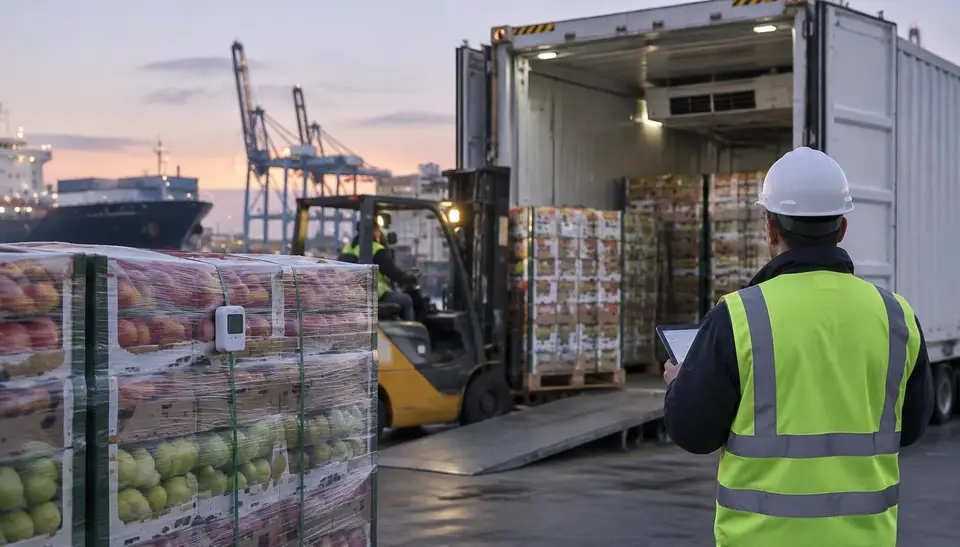

Refrigerated and frozen shipping planning for food importers
What to decide before booking a reefer or air shipment — and what to send us so the team can obtain a route-specific proposal.
Short answer
Plan the cold chain before you confirm a supplier: temperature, humidity and ventilation settings, packaging and pallet pattern, pre-cooling, loading, transit time with buffers, the port or airport of entry, insurance, and which party handles each document under the chosen Incoterm.
We do not publish freight rates, transit times or temperature settings; they depend on the product, route, carrier and season. Send origin and destination, product, packaging, volume, required temperature, Incoterm and delivery date, and the team requests a route-specific proposal.
Submit an importer RFQ
One reviewed request: commodity and specification, volume, destination, delivery window and preferred terms. Free for buyers; B2B requests from USD 250,000.
Reefer containers, frozen cargo and air freight
Chilled fresh produce usually travels in refrigerated containers with controlled temperature and ventilation; frozen seafood and shrimp travel in a continuous frozen chain; some high-value, short-shelf-life products travel by air. The right mode depends on shelf life, volume and your delivery window.
Product-specific handling
- Temperature, humidity and ventilation settings come from the product and variety specification agreed with the supplier, not from a generic table.
- Some fruit is sensitive to ethylene or chilling injury, so mixed loads must be checked.
- Some destinations require cold treatment in transit for certain fruit and origin combinations; it must be planned before loading.
- Frozen products need temperature records at every handover.
Packaging, pre-cooling and loading
- Cartons, liners and pallets suited to the product and to wood-packaging rules (ISPM 15).
- Pre-cooling to the agreed product temperature before loading.
- A pallet pattern that keeps air flowing, with the container set-point and ventilation checked and recorded.
- Temperature recorders in the load, with the data shared on arrival.
Transit time, buffers and port or airport choice
Allow buffers for vessel or flight changes, port congestion, inspections and holiday closures. Choose a port or airport of entry with the border-control facility your product needs — for example an EU Border Control Post for animal products — and cold storage close to the point of entry.
Incoterms, insurance and document handoff
- The Incoterm decides who books freight, who insures and where risk passes; agree it in the RFQ (for example FOB, CFR, CIF, FCA or DAP).
- Check whether cargo insurance covers temperature deviation and read the policy wording.
- Agree who sends which original or electronic document, and when, so certificates arrive before the cargo.
- Claims depend on evidence: temperature logs, inspection reports and photos at loading and on arrival.
What to send for a route-specific proposal
- Origin country and region; destination port, airport or warehouse.
- Product, variety or species, grade and size.
- Packaging and pallet type.
- Volume per shipment and number of shipments.
- Required temperature and other handling instructions from your specification.
- Preferred Incoterm and delivery date or window.
Sources and official links
Regulatory and source information last reviewed:
- ICC — Incoterms® rules — official portal
- PPECB — Perishable Products Export Control Board (South Africa) — official portal
- European Commission — TRACES — checked 2026-10-22
Frequently asked questions
What temperature should my product travel at?
It depends on the product, variety, maturity and transit time. Use the setting in your agreed specification; we confirm it with the supplier and carrier and do not publish generic ranges.
Can you give me a freight rate now?
No. Rates change with route, season and equipment availability. The team requests route-specific proposals once your request is complete.
Who is responsible if the temperature fails in transit?
That depends on the Incoterm, the sales contract and the insurance. Temperature records and inspection reports are the evidence for any claim.
In this importer center
Country markets: 2024 trade evidence by HS code — 18 import markets and origins, hubs such as the Netherlands, seasonal windows, access rules, official authorities and an evidence-ranked corridor map. Global B2B Opportunities Center — five produce corridors with a dated status: SA cherries and stone fruit to China, Indian grapes to Vietnam, Indian produce to Canada, SA apples to Thailand. Import glossary — phytosanitary certificates, HS codes, CHED, Incoterms® and landed cost, with sources. Importer demand map — 15 markets matched to 2024 flows from Peru, Ecuador, India, Kenya and Colombia. Buyer sourcing service — one confidential request, several screened suppliers. Origin export guides — 2024 export flows and national statistics for five origins. Import duties and entry rules for fresh fruit and vegetables — where 16 markets publish duty, import VAT/GST, plant-health and food-safety rules, with a quote-request checklist (12 languages). Market entry guides: Great Britain (IPAFFS, CHED, BTOM), United States (prior notice, FSVP, APHIS), Japan (plant quarantine, food import notification), Japan buyer map (Ecuador, Peru, India, Kenya, Colombia), origin export guide for those origins, Japan import-readiness checklists, for Japanese importers, UAE and Saudi Arabia (MOCCAE, SFDA Ghad, FASAH), South Korea (MFDS registration, PLS, seafood certificates), EU via the Netherlands (phytosanitary, CHED, KCB marketing standards) and supplier certifications. Origin guide: certified organic produce from Brazil (MAPA rules, CNPO checks).
Global B2B Group is a managed sourcing service. We are not a supplier, importer of record, certifier, carrier or customs broker. Figures are dated reference points from the cited sources; availability, documents, prices and timings are confirmed for each request. No availability, regulatory clearance, delivery or savings is guaranteed. Global B2B Group accepts no paid placement: suppliers cannot pay for inclusion, ranking or recommendation. Buyers pay nothing. The selected supplier pays a fee only after the deal or project proceeds; this is disclosed to buyers. Suppliers are invited against documented selection criteria, not the fee.