
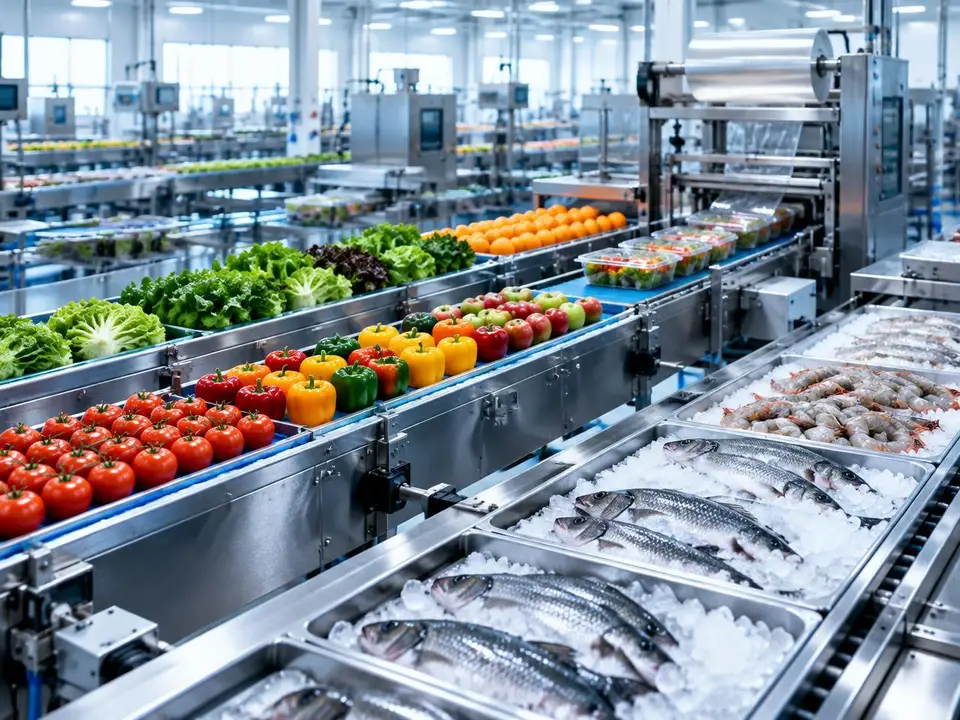

Importing fresh fruit and shrimp into South Korea: what a commercial buyer must check
Import declaration, registration of the supplier's facility before you declare, residue limits, seafood certificates and customs — and how to write them into one sourcing request.
Prepared by the Global B2B Group project team · Published · Last reviewed · Scope: Republic of Korea. Requirements depend on product, origin and date; confirm each consignment with MFDS, APQA or NFQS and your customs broker.
Also available in: 한국어
What does a Korean importer need for fresh fruit or shrimp?
Food imported for sale must be declared to the Ministry of Food and Drug Safety (MFDS) under the Special Act on Imported Food Safety Control, and the supplier's site must be registered with MFDS before that declaration — a packing location for fresh agricultural products, a foreign food facility for fishery products. Pesticide residues are controlled under the Positive List System: where Korea has set no limit for a pesticide, 0.01 mg/kg applies. Seafood from countries with a sanitary agreement needs a health certificate with the declaration. Fresh fruit and vegetables also pass plant quarantine by the Animal and Plant Quarantine Agency (APQA), and customs clearance is filed through UNI-PASS.
Who checks what for fresh fruit and seafood
Korea separates food safety, plant or aquatic-animal health, and customs. Each step has its own documents, and the supplier's registration must be in place before the importer can declare.
| Check | Authority | What it involves |
|---|---|---|
| Import declaration (수입신고) | MFDS | Food imported for sale or business use is declared under Article 20(1) of the Special Act on Imported Food Safety Control; MFDS applies document review, field inspection, close inspection or random sampling |
| Registration before declaration | MFDS | Fresh agricultural products: the packing location (포장장소). Fishery products: the foreign food facility (해외제조업소); for agreement countries the application goes through that country's government |
| Pesticide residues (PLS) | MFDS | Positive List System for all agricultural products since 1 January 2019; 0.01 mg/kg where no Korean limit is set |
| Seafood certificates | MFDS and NFQS | Health certificate (위생증명서) for fishery products from agreement countries; a separate NFQS quarantine certificate (검역증명서) concerns aquatic-animal diseases |
| Plant quarantine | APQA (농림축산검역본부) | Fresh fruit and vegetables are subject to plant quarantine; conditions depend on the origin and product |
| Customs (수입통관) | Korea Customs Service, UNI-PASS | The goods owner or customs broker files the import declaration with invoice, packing list, bill of lading and any inspection or quarantine certificates |
Registration of the supplier's site comes first
MFDS states that an import declaration cannot be made for a product from an unregistered site. For fresh fruit and vegetables the registered unit is the packing location; for shrimp and fish it is the foreign food facility that produces or processes the product. Either the importer or the facility operator registers it; for fishery products from countries with a sanitary agreement, the application is made through that country's government.
In practice, ask every supplier for the registered name and number of the packhouse or plant that will pack your product, and make sure it matches the commercial documents.
Pesticide residues: the Positive List System
Since 1 January 2019 the Positive List System (PLS) has applied to all agricultural products in Korea. A pesticide that has no Korean maximum residue limit for that crop is held to 0.01 mg/kg. Growers who follow another market's spray programme can exceed Korean limits even when they meet those of their usual markets.
Ask for residue results tested against Korean limits for the crop, and for the spray record of the orchards that will supply your programme.
Shrimp and fish: health certificates and origin labelling
For fishery products from countries with which Korea has a seafood sanitary agreement, MFDS requires a health certificate issued by the exporting country's authority with the import declaration. The government distinguishes this sanitary certificate, which concerns Korean food-safety standards, from the NFQS quarantine certificate, which concerns aquatic-animal diseases.
NFQS states that imported fishery products and products made from them must show the country of origin at customs clearance under the Foreign Trade Act — on the package or, for unpackaged goods, at the point of sale.
Fresh fruit: plant quarantine by APQA
Fresh fruit and vegetables are subject to plant quarantine by the Animal and Plant Quarantine Agency. Whether a fruit may be imported from a given origin, and under which conditions, is set per origin and product. We could not open APQA's fruit import-condition pages when this guide was reviewed, so it lists no origins: confirm the current condition for your fruit and origin with APQA or your customs broker before you plan a programme, and ask the exporter which condition its orchard and packhouse operate under.
Korea's 2024 imports of the products we source
Recorded imports show where an established trade already exists. They are past trade values by HS code — not demand forecasts, stock or prices.
| Product (HS code) | Imports, US$ thousand | Quantity | Position among reporters |
|---|---|---|---|
| Frozen shrimps and prawns (030613) | 490,618.28 | 65,949,900 kg | 8 |
| Shrimps and prawns, prepared or preserved (160520) | 208,584.74 | 39,027,000 kg | 7 |
| Guavas, mangoes and mangosteens, fresh or dried (080450) | 171,161.08 | 37,214,600 kg | 8 |
| Cherries, fresh (080920) | 134,258.10 | 14,759,200 kg | 7 |
| Fresh grapes (080610) | 116,546.30 | 29,768,000 kg | 17 |
| Blueberries and other Vaccinium, fresh (081040) | 61,188.52 | 5,226,280 kg | 16 |
| Avocados, fresh or dried (080440) | 36,885.26 | 11,251,600 kg | 25 |
What Global B2B Group does — and does not do — for Korea-bound programmes
We do
- Review your Korea-bound request with you and complete the specification
- Approach suitable suppliers on your behalf and ask each for the registration, residue and certificate information listed on this page
- Return offers set out on the same basis so you can compare them
We do not
- Import, buy, sell, ship or clear goods — the Korean importer files the declaration
- Confirm that a supplier is registered with MFDS or that a consignment will be released
- Publish stock, prices or supplier contact details, or connect you directly with suppliers before review
What to put in a Korea-bound sourcing request
- Product, variety or species, grade, size or count, and fresh, chilled or frozen
- The registered packing location or foreign food facility the supplier will use
- Residue results against Korean limits and the orchard spray record (fruit)
- Health certificate for agreement-country seafood, and whether an NFQS quarantine certificate also applies
- Plant-quarantine condition for the fruit and origin, confirmed with APQA or your broker
- Country-of-origin labelling, Korean label text and pack format
- Port of entry, arrival weeks, Incoterms® rule and named place, and who files the declaration
Our team turns these points into one reviewed request and approaches suitable suppliers on your behalf. Buyers pay nothing; sourcing programmes start from USD 250,000 per year or season, and every requirement is confirmed per shipment rather than assumed.
Frequently asked questions
Does a fresh fruit supplier need to be registered with MFDS?
Yes. MFDS requires the packing location for fresh agricultural products to be registered before the import declaration; a declaration cannot be made for an unregistered site.
Official guidance: MFDS — imported food guide, revised 9 February 2026 (packing locations, fishery facilities, health certificates; PDF)
What is Korea's Positive List System for pesticides?
Since 1 January 2019 it applies to all agricultural products: a pesticide without a Korean limit for that crop is held to 0.01 mg/kg.
Official guidance: MFDS — Positive List System for pesticide residues (농약 허용물질목록관리제도)
Which certificate does imported shrimp need in Korea?
Fishery products from countries with a seafood sanitary agreement need a health certificate from the exporting authority with the import declaration. A separate NFQS quarantine certificate concerns aquatic-animal diseases.
Official guidance: Ministry of Oceans and Fisheries / NFQS — sanitary (위생증명서) versus quarantine (검역증명서) certificates for imported seafood, 26 January 2024
Can I import cherries or avocados into Korea from any origin?
Not necessarily. Fresh fruit is subject to APQA plant quarantine and conditions are set per origin and product. This guide lists no origins; confirm the current condition with APQA or your customs broker.
Official guidance: Animal and Plant Quarantine Agency (APQA, 농림축산검역본부) — home page
Does Global B2B Group import or clear goods into Korea?
No. We are a buyer-side sourcing service: our team reviews your request, approaches suitable suppliers on your behalf and returns comparable offers. The Korean importer files the declaration and clearance.
Is there a minimum programme size?
Assisted sourcing applies to programmes from USD 250,000 in total annual or seasonal value. It is free for buyers.
Sources
- Ministry of Government Legislation (EasyLaw) — import declaration of food under Article 20(1) of the Special Act on Imported Food Safety Control (수입식품안전관리 특별법) — checked 25 October 2026
- MFDS Imported Food Information Maru — registration of foreign food facilities (해외제조업소 등록) — checked 25 October 2026
- MFDS — imported food guide, revised 9 February 2026 (packing locations, fishery facilities, health certificates; PDF) — checked 25 October 2026
- MFDS — Imported Food Information Maru (English portal) — checked 25 October 2026
- MFDS — Positive List System for pesticide residues (농약 허용물질목록관리제도) — checked 25 October 2026
- MFDS — notice on PLS for all agricultural products from 1 January 2019 (English, 13 April 2018) — checked 25 October 2026
- MFDS — safety control of imported food at the border (English) — checked 25 October 2026
- Ministry of Oceans and Fisheries / NFQS — sanitary (위생증명서) versus quarantine (검역증명서) certificates for imported seafood, 26 January 2024 — checked 25 October 2026
- NFQS — country-of-origin labelling of imported fishery products (원산지 표시) — checked 25 October 2026
- Korea Customs Service — import clearance and UNI-PASS (English) — checked 25 October 2026
- Animal and Plant Quarantine Agency (APQA, 농림축산검역본부) — home page — checked 25 October 2026
- WITS / UN Comtrade — cherries, fresh (HS 080920), imports by reporter, 2024 — checked 25 October 2026
- WITS / UN Comtrade — guavas, mangoes and mangosteens (HS 080450), imports by reporter, 2024 — checked 25 October 2026
- WITS / UN Comtrade — frozen shrimps and prawns (HS 030613), imports by reporter, 2024 — checked 25 October 2026
- WITS / UN Comtrade — shrimps and prawns, prepared or preserved (HS 160520), imports by reporter, 2024 — checked 25 October 2026
This guide summarises official sources for planning a sourcing request. It is not legal or customs advice; rules change and depend on the product, HS code, origin, destination and date — confirm them with the authority or your customs broker before you ship.