
Premium produce · Cherries
Bulk premium cherries: specify calibre, firmness and arrival window before you ask for offers
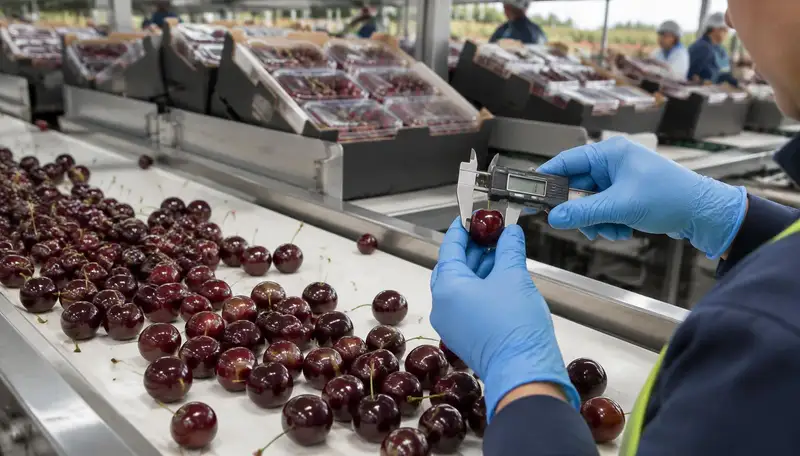
How do buyers source cherries in bulk?
Buyers source bulk premium cherries by fixing variety or colour group, minimum calibre in millimetres, firmness and stem condition, the arrival window, pack format and air or sea transport, then comparing only offers that quote on that basis. Southern-hemisphere supply is concentrated in a short window — USDA reports that historically more than 99% of Chile's fresh cherry exports occur from November through March.
What “premium” means in a wholesale cherries specification
- Calibre stated in millimetres (or row size) with the allowed spread inside each pack
- Firmness and stem condition — green, attached stems are often part of the premium brief
- Dark-red or mahogany colour group consistency across a pallet
- Short time from harvest to cooling and a stable temperature in transit
Variety and colour group
Name the varieties you accept, or the colour group and firmness if you are flexible. Varieties ripen at different points of the season, so a variety list also shapes your arrival window. Ask exporters which varieties they expect to pack in each week rather than assuming a calendar.
Grade and reference standard
UNECE FFV-13 (cherries). The UNECE standard for cherries sets minimum requirements, quality classes, sizing and tolerances that many trading partners reference. Your customers may use it, a national standard or a private specification — state which one in the RFQ. UNECE standards list
Origin and season — what the sources say
Chile · November–March
Historically, more than 99% of Chile's fresh cherry exports occur in November through March.
Within that window each region and variety packs for a few weeks only, and the timing moves with the weather. Confirm the expected packing weeks per variety with each exporter and record the date of their answer.
Where cherries moved in 2024: importers, exporters and hubs
Cherries, fresh (HS 080920), 2024. Values as published by WITS / UN Comtrade, checked 22 October 2026. They show demand and supply concentration — not stock, suppliers, prices or next season's volumes.
| Reporter | US$ million | Million kg |
|---|---|---|
| China | 3,685.2 | 451.0 |
| Hong Kong, China | 1,117.2 | 175.2 |
| European Union | 214.8 | 56.6 |
| Germany | 184.8 | 52.3 |
| Canada | 168.3 | 35.2 |
| United States | 140.5 | 20.3 |
| Korea, Rep. | 134.3 | 14.8 |
| Austria | 103.8 | 27.4 |
| United Kingdom | 68.8 | 12.3 |
| Reporter | US$ million | Million kg |
|---|---|---|
| Chile | 3,515.4 | 529.6 |
| Hong Kong, China | 1,026.7 | 168.4 |
| United States | 509.0 | 85.1 |
| Turkey | 208.9 | 66.6 |
| Spain | 144.6 | 39.5 |
| Greece | 84.8 | 29.6 |
| Uzbekistan | 73.5 | 34.5 |
| European Union | 63.6 | 12.1 |
| Australia | 59.1 | 4.2 |
How to read these tables
- Hong Kong, China appears among both the largest importers and the largest exporters, so its imports are not final consumption; the table does not show where re-exported fruit went.
- The European Union is reported as one bloc alongside its member states; do not add the EU row to the country rows.
- These values show where fruit moved in 2024. They are not a list of available stock, suppliers or prices, and they do not forecast next season.
Hortgro reports that South Africa's cherry exports were small next to Chile's in 2024 (0.1% against 49%), and that in the 2024/25 season 60% of South African cherry exports went to the United Kingdom, 18% to the EU and 12% to the Middle East.
South Africa's Department of Agriculture announced on 8 September 2026 that a protocol opening China to South African cherries has been signed. A protocol sets the conditions; each orchard, packhouse and consignment must still meet them, and Hortgro reported cold-treatment trials to meet the protocol. Confirm registration and treatment status with the exporter and the destination authority before planning shipments.
South African Government (Department of Agriculture), 8 September 2026
Where fresh cherries are imported: priority markets and who regulates entry
The main destination markets in the 2024 UN Comtrade importer table, with the official bodies whose rules apply at entry. Use it to choose a destination and to check the import documents before you send a request.
| Market | 2024 imports (US$ million, rank) | Role in 2024 trade | Official bodies to check | Our import guide |
|---|---|---|---|---|
| China | 3,685.2 · #1 | Importer | Market profile | |
| Hong Kong, China | 1,117.2 · #2 | Importer and top-10 exporter (hub or producer) | Market profile | |
| Germany | 184.8 · #4 | Importer | Import guide | |
| United States | 140.5 · #6 | Importer and top-10 exporter (hub or producer) | Import guide | |
| South Korea | 134.3 · #7 | Importer | Import guide | |
| United Kingdom | 68.8 · #10 | Importer | Import guide | |
| Netherlands | 45.6 · #13 | Importer | Import guide | |
| Japan | 40.2 · #14 | Importer | Import guide | |
| Spain | 21.8 · #19 | Importer and top-10 exporter (hub or producer) | Import guide |
Values and ranks are copied from the 2024 WITS / UN Comtrade importer table for HS 080920 (the rank counts the EU bloc row). Markets ranked below 30 are left out. Past trade only — not stock, prices or a forecast. Entry rules change: confirm them with the official body for each consignment. Source table
The United Arab Emirates did not report 2024 data to UN Comtrade, so it is not ranked here; see our UAE and Saudi Arabia import guide. Import guide
Planning cold storage or reefer capacity for these imports?
Cold rooms, ripening and temperature-controlled warehousing are projects in their own right. ColdMatch, our specialist cold-chain platform, handles that planning.
Cherries specification worksheet
Fill what you know; leave the rest blank. Your answers are copied into the request form for you to check — nothing is sent from this page, and no supplier is promised to meet every point.
Blank fields stay blank in the form.
Cold chain and packing
- Agree when fruit is pre-cooled after harvest and how pulp temperature is checked at packing
- Choose air or sea per period; sea freight needs a longer shelf life from the variety and pack
- Ask for a temperature logger per pallet or container and who reads it on arrival
- Modified-atmosphere liners only if your customer and the exporter agree on them
Documents to check
- Phytosanitary certificate from the exporting country's plant protection organisation
- Any market-access protocol for your origin–destination pair (registered orchards or packhouses, treatments)
- Certificate of origin where a trade agreement applies
- Food-safety or residue certificates your buyers require — request copies and check them with the issuer
Global B2B Group is committed to conducting its own activities in accordance with applicable law. It facilitates sourcing and RFQs and does not itself produce, manufacture, export or sell the listed products, or approve them on behalf of any authority. Suppliers are responsible for the products and shipments they offer and supply meeting the requirements of the origin and destination countries — for example safety, quality, labelling, traceability, sanitary or phytosanitary certificates and export documents, where relevant. Buyers remain responsible for their own import permissions, local requirements and due diligence. Requirements differ by product and country; this is not legal advice. Compliance & responsibilities · Terms
How our team evaluates supply options
After review, our team asks suitable suppliers to quote on your specification and to evidence the points below. Not every supplier can meet every specification; offers that differ are shown as alternatives, not ranked as equivalents. You decide which, if any, to take forward — introductions happen only with your approval.
- Packing weeks per variety for the season you are buying
- Sizing method and the calibre spread they can hold per box
- Pre-cooling capacity and cold-chain records from previous seasons
- Market-access approval for your destination, where required
Prices are provided after your specification is reviewed; we do not publish cherries prices or stock.
Searching for one of these?
Common buyer searches this page answers: bulk premium cherries supplier · wholesale export cherries · Chile cherries November–March for import · 28 mm+ cherries by sea container.
Buyer questions
- Can South African cherries be exported to China?
- South Africa's Department of Agriculture announced on 8 September 2026 that the protocol opening China to South African cherries has been signed. A protocol sets the conditions for trade; it does not mean every orchard, packhouse or shipment is approved. Ask the exporter for its registration status and the required treatment, and confirm with your importer or broker in China. Status checked 25 October 2026: China has published the requirements, but first commercial shipments still await China's final confirmation — treat access as pending verification.
- Where do South African cherries go today?
- Hortgro reports that in the 2024/25 season 60% of South African cherry exports went to the United Kingdom, 18% to the EU and 12% to the Middle East.
- When are Chilean cherries available for import?
- USDA reports that historically more than 99% of Chile's fresh cherry exports occur from November through March. Individual regions and varieties pack for shorter periods; confirm the weeks with each exporter.
- How do I specify cherry size?
- State a minimum diameter in millimetres (or the row size the packer uses), the spread allowed inside one box, and how you will measure it on arrival.
- Can Global B2B Group guarantee cherry quality on arrival?
- No. Arrival quality depends on harvest, cooling, packing and transport. Inspection, tolerances and claims are agreed between buyer and supplier in the contract; our team reviews the request and coordinates supplier outreach.
- What is the minimum for a cherry sourcing request?
- Assisted sourcing applies to programmes of USD 250,000 or more per year or season, not per shipment. Smaller requests are kept on file without supplier outreach.
Guides and other premium products
- Buyer's guide: premium produce and seafood at scale
- Premium cherries: wholesale specification guide
- Avocado, cherries and tomatoes: specification checklist
- Optical sorting and grading for premium fruit: what to specify
- Importing cherries and avocados into Japan: quarantine rules by origin
- Importing fresh produce into the UAE and Saudi Arabia: documents and registration
- Source premium cherries for China: 2026/27 importer guide and RFQ
- Premium produce sourcing checklist
- Wholesale fresh produce sourcing
- Buyer profile: varieties, UNECE grades and storage
Submit your cherries requirements
Free for buyers. Assisted sourcing from USD 250,000 per year or season; smaller requests stay on file without supplier outreach. Global B2B Group is not a grower, exporter, importer or seller — suppliers remain responsible for product, compliance and documents.
Share this page