
Premium produce · Table grapes
Table grapes wholesale: variety, berry size and bunch quality across the season
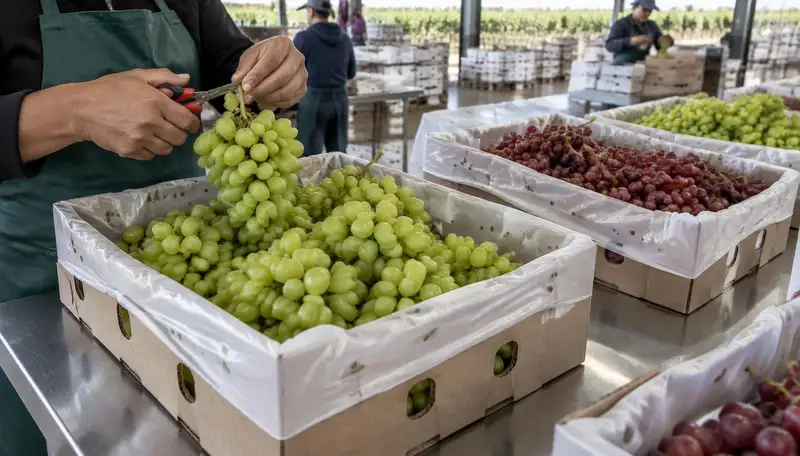
How do buyers source table grapes in bulk?
Specify table grapes by variety and colour (white, red or black, seedless or seeded), minimum berry size, bunch weight, sugar content or taste requirement, defect tolerances, pack and liner, and transit time. Seasons depend on origin: USDA reports that Peru's harvest begins in October and ends in April, moving from north to south, with Ica (50%) and Piura (35%) the main growing areas.
What “premium” means in a wholesale table grapes specification
- Large, uniform berries of one variety per pallet
- Well-shaped bunches within an agreed weight range
- Green, healthy stems and low shatter
- Sugar or taste requirement agreed in advance and checked on arrival
Variety and colour
Seedless varieties dominate many retail programmes, and many new proprietary varieties are licensed. Name the varieties or colour and seedless requirement you accept and whether alternates are allowed when a variety ends.
Grade and reference standard
UNECE FFV-19 (table grapes). The UNECE table-grape standard sets minimum requirements, classes, bunch and berry sizing and tolerances. Many retailers add their own Brix or taste and pack requirements. UNECE standards list
Origin and season — what the sources say
Peru · October–April
The harvesting season in Peru begins in October and ends in April with a north-to-south harvest pattern; Ica (50%) and Piura (35%) are the main production areas.
Within Peru's window, northern and southern regions harvest at different times, and some areas can harvest twice a year. Confirm weekly volume per variety and region with exporters.
Where table grapes moved in 2024: importers, exporters and hubs
Fresh grapes (HS 080610), 2024 — all fresh grapes, not only table grapes. Values as published by WITS / UN Comtrade, checked 22 October 2026. They show demand and supply concentration — not stock, suppliers, prices or next season's volumes.
| Reporter | US$ million | Million kg |
|---|---|---|
| United States | 2,544.1 | 894.2 |
| European Union | 1,406.2 | 613.8 |
| Germany | 951.5 | 326.2 |
| United Kingdom | 763.7 | 273.5 |
| Netherlands | 621.5 | 254.8 |
| Canada | 598.4 | 190.0 |
| Indonesia | 436.1 | 114.2 |
| Mexico | 328.0 | 110.2 |
| China | 325.5 | 109.1 |
| Reporter | US$ million | Million kg |
|---|---|---|
| Peru | 1,726.3 | 558.1 |
| Chile | 1,352.2 | 527.1 |
| Netherlands | 989.2 | 316.5 |
| Italy | 980.4 | 379.4 |
| China | 927.8 | 593.6 |
| United States | 843.7 | 262.6 |
| South Africa | 838.3 | 399.9 |
| Spain | 467.2 | 166.5 |
| Mexico | 390.9 | 218.9 |
How to read these tables
- The Netherlands appears among both the largest importers and the largest exporters in the same year — the pattern of a trading and logistics hub that receives fruit and ships much of it on. Its import value is not Dutch consumption, and adding it to other European countries' imports counts the same fruit twice.
- Reported Dutch grape exports are higher than reported Dutch imports for 2024. Countries record trade at different times and values, so import and export tables are not exactly comparable.
- The European Union is reported as one bloc alongside its member states; do not add the EU row to the country rows.
- These values show where fruit moved in 2024. They are not a list of available stock, suppliers or prices, and they do not forecast next season.
For South Africa, NAMC reports grape exports of US$818.8 million in 2024, up 36.8% on the previous year. NAMC and UN Comtrade use different sources and definitions, so the figures differ slightly.
National Agricultural Marketing Council (NAMC), 2024 data, checked 22 October 2026
Table grapes specification worksheet
Fill what you know; leave the rest blank. Your answers are copied into the request form for you to check — nothing is sent from this page, and no supplier is promised to meet every point.
Blank fields stay blank in the form.
Cold chain and packing
- Agree cooling after harvest and the carrying temperature
- State whether SO₂ generating pads are acceptable for your market
- Ask for loggers and specify who reads them on arrival
- Allow for transit time when setting shelf-life requirements
Documents to check
- Phytosanitary certificate and any protocol for the origin–destination pair
- Residue limits your destination applies — confirm with your broker
- Food-safety certificates your buyers require
Global B2B Group is committed to conducting its own activities in accordance with applicable law. It facilitates sourcing and RFQs and does not itself produce, manufacture, export or sell the listed products, or approve them on behalf of any authority. Suppliers are responsible for the products and shipments they offer and supply meeting the requirements of the origin and destination countries — for example safety, quality, labelling, traceability, sanitary or phytosanitary certificates and export documents, where relevant. Buyers remain responsible for their own import permissions, local requirements and due diligence. Requirements differ by product and country; this is not legal advice. Compliance & responsibilities · Terms
How our team evaluates supply options
After review, our team asks suitable suppliers to quote on your specification and to evidence the points below. Not every supplier can meet every specification; offers that differ are shown as alternatives, not ranked as equivalents. You decide which, if any, to take forward — introductions happen only with your approval.
- Weekly volume by variety and region
- Variety licences where proprietary varieties are requested
- Arrival-quality records (shatter, stem condition) from earlier seasons
- Market access for your destination
Prices are provided after your specification is reviewed; we do not publish table grapes prices or stock.
Searching for one of these?
Common buyer searches this page answers: table grapes wholesale export · Peru table grapes October–April · seedless grapes container programme · red seedless grapes importer sourcing.
Buyer questions
- Which markets imported the most fresh grapes in 2024?
- WITS / UN Comtrade lists the United States (US$2.54 billion), the EU as a bloc (US$1.41 billion), Germany (US$952 million), the United Kingdom (US$764 million) and the Netherlands (US$621 million). HS 080610 covers all fresh grapes, not only table grapes.
- When is the Peruvian table grape season?
- USDA reports that Peru's harvest begins in October and ends in April, moving from north to south. Confirm the weeks for your varieties with exporters.
- How do I compare grape offers?
- Only on the same variety or colour group, berry size, bunch weight, pack, Incoterms® rule and arrival window. Different varieties are alternatives, not cheaper versions of the same product.
- Do you guarantee supply of proprietary varieties?
- No. Licensed varieties are available only through growers authorized to produce them. Our team checks what suppliers can evidence before any introduction.
Guides and other premium products
Submit your table grapes requirements
Free for buyers. Assisted sourcing from USD 250,000 per year or season; smaller requests stay on file without supplier outreach. Global B2B Group is not a grower, exporter, importer or seller — suppliers remain responsible for product, compliance and documents.
Share this page