
Premium produce · Mangoes
Bulk mango sourcing: pick the variety and maturity, then match origins to the season
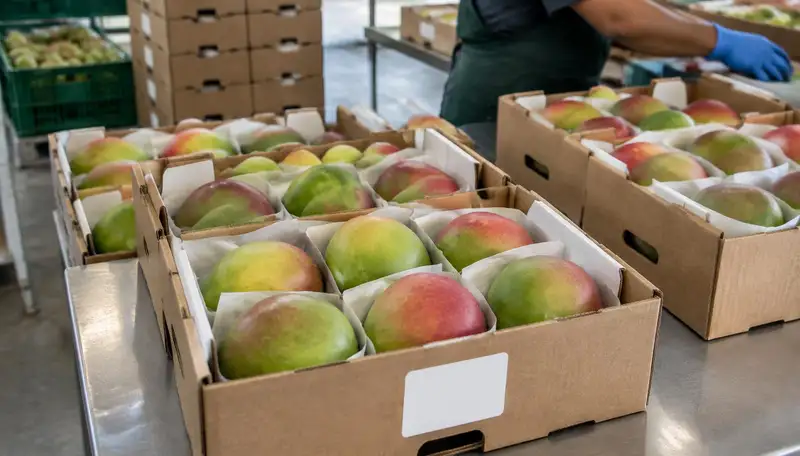
How do buyers source mangoes in bulk?
Specify bulk mangoes by variety, size count per box, maturity at harvest and ripeness on arrival, skin and internal defect limits, pack format and any treatment your destination requires. Supply comes from several origins in two overlapping seasons: the U.S. National Mango Board reports that mangoes sold in the U.S. come mostly from Mexico, Ecuador, Peru, Brazil, Guatemala and Haiti, in a spring/summer and a fall/winter season.
What “premium” means in a wholesale mangoes specification
- One named variety per programme, not mixed lots
- Consistent size count per box and net weight
- Maturity at harvest that ripens evenly, with internal quality checked on cut samples
- Low skin-defect tolerance and careful handling to avoid sap burn and bruising
Variety
The National Mango Board tracks availability for Tommy Atkins, Kent, Keitt, Haden and Honey (Ataulfo). Varieties differ in fibre, colour, size and ripening behaviour, so name the ones you accept and whether substitutions are allowed.
Grade and reference standard
UNECE FFV-45 (mangoes). The UNECE mango standard sets minimum requirements, classes, sizing and tolerances. State which standard or customer specification applies and how maturity and internal quality will be checked. UNECE standards list
Origin and season — what the sources say
Mexico, Ecuador, Peru, Brazil, Guatemala, Haiti (U.S. supply) · Spring/summer and fall/winter
Mangoes sold in the U.S. come mostly from these origins, which harvest at different times; the year has two overlapping seasons, spring/summer and fall/winter.
The National Mango Board also publishes a variety-by-month availability chart for the U.S. market. Other destinations draw on different origins; ask exporters for weekly volume by variety for your own market.
Mangoes specification worksheet
Fill what you know; leave the rest blank. Your answers are copied into the request form for you to check — nothing is sent from this page, and no supplier is promised to meet every point.
Blank fields stay blank in the form.
Cold chain and packing
- Agree the carrying temperature for the variety and voyage length
- Avoid chilling injury and condensation at handovers
- Ask for a logger per container and who reads it
- Plan ripening capacity for the arrival cadence
Documents to check
- Phytosanitary certificate and any treatment certificate your destination requires
- Market-access protocol or registered packhouse where required
- Food-safety certificates your buyers require
Global B2B Group is committed to conducting its own activities in accordance with applicable law. It facilitates sourcing and RFQs and does not itself produce, manufacture, export or sell the listed products, or approve them on behalf of any authority. Suppliers are responsible for the products and shipments they offer and supply meeting the requirements of the origin and destination countries — for example safety, quality, labelling, traceability, sanitary or phytosanitary certificates and export documents, where relevant. Buyers remain responsible for their own import permissions, local requirements and due diligence. Requirements differ by product and country; this is not legal advice. Compliance & responsibilities · Terms
How our team evaluates supply options
After review, our team asks suitable suppliers to quote on your specification and to evidence the points below. Not every supplier can meet every specification; offers that differ are shown as alternatives, not ranked as equivalents. You decide which, if any, to take forward — introductions happen only with your approval.
- Varieties and weekly volume for your window
- Treatment facilities approved for your destination, where required
- Maturity and internal-quality records from previous seasons
- Packhouse references you can contact
Prices are provided after your specification is reviewed; we do not publish mangoes prices or stock.
Searching for one of these?
Common buyer searches this page answers: bulk mango sourcing · Kent mangoes container supplier · mango exporter by origin and season · Ataulfo mangoes wholesale.
Buyer questions
- Which mango varieties are traded most?
- The U.S. National Mango Board tracks Tommy Atkins, Kent, Keitt, Haden and Honey (Ataulfo). Other markets may use different varieties; name the ones your customers accept.
- Can I get mangoes year-round?
- Often, by combining origins. The National Mango Board describes two overlapping seasons for the U.S. market. Year-round supply still needs confirmed weekly volumes from each origin.
- Do mangoes need treatment for import?
- Some destinations require phytosanitary treatments such as hot-water treatment for certain origins. Requirements are set by the destination; confirm them with the competent authority and your broker.
Guides and other premium products
Submit your mangoes requirements
Free for buyers. Assisted sourcing from USD 250,000 per year or season; smaller requests stay on file without supplier outreach. Global B2B Group is not a grower, exporter, importer or seller — suppliers remain responsible for product, compliance and documents.
Share this page