
Fresh fruit & vegetables · Buyer profile
Mangoes for import: Kent, Keitt, Ataulfo and grades
Mangifera indica L.
Fresh mangoes are classified as Extra, Class I, or Class II and sized by weight or count under FFV-45.[1]
Mature-green mangoes require warmer storage than ripe mangoes, and chilling risk depends on variety, ripeness, and exposure time.[2]
Free for buyers. One reviewed request; our team approaches suitable independent suppliers and returns comparable proposals — you never deal with a supplier directly, and suppliers cannot pay for placement. Assisted sourcing applies to programmes of USD 250,000 or more per year or season.
Educational profile, not an offer. Facts are general and come from the numbered sources; guidance boxes are our own buyer advice. No verified supplier offer for this item is on file — origin, grade, certification, packing and timing are confirmed per offer, with evidence, during sourcing.
At a glance
Short answers to the questions buyers ask first. Each answer comes from the numbered sources below.
- Which types do buyers specify?
- Tommy Atkins, Kent, Keitt, Ataulfo / Honey, Haden, Francis.[5],[6],[7],[8],[9],[10]
- How is quality graded?
- Minimum fruit weight is 100 g.[1]
- What do the sources say about seasons?
- The National Mango Board lists U.S.-market peak windows of March–July for Tommy Atkins and Honey, March–May for Haden, December–February for Kent, March–April and August–September for Keitt, and May–June for Francis; these are general variety windows, not origin-specific shipment commitments.[5],[8],[9],[6],[7],[10]
- How is it stored and shipped?
- Optimum temperature is 13°C for mature-green mangoes and 10°C for partially ripe or ripe fruit.[2]
- What makes it premium?
- Extra Class requires superior quality, characteristic of the variety, under section II.C(i).[1]
What mangoes are
Recognized types and varieties
How the types buyers name in requests differ, as described by the sources. Pick one to carry it into your request.
Tommy Atkins
- Firm flesh contains fibers throughout, and red blush may cover much of the fruit; skin color may provide no reliable ripeness cue.[5]
Kent
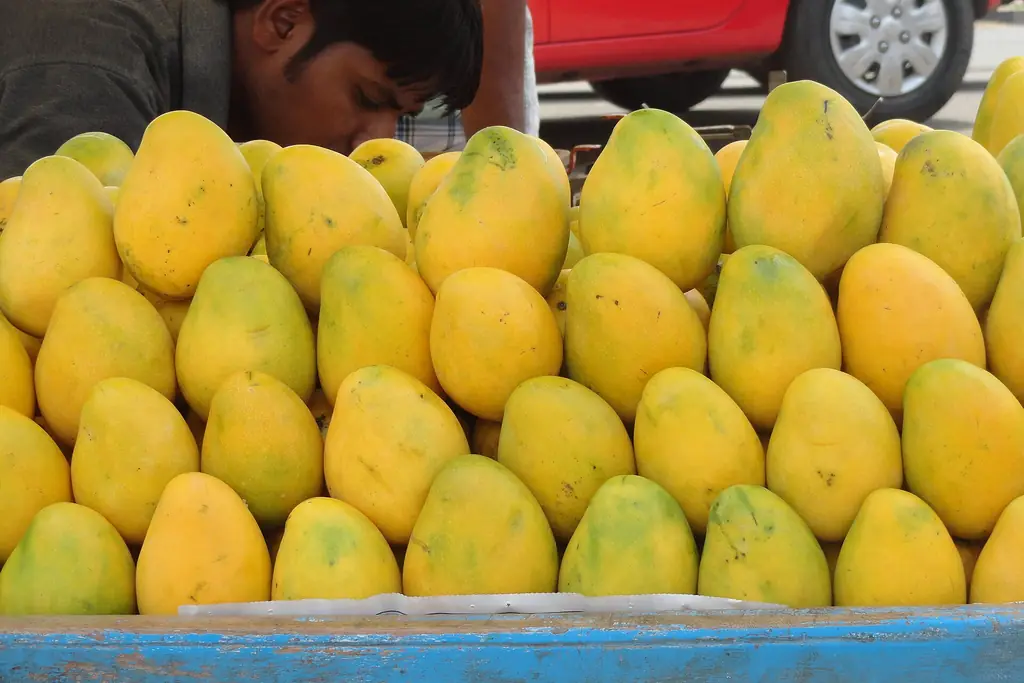
- Kent has juicy, tender flesh with limited fibers and a large oval shape.[6]
Keitt
- Keitt has firm, juicy flesh with limited fibers; its skin stays green even when ripe.[7]
Ataulfo / Honey
- Honey is small and flattened-oblong, with smooth, firm, fiber-free flesh and a small seed.[8]
Haden
- Haden has firm flesh with fine fibers; green skin areas turn yellow during ripening.[9]
Francis
- Francis has soft, juicy flesh with fibers and an oblong, sigmoid shape.[10]
Commercial formats, classes and grades
- Minimum fruit weight is 100 g.[1]
- Size A is 100–350 g with a maximum within-package weight difference of 75 g.[1]
- Size B is 351–550 g with a maximum within-package weight difference of 100 g.[1]
- Size C is 551–800 g with a maximum within-package weight difference of 125 g.[1]
- Size D is above 800 g with a maximum within-package weight difference of 150 g.[1]
- When fruit is sized by count, within-package size differences must remain consistent with the weight-size table.[1]
- Class I permits slight shape defects and slight skin defects from rubbing, sunburn, or healed stains up to 3, 4, 5, or 6 cm² for sizes A, B, C, or D respectively.[1]
- Class II permits skin defects up to 5, 6, 7, or 8 cm² for sizes A, B, C, or D respectively, while retaining essential quality and keeping characteristics.[1]
- Extra allows 5% by number or weight below class but meeting Class I, including no more than 0.5% in total of Class II quality.[1]
- Class I allows 10% below class but meeting Class II, including no more than 1% in total below Class II or minimum requirements, or affected by decay.[1]
- Class II allows 10% below class or minimum requirements, including no more than 2% in total affected by decay.[1]
- Each package must be uniform in origin, variety, quality, and size; visible contents must represent the entire contents.[1]
Typical uses and buyer profiles
- Kent is identified for snacking, juicing, and drying.[6]
- Keitt is also eaten at the mature-green stage or used for pickles.[7]
Who typically specifies this — general guidance
- For retail programs, define the acceptance specification before comparing proposals.
- For foodservice programs, specify delivery cadence and intended preparation.
Seasonality and sourcing considerations
Season windows are shown as the sources state them; confirm packing or harvest weeks with each supplier for the season you buy.
- The National Mango Board lists U.S.-market peak windows of March–July for Tommy Atkins and Honey, March–May for Haden, December–February for Kent, March–April and August–September for Keitt, and May–June for Francis; these are general variety windows, not origin-specific shipment commitments.[5],[8],[9],[6],[7],[10]
- The January 2026 availability chart uses 2019–2022 average shipping data; it is a historical planning reference rather than a live supply forecast.[4]
- The Board’s variety directory includes distinct commercial mango varieties with different flavor and texture profiles.[3]
Storage, handling and logistics
- Optimum temperature is 13°C for mature-green mangoes and 10°C for partially ripe or ripe fruit.[2]
- Optimum relative humidity is 90–95%.[2]
- Exposure to 100 ppm ethylene for 12–24 hours at 20–22°C and 90–95% relative humidity can produce faster, more uniform ripening within 5–9 days, depending on cultivar and maturity.[2]
- Carbon dioxide should remain below 1% in ripening rooms.[2]
- Postharvest-life potential is two to four weeks in air at 13°C, depending on cultivar and maturity.[2]
- Chilling injury can cause uneven ripening, poor color and flavor, pitting, gray scald-like skin discoloration, and increased decay susceptibility.[2]
Strengths, trade-offs and best fit
What to state in your request
- State destination, delivery window, annual or seasonal volume, and shipment cadence.
- Specify variety, quality class, size basis, and acceptance tolerances.
- Describe pack format, net weight, labeling language, and pallet requirements.
- Request harvest, packing, and temperature records with the proposal.
- Ask for the destination-specific plant-health documents and market-access evidence.
- Agree inspection method, sampling plan, and claims procedure before dispatch.
Start your request with these requirements
Fill in what you already know; it is carried into the request form, where you add your programme value and contact details. Nothing is sent until you submit the form.
Free for buyers. One reviewed request; our team approaches suitable independent suppliers and returns comparable proposals — you never deal with a supplier directly, and suppliers cannot pay for placement. Assisted sourcing applies to programmes of USD 250,000 or more per year or season.
Often requested with mangoes
Starter kits group products that buyers commonly source in one programme. The notes explain how the lines depend on each other — they are our general guidance; the product facts stay on each sourced profile.
Counter-season premium fruit programme
For importers and retailers who want one request covering the main premium fruit lines of the off-season: cherries, blueberries and table grapes, with mangoes as an option.
Our guidance: Each fruit has its own storage temperature (see the sourced handling line under each product). Plan separate reefers or compartments where the ranges differ, rather than one mixed load.
Avocado and tropical fruit ripening programme
For distributors who receive firm fruit and ripen or condition it before delivery to stores or food service.
Our guidance: State the ripeness stage you need on arrival — for example firm for your own ripening, or pre-conditioned — because it changes how the fruit is packed and shipped.
Compliance, documents and who is responsible
- Requirements for mangoes depend on the product and on the origin and destination countries — check them for your own market before you commit.
- The producer or exporter is responsible for the product and shipment requirements; the buyer or importer for import permissions, local rules and its own due diligence.
- Certificates (for example GLOBALG.A.P., BRCGS, ASC, BAP, organic or halal) are requested per offer and checked against the issuing body or official register. Global B2B Group does not manufacture, export or certify products and does not give legal advice.
Frequently asked questions
What are UNECE mango size codes?
A is 100–350 g, B is 351–550 g, C is 551–800 g, and D is above 800 g. Each code also limits within-package weight spread.[1]
Is a red mango ready to eat?
Not necessarily. Tommy Atkins may give no visual ripeness cue, while Keitt stays green even when ripe.[5],[7]
Can mature-green mangoes share a near-zero cold chain?
The recommended optimum is 13°C for mature-green mangoes, not near zero; chilling injury depends on cultivar, ripeness, and exposure.[2]
Related guides and tools
- Fresh fruit & vegetables: category guide
- Compare with avocados
- Compare with cherries
- Compare with blueberries
- Compare with table grapes
- Compare with citrus
- Compare with durian
- Compare with tomatoes
- Indian grapes to Vietnam and Indian produce to Canada: what APEDA published
- Global B2B Opportunities Center: verified trade corridors
- Premium produce sourcing
- Fresh produce RFQ
Farm, plant or input projects
Production projects behind this product — farms, hatcheries, processing or growing systems — are handled by our specialist platform.
SeedMatchSources
Numbers in the text point to these sources. Dates are those shown on each source, or the date we checked an undated page.
- 1.UNECE Standard FFV-45 Mangoes, 2023 edition (opens in a new tab) — UNECE, 2023
- 2.Mango — Produce Facts (opens in a new tab) — UC Davis Postharvest Technology Center, February 1997
- 3.Varieties & availability (opens in a new tab) — National Mango Board, page checked 2026-10-25
- 4.Varieties & availability chart 2026 (opens in a new tab) — National Mango Board (U.S.), January 2026
- 5.Tommy Atkins mango variety (opens in a new tab) — National Mango Board, page checked 2026-10-25
- 6.Kent mango variety (opens in a new tab) — National Mango Board, page checked 2026-10-25
- 7.Keitt mango variety (opens in a new tab) — National Mango Board, page checked 2026-10-25
- 8.Honey mango variety (opens in a new tab) — National Mango Board, page checked 2026-10-25
- 9.Haden mango variety (opens in a new tab) — National Mango Board, page checked 2026-10-25
- 10.Francis mango variety (opens in a new tab) — National Mango Board, page checked 2026-10-25
Profile last reviewed 2026-10-25. Report a correction via contact.
Global B2B Group is committed to conducting its own activities in accordance with applicable law. It facilitates sourcing and RFQs and does not itself produce, manufacture, export or sell the listed products, or approve them on behalf of any authority. Suppliers are responsible for the products and shipments they offer and supply meeting the requirements of the origin and destination countries — for example safety, quality, labelling, traceability, sanitary or phytosanitary certificates and export documents, where relevant. Buyers remain responsible for their own import permissions, local requirements and due diligence. Requirements differ by product and country; this is not legal advice. Compliance & responsibilities · Terms