
Trade openings · India
Indian grapes to Vietnam and Indian produce to Canada: what APEDA published
Two official notices from India's export authority, read from the buyer's side: what each one allows, what still has to be verified per exporter, and how to request comparable offers.
Reviewed: 9 min read
Short answer
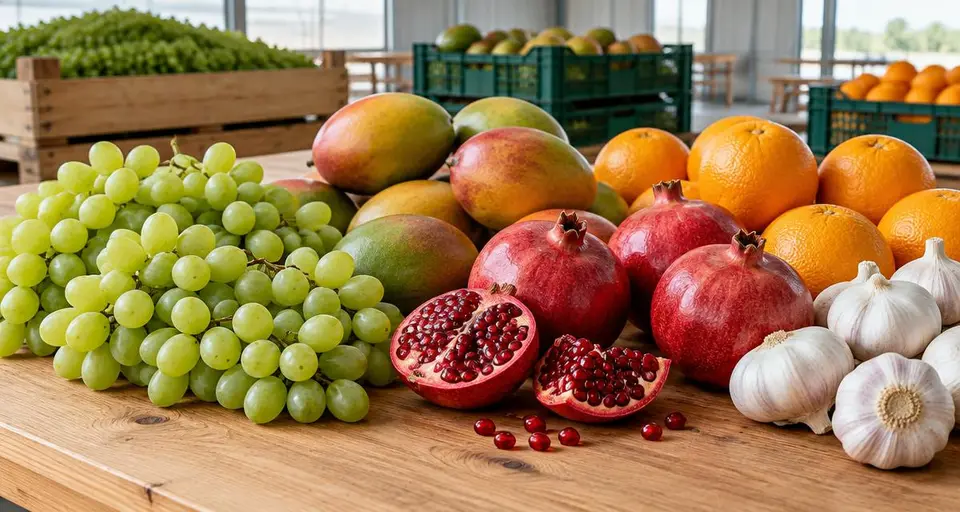
APEDA circulated Vietnam's market access for fresh Indian grapes, effective 6 May 2026, in a circular dated 13 May 2026. A circular dated 1 April 2026 says Canada approved Indian mangoes, pomegranates and arils, oranges and garlic under its general requirements.
What the two circulars say
APEDA's circular dated 13 May 2026 (ref. APEDA-FFV/16/2024-FFV) passes on a letter from Vietnam's Plant Production and Protection Department granting market access for fresh grapes from India with effect from 6 May 2026, and attaches Vietnam's final phytosanitary import requirements (APEDA, 13 May 2026 (opens in a new tab)).
A second circular, dated 1 April 2026 (ref. APEDA-FFV/43/2024-FFV), says Canada's plant protection organisation informed India by letter dated 20 January 2026 that fresh mangoes, pomegranates, pomegranate arils, oranges and garlic are approved for entry, with Canada's general phytosanitary import requirements applying (APEDA, 1 April 2026 (opens in a new tab)). Both circulars are listed on APEDA's announcements page (APEDA announcements, checked 26 October 2026 (opens in a new tab)).
| Corridor | Products | Status | Source |
|---|---|---|---|
| India → Vietnam | Fresh grapes | Market access effective 6 May 2026; circular dated 13 May 2026 | APEDA (opens in a new tab) |
| India → Canada | Fresh mangoes, pomegranates and arils, oranges, garlic | Requirements published; circular dated 1 April 2026 | APEDA (opens in a new tab) |
Takeaway: Requirements are published. Whether a given exporter, packhouse and product qualify — and whether a shipment clears — is verified per shipment.
Origins, destinations and products
The Vietnam opening covers fresh table grapes from India. The Canada notice covers fresh mangoes, whole pomegranates, pomegranate arils, oranges and garlic. Each product has its own specification, packing and shelf-life questions, so request them as separate lines even when one importer buys several.
Neither circular names exporters, volumes or prices, and neither guarantees clearance of a specific consignment. Read them as the rules a compliant shipment must meet, not as evidence that supply is available.
Seasonality
APEDA's Farmer Connect profiles give peak harvesting seasons by state. For grapes: Maharashtra March to May, Karnataka March, April and November, and Tamil Nadu May and November (APEDA Farmer Connect — grapes (opens in a new tab)). For mangoes: Andhra Pradesh and Telangana April to May, Karnataka April to June, Gujarat May, Uttar Pradesh June and Bihar June to July (APEDA Farmer Connect — mango (opens in a new tab)).
We have not found an equivalent official calendar for pomegranates, oranges or garlic for these corridors. Ask each supplier for its packing window per product and region, and plan arrivals against the treatment and transit time it states.
Quality and specification to write into the request
Write one line per product, with the points that decide acceptance on arrival.
- Grapes: variety, colour, berry size, bunch weight, pack and the arrival tolerance for loose berries and decay.
- Mangoes: variety, count per box, maturity at shipment and ripeness expected on arrival.
- Pomegranates: size or count, skin condition; for arils, pack format and shelf-life stated by the supplier.
- Oranges: variety, size count and skin condition.
- Garlic: bulb size range, dryness and whether stems or roots are trimmed.
- For every line: pack, net weight, pallet configuration and label language.
Phytosanitary and compliance checks
For Vietnam, exports of fresh grapes are subject to a systems approach and in-transit cold treatment, with the conditions set in Vietnam's final phytosanitary import requirements attached to the circular (APEDA, 13 May 2026 (opens in a new tab)). Ask the exporter how its vineyards and packhouse meet the systems-approach conditions and who documents the treatment.
For Canada, the circular lists the core points: inspection by the Canadian Food Inspection Agency, origin clearly identified on shipping documents, produce free from soil, pests, leaves and plant debris, straw-packing rules, and extra requirements if branches or leaves are attached (APEDA, 1 April 2026 (opens in a new tab)). Product-specific requirements are referenced in CFIA's Automated Import Reference System (CFIA AIRS (opens in a new tab)) — check the current entry for your exact product.
- Vietnam: written confirmation that the exporter meets the systems-approach conditions and the in-transit cold treatment.
- Canada: the current AIRS entry for the exact product and form (fruit, arils or bulbs).
- Both: draft phytosanitary certificate wording from India's plant protection authority.
- Both: residue results for the actual lot against the destination's limits.
Cold chain and logistics
Because Vietnam requires the grape cold treatment in transit, the routing must allow the full treatment to be completed and recorded before arrival. Ask the supplier and carrier to confirm this for the planned route before you fix an arrival date.
For Canada, plan documents around inspection: shipping documents that state the origin clearly, clean produce without soil or leaves, and compliant packing materials. Agree who is the importer of record in Canada and who covers inspection costs or delays.
Buyer checklist before you contract
- Each product is a separate line with variety, size, pack and arrival tolerances.
- Vietnam grapes: the exporter meets the systems approach and the in-transit cold treatment is arranged and recorded.
- Canada: the current CFIA AIRS entry matches your exact product and form.
- Shipping documents will state the origin clearly.
- Produce and packing will be free of soil, leaves and plant debris; any straw packing is compliant.
- Phytosanitary certificate wording matches the destination's requirements.
- Residue results for the actual lot are available before loading.
- The importer of record and responsibility for inspection costs are agreed.
Plan an Indian produce programme for Vietnam or Canada
Send one request with product, variety, size, pack, volume, destination port and arrival window. Our team reviews it, checks it against the published requirements and approaches suitable suppliers for you. Free for buyers; programmes from USD 250,000 per year or season.
Request Indian produceFree for buyers · programmes from USD 250,000 per year or season · our team contacts suppliers for you — no direct buyer–supplier contact.
Frequently asked questions
Can Indian grapes be exported to Vietnam?
Yes, according to APEDA's circular dated 13 May 2026: Vietnam granted market access with effect from 6 May 2026, subject to a systems approach and in-transit cold treatment (APEDA (opens in a new tab)).
Which Indian products did Canada approve?
Fresh mangoes, pomegranates, pomegranate arils, oranges and garlic, under Canada's general phytosanitary requirements, per APEDA's circular dated 1 April 2026 (APEDA (opens in a new tab)).
Does the Canada circular mean my shipment will clear?
No. It publishes requirements. Each shipment is still inspected by the Canadian Food Inspection Agency, and the exporter and product must meet the current requirements.
When are Indian grapes and mangoes in season?
APEDA's Farmer Connect lists peak grape harvests in Maharashtra from March to May and mango harvests from April to July depending on the state (APEDA (opens in a new tab)).
Will you introduce me directly to Indian exporters?
No. You send one request; our team reviews it, approaches suitable suppliers on your behalf and returns comparable offers. Buyers pay nothing, and we do not list suppliers, prices or availability.
Related guides and tools
Sources
Dates are those shown on each source, or the date we checked an undated page.
- Circular — Grant of market access of Indian grapes for export to Vietnam and its phytosanitary requirements (ref. APEDA-FFV/16/2024-FFV) — APEDA, India, 2026-05-13
- Circular — Phytosanitary requirements for export of mango, pomegranate fruits & arils, oranges and garlic from India to Canada (ref. APEDA-FFV/43/2024-FFV) — APEDA, India, 2026-04-01
- APEDA announcements — Fresh Fruits & Vegetables Division — APEDA, India, page checked 2026-10-26
- Automated Import Reference System (AIRS) — Canadian Food Inspection Agency, referenced in the APEDA circular of 2026-04-01
- Farmer Connect — Grapes: peak harvesting season — APEDA, India, page checked 2026-10-26
- Farmer Connect — Mango: peak harvesting season — APEDA, India, page checked 2026-10-26
Global B2B Group is committed to conducting its own activities in accordance with applicable law. It facilitates sourcing and RFQs and does not itself produce, manufacture, export or sell the listed products, or approve them on behalf of any authority. Suppliers are responsible for the products and shipments they offer and supply meeting the requirements of the origin and destination countries — for example safety, quality, labelling, traceability, sanitary or phytosanitary certificates and export documents, where relevant. Buyers remain responsible for their own import permissions, local requirements and due diligence. Requirements differ by product and country; this is not legal advice. Compliance & responsibilities · Terms