
Output sourcing · 10 min read
How to Write an International RFQ for Fresh Vegetables and Premium Produce
Also available in: Español · العربية
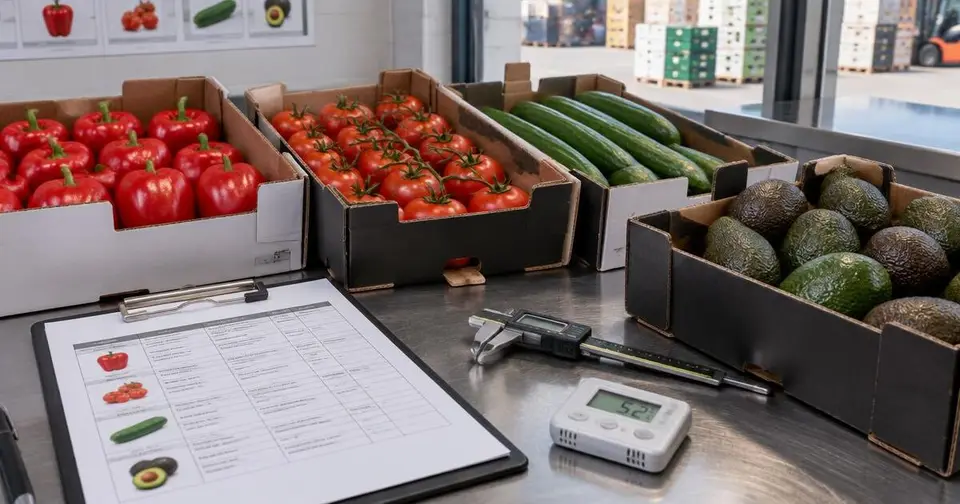
A checklist tells you what to specify; an RFQ is the document a grower, packer or exporter on another continent actually answers. This guide shows how to structure that document so every supplier quotes the same product, on the same terms, in the same format.
The outcome comes first. Procurement follows.
Plan the production or project → define the output and market → structure a reviewed RFQ → our team approaches suitable counterparties → compare offers. Equipment and production-line procurement remains a separate path: plan an equipment RFQ.
An RFQ is a document, not a message
A one-line enquiry such as "price for five containers of peppers?" invites five different answers: different varieties, sizes, packs and delivery terms. A structured RFQ fixes the product, the condition it must arrive in and how the supplier must answer, so offers can be laid side by side.
Keep it to six short parts. Suppliers read requests from many buyers; the clearer the structure, the more likely a complete reply.
| Part | What it contains | Why suppliers need it |
|---|---|---|
| 1. Buyer and programme | What it containsCompany type, end market, programme length, declared annual or seasonal value | Why suppliers need itShows the scale and whether they can serve it |
| 2. Specification annex | What it containsOne sheet per product: variety, class, size or count, form, maturity, packing, labelling | Why suppliers need itDefines exactly what is being priced |
| 3. Quality and inspection | What it containsReference standard, tolerances, pre-shipment and arrival inspection, claims window | Why suppliers need itSets what counts as a conforming delivery |
| 4. Cold chain and logistics | What it containsPre-cooling, carrying temperature, loggers, sea or air, ports | Why suppliers need itPrevents quotes that assume different handling |
| 5. Commercial terms | What it containsIncoterms® rule and named place, volume per shipment, delivery window, optional target price, documents | Why suppliers need itPuts every price on the same basis |
| 6. Response format | What it containsQuote fields, currency, validity, samples, deadline | Why suppliers need itMakes replies comparable |
Write a specification annex for each product
Greenhouse vegetables, field crops and premium fruit fail on different points, so write one annex per product line rather than one paragraph covering "mixed vegetables".
Use measurable terms. Where a UNECE marketing standard exists for the product, naming its class (for example Extra Class or Class I) and size code gives suppliers a shared reference; your own tolerances can be stricter.
- Product and variety, with any accepted alternatives (for example Hass avocado, vine tomatoes, named pepper colours)
- Class and size: calibre in millimetres, weight band or count per carton
- Form: fresh, chilled or frozen (for example IQF vegetables), and any cut or trim
- Maturity: harvest stage and the ripeness or remaining shelf life you need at arrival
- Packing: carton type and net weight, punnets or bags, pallet pattern, labelling language and private-label artwork
Agree quality, inspection and claims before anyone quotes
A price means little until both sides agree what a conforming delivery is. State the reference standard and your tolerances, who inspects before loading, how arrival inspection is sampled, and within how many hours after arrival a quality claim must be raised and evidenced.
Food-safety expectations belong here too. The Codex Code of Hygienic Practice for Fresh Fruits and Vegetables (CXC 53-2003) sets out hygienic practices from primary production to packing; many buyers ask suppliers to describe how they apply it or a scheme their own customers require. List those schemes as requirements to be evidenced, not as something a supplier is assumed to hold.
Cold chain, documents and the Incoterms® basis
Specify pre-cooling, the carrying temperature agreed for each product, temperature loggers and the handover points. Ask whether the offer is for sea or air freight and from which port or airport.
Documents depend on the product and the destination. Fresh fruit and vegetables commonly travel with a phytosanitary certificate issued by the exporting country's national plant protection organisation, under the framework described in ISPM 12. Check the destination's own import conditions with its competent authority before the first shipment.
Name one Incoterms® rule and a named place for every supplier — for example CFR Rotterdam — so all prices include the same costs. A target or budget price is optional; if you share it, state the unit and the Incoterms® basis. It is never published.
Tell suppliers exactly how to answer
Ask everyone for the same fields: price per unit and per carton on your Incoterms® basis, currency, validity date, weeks they can supply, volume per week, packing confirmed, the documents they can provide, and any deviation from your specification listed separately.
Set a deadline and say whether samples or a trial shipment are expected. Through Global B2B Group, buyers submit the request once; our team reviews it, approaches suitable growers, packers or exporters on the buyer's behalf and returns their offers side by side. There is no direct buyer–supplier contact before review, and any introduction happens only with your approval.
Buyer & seller checklist
Editorial suggestions for a complete request — not legal requirements.
- Programme: End market, programme length and declared annual or seasonal value (assisted RFQs from USD 250,000)
- Specification annex: One per product: variety, class, size, form, maturity, packing and labelling
- Reference standard: The UNECE or customer standard you buy against, plus your own tolerances
- Inspection and claims: Pre-shipment inspection, arrival sampling, claims window and the evidence required
- Cold chain: Pre-cooling, carrying temperature, loggers and handover points
- Documents: Phytosanitary certificate and any destination or customer documents, confirmed with the competent authority
- Commercial basis: One Incoterms® rule and named place, volume per shipment, delivery window, optional target price
- Response format: Same quote fields for everyone, currency, validity, deviations listed separately, deadline
Planning the production side? SeedMatch
Our specialist platform for greenhouse, nursery and crop-production projects — for buyers who want to grow produce rather than buy it.
Go to SeedMatchOptional next step
This guide is free to use. If you have a programme of USD 250,000 or more per year or season, you can send a request for review. A request is not a guarantee of supply, quality, price or a sale.
Request a reviewed supply programmeFrequently asked questions
- What is the difference between an RFQ and a specification checklist?
- A checklist lists what to decide. The RFQ is the document suppliers answer: it combines the specification annex with inspection terms, logistics, the commercial basis and a fixed response format, so the replies can be compared.
- Should I include a target price in a produce RFQ?
- Only if you have one and are comfortable sharing it. State the unit and the Incoterms® basis. Global B2B Group uses it to review fit and never publishes it or presents it as a market price.
- Can one RFQ cover several vegetables?
- Yes, but give each product its own specification annex. A description such as "assorted vegetables" produces offers that cannot be compared.
- Who sends the RFQ to suppliers?
- You submit it once through the produce request form. For programmes with a declared value from USD 250,000 per year or season, our team reviews it and contacts suitable suppliers on your behalf; smaller requests are kept on file without supplier outreach. The service is free for buyers.
Sources and editorial note
- IPPC — ISPM 12: Phytosanitary certificates
- FAO/WHO Codex Alimentarius — Code of Hygienic Practice for Fresh Fruits and Vegetables (CXC 53-2003)
- UNECE — Standards for fresh fruit and vegetables
- International Chamber of Commerce — Incoterms® rules
Written by the Global B2B Group project team. Published and last reviewed . Regulatory references are examples and change over time; confirm current requirements for your product and destination with the competent authority. This guide is not legal advice.
