
Trade openings · Stone fruit
South African stone fruit to China: what the protocol covers and how to buy
Five fruits, one protocol, registered orchards and packhouses: a dated buyer guide to sourcing South African apricots, peaches, nectarines, plums and prunes for China.
Reviewed: 8 min read
Short answer
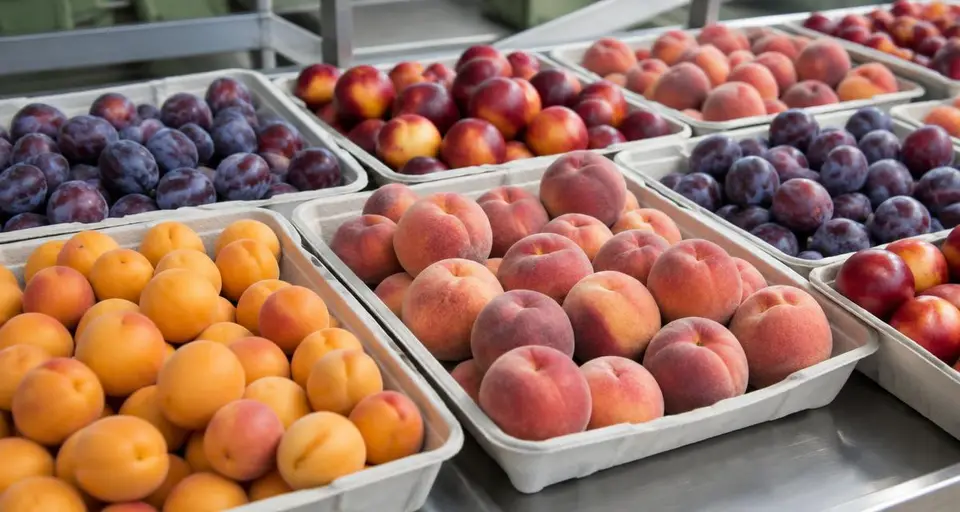
A protocol signed on 15 October 2025 and GACC Announcement No. 222 of 14 November 2025 allow South African apricots, peaches, nectarines, plums and prunes into China from registered orchards and packhouses. The first shipment left South Africa in February 2026.
What the official record shows
South Africa's Minister of Agriculture and China's GACC signed a stone fruit trade protocol in Shanghai on 15 October 2025. It opens China for the first time to five South African stone fruits: apricots, peaches, nectarines, plums and prunes (South African Government, 15 October 2025 (opens in a new tab)).
GACC then issued Announcement No. 222 of 2025, dated 14 November 2025, allowing imports of fresh South African stone fruit that meet its requirements (GACC, 14 November 2025 (opens in a new tab)). On 19 February 2026 the South African Government reported that the first stone fruit shipment for China had been prepared at a packhouse in Franschhoek on 18 February 2026 (South African Government, 19 February 2026 (opens in a new tab)).
| Date | What happened | Source |
|---|---|---|
| 15 October 2025 | Protocol signed for apricots, peaches, nectarines, plums and prunes | South African Government (opens in a new tab) |
| 14 November 2025 | GACC Announcement No. 222 of 2025 issued: imports allowed if the requirements are met | GACC (opens in a new tab) |
| 18 February 2026 | First stone fruit shipment prepared for China (reported 19 February 2026) | South African Government (opens in a new tab) |
Takeaway: Access is in force. Each supplier's registration and each shipment's documents are still checked one by one.
Origin, destination and products
The announcement covers fresh peaches (Prunus persica), nectarines (Prunus persica var. nucipersica), plums (Prunus salicina), apricots (Prunus armeniaca) and prunes (Prunus domestica) from South Africa's stone fruit areas, for import into mainland China.
Treat each fruit as its own line in a request: varieties, sizes, ripeness and packing differ, and so does what each supplier can offer in a given season. The protocol allows all five; it does not tell you which supplier has which fruit.
Seasonality by fruit
Hortgro's industry calendar gives these South African seasons: apricots October to January, peaches October to mid-April, nectarines November to mid-April, and plums November to mid-May (Hortgro, Key Deciduous Fruit Statistics 2020 (opens in a new tab)). The calendar does not list prunes separately; ask suppliers for their window.
These are industry calendars, not commitments. Ask each supplier for the weeks it can pack each fruit and variety for China, and plan arrivals against the transit and treatment time it states.
| Fruit | Season in South Africa |
|---|---|
| Apricots | October – January |
| Peaches | October – mid-April |
| Nectarines | November – mid-April |
| Plums | November – mid-May |
| Prunes | Not listed separately — ask the supplier |
Quality and specification to write into the request
Stone fruit offers are only comparable when each one answers the same points. Write them per fruit.
- Fruit, variety and flesh type (for example yellow or white flesh) — and whether substitutions are acceptable.
- Size range or count per pack, and the share allowed outside it.
- Ripeness and firmness you need on arrival, and how they will be measured.
- Defect tolerances (bruising, skin marks, splits) on arrival.
- Pack format, net weight and pallet configuration.
- Label language and the carton information your customer requires.
Phytosanitary and compliance checks
Under Announcement No. 222, orchards, packhouses and cold-treatment facilities must be inspected by South Africa and approved for registration by China; before each export season South Africa submits the list and GACC publishes it once approved (GACC, 14 November 2025 (opens in a new tab)).
The announcement also sets the quarantine pests of concern, packing and labelling rules, the phytosanitary certificate content and what happens if a non-compliant consignment arrives — re-treatment where possible, return or destruction. Ask for each document in advance.
- Registration codes for the orchard, packhouse and cold-treatment facility, checked against the current GACC list.
- Draft phytosanitary certificate wording from the exporter's plant protection authority.
- Pesticide-residue results against China's limits for the actual lot.
- Confirmation that your importer in China holds the import permits China requires for this fruit.
Cold chain and logistics
Cold treatment before export or in transit is part of the GACC requirements, following the procedures attached to the announcement (GACC, 14 November 2025 (opens in a new tab)). Agree in writing who arranges the treatment, who keeps the treatment and probe records, and who carries the risk if a treatment is found invalid.
Stone fruit is perishable and differs by fruit and variety in how it holds up during a long cold transit. Ask each supplier to state how it manages that for the fruit it offers, and make the arrival-quality criteria part of the contract rather than an afterthought.
Buyer checklist before you contract
- Fruit, variety, size and ripeness are written per line, with arrival tolerances.
- Orchard, packhouse and cold-treatment facility are on the current GACC list.
- The supplier's season window for each fruit is stated in writing.
- Cold treatment (pre-export or in transit) and its records are agreed.
- Carton and pallet labels follow the GACC rules.
- Phytosanitary certificate wording matches the announcement.
- Residue results for the actual lot are available before loading.
- Your importer holds the permits China requires and the arrival port accepts imported fruit.
Plan a South African stone fruit programme for China
Send one request with fruit, variety, size, pack, volume, destination port and arrival window. Our team reviews it, checks registration status and approaches suitable suppliers for you. Free for buyers; programmes from USD 250,000 per year or season.
Request South African stone fruitFree for buyers · programmes from USD 250,000 per year or season · our team contacts suppliers for you — no direct buyer–supplier contact.
Frequently asked questions
Which South African stone fruits can enter China?
Apricots, peaches, nectarines, plums and prunes, under the protocol signed on 15 October 2025 and GACC Announcement No. 222 of 14 November 2025 (GACC (opens in a new tab)).
Has stone fruit already been shipped to China?
Yes. The South African Government reported that the first shipment for China was prepared on 18 February 2026 (South African Government (opens in a new tab)). That does not mean every supplier is registered.
Do suppliers need to be registered?
Yes. Orchards, packhouses and cold-treatment facilities must be approved and registered by China, and the list is published on the GACC website before each season.
When is the South African stone fruit season?
Hortgro's calendar lists apricots October–January, peaches October–mid-April, nectarines November–mid-April and plums November–mid-May (Hortgro (opens in a new tab)).
Will you introduce me directly to stone fruit exporters?
No. You send one request; our team reviews it, approaches suitable suppliers on your behalf and returns comparable offers. Buyers pay nothing, and we do not list suppliers, prices or availability.
Related guides and tools
Sources
Dates are those shown on each source, or the date we checked an undated page.
- Minister John Steenhuisen signs landmark stone fruit trade protocol with China — South African Government, 2025-10-15
- 海关总署公告2025年第222号(关于进口南非鲜食核果植物检疫要求的公告) — General Administration of Customs of China (GACC), 2025-11-14
- Agriculture on historic milestone of first stone fruit shipment departing for China — South African Government, 2026-02-19
- Key Deciduous Fruit Statistics 2020 — Fruit seasons of South Africa — Hortgro, 2021 edition (2020 statistics)
Global B2B Group is committed to conducting its own activities in accordance with applicable law. It facilitates sourcing and RFQs and does not itself produce, manufacture, export or sell the listed products, or approve them on behalf of any authority. Suppliers are responsible for the products and shipments they offer and supply meeting the requirements of the origin and destination countries — for example safety, quality, labelling, traceability, sanitary or phytosanitary certificates and export documents, where relevant. Buyers remain responsible for their own import permissions, local requirements and due diligence. Requirements differ by product and country; this is not legal advice. Compliance & responsibilities · Terms