
Fresh fruit & vegetables · Buyer profile
Bulk and wholesale tomatoes: types, grades and ripeness
Solanum lycopersicum L.
Fresh tomatoes are specified by commercial type, class, size and maturity; FFV-36 recognizes round, ribbed, oblong/elongated and cherry/cocktail types.[1]
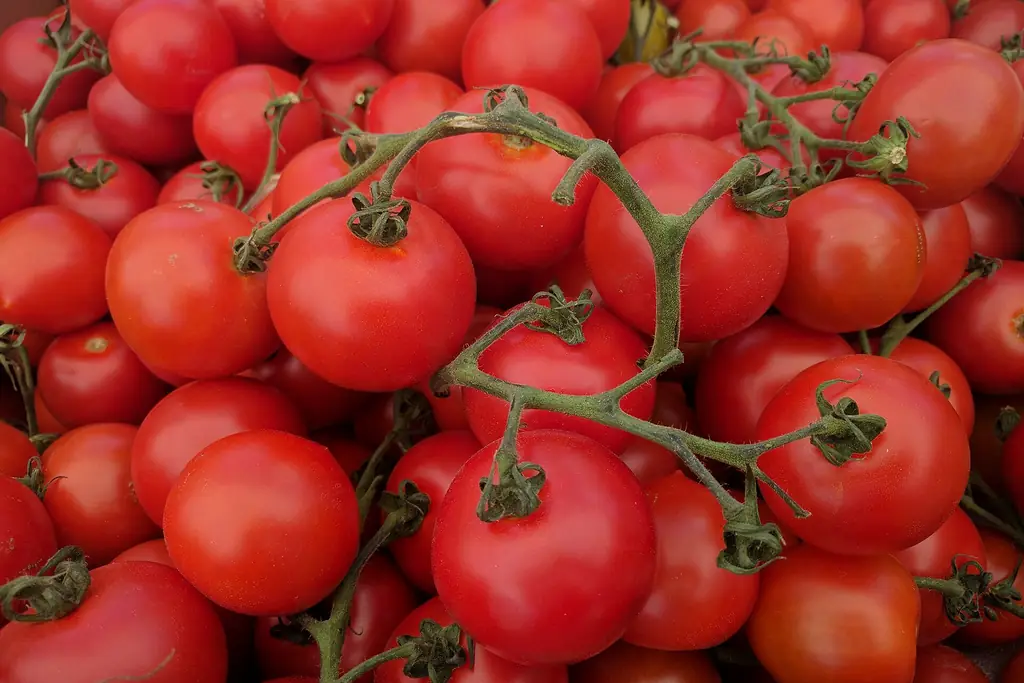
Trusses are a presentation with distinct stalk requirements and an exemption from the sizing provisions.[1]
Free for buyers. One reviewed request; our team approaches suitable independent suppliers and returns comparable proposals — you never deal with a supplier directly, and suppliers cannot pay for placement. Assisted sourcing applies to programmes of USD 250,000 or more per year or season.
Educational profile, not an offer. Facts are general and come from the numbered sources; guidance boxes are our own buyer advice. No verified supplier offer for this item is on file — origin, grade, certification, packing and timing are confirmed per offer, with evidence, during sourcing.
At a glance
Short answers to the questions buyers ask first. Each answer comes from the numbered sources below.
- Which types do buyers specify?
- Round, Ribbed, Oblong / elongated, Cherry / cocktail, Trusses.[1]
- How is quality graded?
- Class I fruit must be reasonably firm and free from cracks and visible greenbacks, subject to the specific ribbed provisions.[1]
- What do the sources say about seasons?
- The UC Davis sheet gives maturity and handling requirements rather than an origin-specific harvest calendar; it does not support a dated supply window.[2]
- How is it stored and shipped?
- Standard mature-green harvest stage MG2 has fully developed seeds that are not cut when the fruit is sliced, with advanced gel formation in at least one locule.[2]
- What makes it premium?
- Extra Class tomatoes must be of superior quality, firm and characteristic of the variety and/or commercial type.[1]
What tomatoes are
Recognized types and varieties
How the types buyers name in requests differ, as described by the sources. Pick one to carry it into your request.
Round
- Round tomatoes are a recognized commercial type; Class II may have healed cracks up to 3 cm long.[1]
Ribbed
- Ribbed Class I fruit may have healed cracks up to 1 cm and stigma suberization up to 1 cm².[1]
Oblong / elongated
- Oblong or elongated tomatoes form a distinct commercial type under FFV-36.[1]
Cherry / cocktail
- Cherry/cocktail tomatoes are miniature varieties of all shapes; sizing is optional below 40 mm diameter.[1]
Trusses
- Truss stalks must be fresh, healthy, clean, leaf-free and free of visible foreign matter.[1]
Commercial formats, classes and grades
- Class I fruit must be reasonably firm and free from cracks and visible greenbacks, subject to the specific ribbed provisions.[1]
- Class II fruit must be reasonably firm and must not have unhealed cracks.[1]
- Size may be determined by maximum equatorial diameter, weight or count.[1]
- For diameter-sized fruit, package spread must not exceed 10 mm if the smallest fruit is below 50 mm.[1]
- The diameter spread limit is 15 mm for smallest fruit at 50 to below 70 mm and 20 mm at 70 to below 100 mm.[1]
- There is no diameter-spread limit when the smallest fruit is at least 100 mm.[1]
- Sizing provisions do not apply to trusses and are optional for irregularly shaped ribbed tomatoes and Class II.[1]
- Optional size codes include 5 for over 40 to 47 mm, 6 for over 47 to 57 mm, 7 for over 57 to 67 mm and 8 for over 67 to 82 mm.[1]
Typical uses and buyer profiles
Who typically specifies this — general guidance
- Build a specification around your receiving operation and intended sales channel.
Seasonality and sourcing considerations
Season windows are shown as the sources state them; confirm packing or harvest weeks with each supplier for the season you buy.
- The UC Davis sheet gives maturity and handling requirements rather than an origin-specific harvest calendar; it does not support a dated supply window.[2]
Storage, handling and logistics
- Standard mature-green harvest stage MG2 has fully developed seeds that are not cut when the fruit is sliced, with advanced gel formation in at least one locule.[2]
- For extended shelf-life tomatoes, the sheet places minimum harvest maturity at Pink, USDA stage 4: more than 30% but no more than 60% pink-red surface color.[2]
- Mature-green tomatoes: optimum storage temperature is 12.5–15°C.[2]
- Light-red fruit, USDA stage 5: optimum storage temperature is 10–12.5°C.[2]
- Firm-ripe fruit, USDA stage 6: 7–10°C is recommended for three to five days.[2]
- Mature-green fruit can be held up to 14 days at 12.5°C before ripening without significant loss of sensory quality or color development.[2]
- Recommended relative humidity is 90–95%; condensation and extended higher humidity can promote molds.[2]
- Standard ripening temperature is 18–21°C; 14–16°C is used for slower ripening.[2]
- Mature-green fruit respond to external ethylene by initiating ripening.[2]
- Ripening treatment commonly uses 100 ppm ethylene for 24–72 hours; carbon dioxide above 1% retards ethylene action.[2]
- Tomatoes are chilling-sensitive below 10°C when held longer than two weeks, or at 5°C longer than six to eight days.[2]
- Chilling injury is cumulative and can cause failure to ripen, uneven color, premature softening, pitting and increased decay.[2]
Strengths, trade-offs and best fit
Strengths
- Mature-green tomatoes can be ripened after harvest using controlled temperature and ethylene conditions.[2]
Trade-offs
- Ripening tomatoes produce ethylene; co-storage with sensitive commodities such as lettuce and cucumbers should be avoided.[2]
Best fit when… — general guidance
- Compare offers against the same grade, size, maturity and arrival-condition brief.
What to state in your request
- State the commercial type and acceptable substitutions.
- Specify grade, size range and inspection tolerances.
- Set the shipment window, destination and delivery terms.
- Request a temperature plan and arrival-condition acceptance criteria.
- Define pack weight, labeling and required documentation.
Start your request with these requirements
Fill in what you already know; it is carried into the request form, where you add your programme value and contact details. Nothing is sent until you submit the form.
Free for buyers. One reviewed request; our team approaches suitable independent suppliers and returns comparable proposals — you never deal with a supplier directly, and suppliers cannot pay for placement. Assisted sourcing applies to programmes of USD 250,000 or more per year or season.
Compliance, documents and who is responsible
- Requirements for tomatoes depend on the product and on the origin and destination countries — check them for your own market before you commit.
- The producer or exporter is responsible for the product and shipment requirements; the buyer or importer for import permissions, local rules and its own due diligence.
- Certificates (for example GLOBALG.A.P., BRCGS, ASC, BAP, organic or halal) are requested per offer and checked against the issuing body or official register. Global B2B Group does not manufacture, export or certify products and does not give legal advice.
Frequently asked questions
Are trusses a fifth commercial type?
FFV-36 lists four commercial types. Trusses are a presentation with stalk requirements and a sizing exemption.[1]
Can tomatoes share a near-freezing grape program?
The tomato sheet recommends stage-specific temperatures and identifies cumulative chilling injury below the appropriate range; it is not a near-freezing storage program.[2]
Related guides and tools
Farm, plant or input projects
Production projects behind this product — farms, hatcheries, processing or growing systems — are handled by our specialist platform.
SeedMatchSources
Numbers in the text point to these sources. Dates are those shown on each source, or the date we checked an undated page.
- 1.UNECE Standard FFV-36: Tomatoes, 2017 edition (opens in a new tab) — UNECE, 2017
- 2.Tomato produce fact sheet (opens in a new tab) — UC Davis Postharvest Technology Center, May 1997
Profile last reviewed 2026-10-25. Report a correction via contact.
Global B2B Group is committed to conducting its own activities in accordance with applicable law. It facilitates sourcing and RFQs and does not itself produce, manufacture, export or sell the listed products, or approve them on behalf of any authority. Suppliers are responsible for the products and shipments they offer and supply meeting the requirements of the origin and destination countries — for example safety, quality, labelling, traceability, sanitary or phytosanitary certificates and export documents, where relevant. Buyers remain responsible for their own import permissions, local requirements and due diligence. Requirements differ by product and country; this is not legal advice. Compliance & responsibilities · Terms