
Fresh fruit & vegetables · Buyer profile
Citrus for import: oranges, mandarins, lemons and grades
Citrus specifications must distinguish fruit types: minimum juice content, maturity and size differ between oranges, mandarins, lemons, limes and grapefruit.[1]
Extra Class, Class I and Class II are defined in FFV-14; a citrus name alone does not establish a quality class.[1]
Free for buyers. One reviewed request; our team approaches suitable independent suppliers and returns comparable proposals — you never deal with a supplier directly, and suppliers cannot pay for placement. Assisted sourcing applies to programmes of USD 250,000 or more per year or season.
Educational profile, not an offer. Facts are general and come from the numbered sources; guidance boxes are our own buyer advice. No verified supplier offer for this item is on file — origin, grade, certification, packing and timing are confirmed per offer, with evidence, during sourcing.
At a glance
Short answers to the questions buyers ask first. Each answer comes from the numbered sources below.
- Which types do buyers specify?
- Oranges, Mandarins, Lemons, Limes, Grapefruit.[1]
- How is quality graded?
- Class I requires good quality and allows specified slight shape, color and skin defects without impairing quality or presentation.[1]
- What do the sources say about seasons?
- South Africa harvest windows in the December 2025 report are March–July for navels and May–September for Valencias.[5]
- How is it stored and shipped?
- Oranges: 3–8°C for up to three months, depending on cultivar, harvest maturity and production area.[2]
- What makes it premium?
- Extra citrus must be of superior quality and characteristic of the variety and/or commercial type.[1]
What citrus are
Recognized types and varieties
How the types buyers name in requests differ, as described by the sources. Pick one to carry it into your request.
Oranges
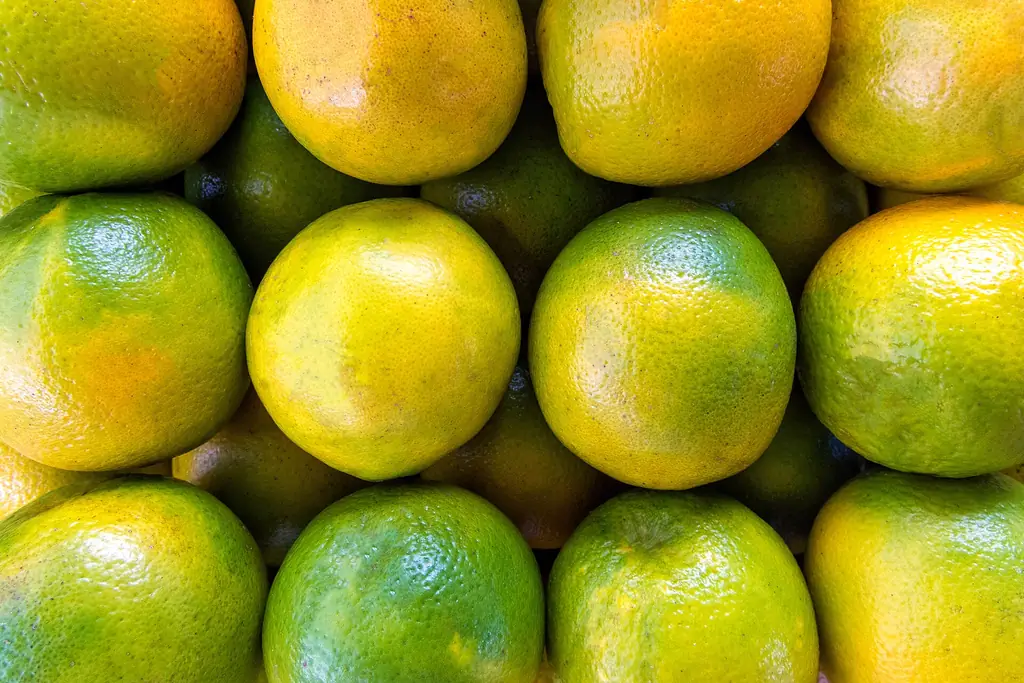
- Blood oranges require at least 30% juice, navels 33% and other varieties generally 35%, with a 6.5:1 minimum sugar/acid ratio; separate green-color exceptions apply.[1]
Mandarins
- Satsumas require 33% juice and a 6.5:1 ratio; clementines 40% and 7:1; other mandarins and hybrids 33% and 7.5:1.[1]
Lemons
- Lemons require at least 20% juice under FFV-14; green but not dark-green fruit is permitted if juice requirements are met.[1]
Limes
- Persian limes require 42% juice; Mexican and Indian sweet limes require 40%.[1]
Grapefruit
- Grapefruit and hybrids require 35% juice; Oroblanco also requires at least 9° Brix.[1]
Commercial formats, classes and grades
- Class I requires good quality and allows specified slight shape, color and skin defects without impairing quality or presentation.[1]
- Class II admits fruit outside higher classes that meets minimum requirements and retains essential quality and keeping characteristics.[1]
- Minimum diameters are 45 mm for lemons, 42 mm for Persian limes, and 25 mm for Mexican and Indian sweet limes.[1]
- Clementines have a 35 mm minimum diameter; satsumas and other mandarins and hybrids have a 45 mm minimum.[1]
- Minimum diameters are 53 mm for oranges and 70 mm for grapefruit and hybrids.[1]
- Under the diameter-range uniformity option, package spread is at most 10 mm when the smallest fruit is below 60 mm, 15 mm at 60 to below 80 mm, and 20 mm at 80 to below 110 mm.[1]
- Orange size codes include 0 at 92–110 mm, 6 at 70–80 mm and 13 at 53–60 mm.[1]
- Lemon codes include 0 at 79–90 mm, 4 at 58–67 mm and 7 at 45–52 mm.[1]
- Persian lime codes run from 1 at 58–67 mm to 5 at 42–49 mm.[1]
- Mandarin codes include 2 at 58–69 mm and 10 at 35–42 mm; sizes below 45 mm apply only to clementines.[1]
- Degreening is permitted only for fruit meeting maturity requirements and only if other natural organoleptic characteristics are not modified.[1]
Typical uses and buyer profiles
Who typically specifies this — general guidance
- Build a specification around your receiving operation and intended sales channel.
Seasonality and sourcing considerations
Season windows are shown as the sources state them; confirm packing or harvest weeks with each supplier for the season you buy.
Storage, handling and logistics
- Oranges: 3–8°C for up to three months, depending on cultivar, harvest maturity and production area.[2]
- Orange exceptions include some Florida cultivars at 0–1°C and Arizona Valencia at 9°C.[2]
- Lemons: 12–14°C, with duration potentially up to six months depending on cultivar, harvest stage, origin and storage conditions.[3]
- Mandarins: 5–8°C for two to six weeks, depending on cultivar, harvest stage and decay treatment.[4]
- Orange, lemon and mandarin sheets each recommend 90–95% relative humidity.[2],[3],[4]
- Mandarin chilling injury becomes more severe with longer exposure below 5°C.[4]
- Orange chilling symptoms include pitting, brown staining and increased decay; safe minimum temperature varies with cultivar, origin and maturity.[2]
- Lemon chilling injury includes pitting, membranous staining and red blotch; severity depends on fruit and time–temperature history.[3]
Strengths, trade-offs and best fit
Strengths
Trade-offs
- Ethylene degreening of lemons may accelerate deterioration and decay.[3]
Best fit when… — general guidance
- Compare offers against the same grade, size, maturity and arrival-condition brief.
What to state in your request
- State the commercial type and acceptable substitutions.
- Specify grade, size range and inspection tolerances.
- Set the shipment window, destination and delivery terms.
- Request a temperature plan and arrival-condition acceptance criteria.
- Define pack weight, labeling and required documentation.
Start your request with these requirements
Fill in what you already know; it is carried into the request form, where you add your programme value and contact details. Nothing is sent until you submit the form.
Free for buyers. One reviewed request; our team approaches suitable independent suppliers and returns comparable proposals — you never deal with a supplier directly, and suppliers cannot pay for placement. Assisted sourcing applies to programmes of USD 250,000 or more per year or season.
Often requested with citrus
Starter kits group products that buyers commonly source in one programme. The notes explain how the lines depend on each other — they are our general guidance; the product facts stay on each sourced profile.
Avocado and tropical fruit ripening programme
For distributors who receive firm fruit and ripen or condition it before delivery to stores or food service.
Our guidance: State the ripeness stage you need on arrival — for example firm for your own ripening, or pre-conditioned — because it changes how the fruit is packed and shipped.
Compliance, documents and who is responsible
- Requirements for citrus depend on the product and on the origin and destination countries — check them for your own market before you commit.
- The producer or exporter is responsible for the product and shipment requirements; the buyer or importer for import permissions, local rules and its own due diligence.
- Certificates (for example GLOBALG.A.P., BRCGS, ASC, BAP, organic or halal) are requested per offer and checked against the issuing body or official register. Global B2B Group does not manufacture, export or certify products and does not give legal advice.
Frequently asked questions
Can every citrus type use the same temperature?
No. The UC Davis recommendations differ: oranges generally 3–8°C, lemons 12–14°C and mandarins 5–8°C, with cultivar and origin qualifications.[2],[3],[4]
Does orange size code 6 mean six fruit per carton?
No. In FFV-14, orange size code 6 means a diameter of 70–80 mm, not carton count.[1]
Related guides and tools
- Fresh fruit & vegetables: category guide
- Compare with avocados
- Compare with cherries
- Compare with blueberries
- Compare with mangoes
- Compare with table grapes
- Compare with durian
- Compare with tomatoes
- Indian grapes to Vietnam and Indian produce to Canada: what APEDA published
- Global B2B Opportunities Center: verified trade corridors
- Fresh produce sourcing
- Write a measurable produce RFQ
Farm, plant or input projects
Production projects behind this product — farms, hatcheries, processing or growing systems — are handled by our specialist platform.
SeedMatchSources
Numbers in the text point to these sources. Dates are those shown on each source, or the date we checked an undated page.
- 1.UNECE Standard FFV-14: Citrus fruit, 2025 edition (opens in a new tab) — UNECE, 2025
- 2.Orange produce fact sheet (opens in a new tab) — UC Davis Postharvest Technology Center, May 1999
- 3.Lemon produce fact sheet (opens in a new tab) — UC Davis Postharvest Technology Center, May 1999
- 4.Mandarin produce fact sheet (opens in a new tab) — UC Davis Postharvest Technology Center, May 1999
- 5.South Africa Citrus Annual (GAIN SF2025-0042) (opens in a new tab) — USDA Foreign Agricultural Service, 19 December 2025
Profile last reviewed 2026-10-25. Report a correction via contact.
Global B2B Group is committed to conducting its own activities in accordance with applicable law. It facilitates sourcing and RFQs and does not itself produce, manufacture, export or sell the listed products, or approve them on behalf of any authority. Suppliers are responsible for the products and shipments they offer and supply meeting the requirements of the origin and destination countries — for example safety, quality, labelling, traceability, sanitary or phytosanitary certificates and export documents, where relevant. Buyers remain responsible for their own import permissions, local requirements and due diligence. Requirements differ by product and country; this is not legal advice. Compliance & responsibilities · Terms