
Fresh fruit & vegetables · Buyer profile
Durian for import: Musang King, Monthong, fresh and frozen
Durio zibethinus
Fresh durian has Extra, Class I, and Class II grades under Codex CXS 317-2014; frozen presentations require a separate specification.[1]
China access differs by origin and presentation: Malaysia’s fresh-fruit approval followed its earlier frozen trade, while Vietnam signed a separate frozen-durian protocol in August 2024.[9],[10],[12]
Free for buyers. One reviewed request; our team approaches suitable independent suppliers and returns comparable proposals — you never deal with a supplier directly, and suppliers cannot pay for placement. Assisted sourcing applies to programmes of USD 250,000 or more per year or season.
Educational profile, not an offer. Facts are general and come from the numbered sources; guidance boxes are our own buyer advice. No verified supplier offer for this item is on file — origin, grade, certification, packing and timing are confirmed per offer, with evidence, during sourcing.
At a glance
Short answers to the questions buyers ask first. Each answer comes from the numbered sources below.
- Which types do buyers specify?
- Monthong, Musang King, Black Thorn, Ri6, Fresh whole fruit, Frozen whole fruit, Frozen pulp / paste.[5],[10],[7],[6],[1],[11]
- How is quality graded?
- Codex size codes are 1: above 4.0 kg; 2: above 3.0–4.0 kg; 3: above 2.0–3.0 kg; 4: above 1.0–2.0 kg; and 5: 0.5–1.0 kg.[1]
- What do the sources say about seasons?
- Thailand’s Department of Agricultural Extension lists April–August as the peak period in its 2023 durian profile; this is a general national window.[5]
- How is it stored and shipped?
- UC Davis recommends 13–15°C and 90–95% relative humidity for durian, with storage potential of 3–5 weeks for mature unripe fruit or 7–14 days for ripe fruit.[4]
- What makes it premium?
- Codex section 2.2.1 defines Extra as superior quality, characteristic of the variety, with at least 4 fertile locules and well-developed thorns without split ends.[1]
What durian is
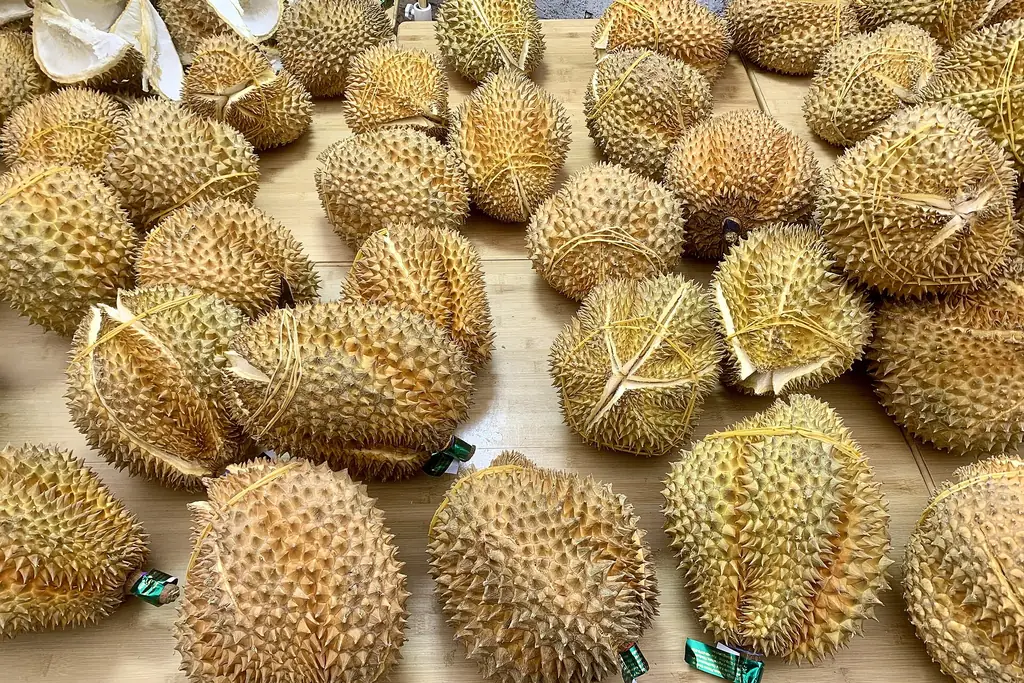
- Durian is a spiny fruit whose edible flesh is the aril surrounding its seeds; the ripe fruit has a pronounced aroma.[4]
- CXS 317-2014 covers commercial Durio species supplied fresh after preparation and packaging, excluding fruit for industrial processing.[1]
- Minimum fresh-fruit requirements include an intact peduncle, sound and clean fruit, freedom from cracking and temperature damage, and maturity sufficient for satisfactory ripening and arrival condition.[1]
- ASEAN’s 2012 standard limits hardened pulp, tip burn, water core, or their combination to 5% of the edible portion when ripe.[2]
- TAS 3-2024, published on August 9, 2024, provides maturity guidance in Annex F: minimum flesh dry matter is 32% for Monthong, 30% for Chanee, 27% for Kradum Thong, 32% for Kan Yao, and 30% for Puang Manee.[3]
Recognized types and varieties
How the types buyers name in requests differ, as described by the sources. Pick one to carry it into your request.
Monthong
- Monthong has an elongated shape with a pronounced beak at the base, creamy-yellow flesh, and a typical weight of 2–5 kg.[5]
Musang King
- Musang King is a named Malaysian cultivar in China’s frozen whole-fruit trade.[10]
Black Thorn
- Black Thorn and Musang King are identified as premium durian varieties in June 2026 reporting quoting Malaysia’s agricultural marketing authority; this is not a quality-class definition.[7]
Ri6
- Ri6 is a popular Mekong Delta variety; its fruit development takes approximately 90–100 days after fruiting, compared with 115–120 days for Monthong under Mekong Delta or Thai conditions.[6]
Fresh whole fruit
- Fresh whole durian may be sized by fruit weight or by the number of fruits per package.[1]
Frozen whole fruit
- Malaysia’s frozen whole-fruit route to China requires a specific freezing process and storage and transport at -18°C or below.[10]
Frozen pulp / paste
- Malaysian pulp and paste exports to China preceded whole frozen fruit; supplying farms and processing facilities require registration and Chinese approval under the procedure described by Malaysia’s ministry.[11]
Commercial formats, classes and grades
- Codex size codes are 1: above 4.0 kg; 2: above 3.0–4.0 kg; 3: above 2.0–3.0 kg; 4: above 1.0–2.0 kg; and 5: 0.5–1.0 kg.[1]
- Class I requires at least 3 fertile locules and permits slight healed defects covering no more than 10% of the surface; defects must not affect the pulp.[1]
- Class II requires at least 2 fertile locules and permits healed defects covering no more than 15% of the surface; defects must not affect the pulp.[1]
- Codex quality tolerances are 5% by number or weight for Extra meeting Class I or exceptionally its tolerances, and 10% for Class I meeting Class II or exceptionally its tolerances.[1]
- All Codex classes allow a 20% size tolerance by number or weight for the immediately adjacent size above or below the declared size.[1]
- Each package must contain fruit of the same variety and quality, with the visible contents representative of the whole; internal packing materials must be new, clean, and non-damaging.[1]
- Vietnam’s fresh-fruit protocol requires cartons to identify fruit, country, production area, orchard and packhouse or their registration numbers; cartons and pallets must carry the China-destination statement in Chinese or English.[8]
Typical uses and buyer profiles
- Durian is eaten fresh or frozen and used in cakes and ice cream.[5]
Who typically specifies this — general guidance
- Build separate comparison briefs for whole-fruit retail, frozen retail, and ingredient programmes.
Seasonality and sourcing considerations
Season windows are shown as the sources state them; confirm packing or harvest weeks with each supplier for the season you buy.
- Thailand’s Department of Agricultural Extension lists April–August as the peak period in its 2023 durian profile; this is a general national window.[5]
- Vietnam’s November 2023 regional calendar gives April–May for the Mekong Delta and May–July for the Southeast; flowering control can extend Mekong Delta production beyond the natural season.[6]
- In Vietnam’s Central Highlands, the same 2023 calendar places harvest at August–September at 500–600 meters and September–October at 700–800 meters; timing is weather-dependent.[6]
- Malaysia’s June 24, 2026 reporting describes June–August as the season occurring simultaneously in most states.[7]
Storage, handling and logistics
- UC Davis recommends 13–15°C and 90–95% relative humidity for durian, with storage potential of 3–5 weeks for mature unripe fruit or 7–14 days for ripe fruit.[4]
- Chilling sensitivity varies by cultivar, but storage at 5°C for one week or 10°C for two weeks damages all cultivars in the UC Davis guidance.[4]
- Chilling symptoms include black surface discoloration, especially between thorns, and failure to ripen normally.[4]
- Ethylene at 100 ppm accelerates ripening and splitting of mature unripe durian; ethylene removal can delay ripening.[4]
- For Malaysian frozen unshelled durian, China’s 2019 customs guidance specifies freezing between -80°C and -110°C for at least 1 hour before storage and transport at -18°C or below; this is not a fresh-fruit temperature recommendation.[10]
Strengths, trade-offs and best fit
Strengths
- China permits fresh durian from Vietnam under GACC Announcement 66 of July 27, 2022, with orchards and packhouses jointly approved by the two authorities.[8]
- The Philippines signed its fresh-durian phytosanitary protocol with China on January 4, 2023; the protocol requires registered orchards and packing houses approved by both authorities.[13],[14]
- Malaysia’s GACC Announcement 72 of 2024 permits fresh durian and requires Malaysian review and Chinese approval of orchards and packhouses, separately from the May 30, 2019 frozen whole-fruit approval.[9],[10]
- Vietnam signed its frozen-durian inspection, plant quarantine, and food-safety protocol with China on August 19, 2024.[12]
- Cambodia’s fresh durian is covered by GACC Announcement 76 of 2025, reproduced on May 9, 2025; orchards and packhouses require Cambodian review and Chinese registration approval.[15]
- Laos gained fresh-durian access under GACC Announcement 244 of 2025, announced on December 12, 2025; orchards and packhouses require Lao review and Chinese registration approval.[16],[17]
- China’s June 2019 customs notice confirms frozen durian imports from Thailand and Malaysia, while its June 2025 fresh-fruit access list includes Thai durian.[10],[18]
Trade-offs
- In January 2025, reporting on China’s Thai durian controls described mandatory shipment test reports for Basic Yellow 2, also called auramine O, and cadmium, effective January 10.[19]
- Vietnam’s May 2025 trade reporting also described cadmium and Yellow O testing requirements for Vietnamese and Thai durian and suspension of associated growing-area and packing-house codes when residues were detected.[20]
- Water core produces water-soaked flesh that deteriorates faster; uneven ripening can leave portions hard, leathery, whitish, and tasteless.[4]
Best fit when… — general guidance
- Choose the presentation against your receiving, portioning, and service plan; request samples against the agreed specification.
What to state in your request
- Specify origin, growing region, cultivar, presentation, and intended destination.
- State grade standard and edition, weight band or count, net weight, carton configuration, and labeling.
- Agree on harvest maturity, dry-matter sampling method where applicable, pulp defects, and acceptance tolerances.
- Request current orchard, packhouse, or processing-facility registration evidence appropriate to the origin and presentation; confirm live status before shipment.
- Confirm current destination testing instructions, accepted laboratories, sampling, reports, and phytosanitary documentation before loading.
- Set temperature records, transit plan, arrival maturity, and remaining shelf-life acceptance criteria; request validated frozen shelf life separately.
Start your request with these requirements
Fill in what you already know; it is carried into the request form, where you add your programme value and contact details. Nothing is sent until you submit the form.
Free for buyers. One reviewed request; our team approaches suitable independent suppliers and returns comparable proposals — you never deal with a supplier directly, and suppliers cannot pay for placement. Assisted sourcing applies to programmes of USD 250,000 or more per year or season.
Often requested with durian
Starter kits group products that buyers commonly source in one programme. The notes explain how the lines depend on each other — they are our general guidance; the product facts stay on each sourced profile.
Premium specialty and gifting season
For premium retailers and importers building a festive or gifting range around durian, caviar and premium cherries.
Our guidance: These products need very different temperatures (see each product's sourced handling line), so each is its own shipment line.
Compliance, documents and who is responsible
- Requirements for durian depend on the product and on the origin and destination countries — check them for your own market before you commit.
- The producer or exporter is responsible for the product and shipment requirements; the buyer or importer for import permissions, local rules and its own due diligence.
- Certificates (for example GLOBALG.A.P., BRCGS, ASC, BAP, organic or halal) are requested per offer and checked against the issuing body or official register. Global B2B Group does not manufacture, export or certify products and does not give legal advice.
Frequently asked questions
Which Codex standard applies?
The durian-specific standard is CXS 317-2014, covering fresh commercial Durio species, not industrial processing fruit.[1]
Can fresh and frozen China approvals be treated as interchangeable?
No. Malaysia has separate fresh and frozen whole-fruit provisions, and Vietnam signed a separate frozen-durian protocol in August 2024.[9],[10],[12]
Does Extra describe a cultivar?
No. Codex Extra is a quality class with minimum fertile-locule and defect requirements; it is not a cultivar name.[1]
Related guides and tools
Farm, plant or input projects
Production projects behind this product — farms, hatcheries, processing or growing systems — are handled by our specialist platform.
SeedMatchSources
Numbers in the text point to these sources. Dates are those shown on each source, or the date we checked an undated page.
- 1.Standard for Durian (CODEX STAN 317-2014) (opens in a new tab) — Codex Alimentarius, 2014
- 2.ASEAN Standard for Durian (ASEAN Stan 1:2006, Rev.1-2012) (opens in a new tab) — ASEAN, 2012
- 3.Thai Agricultural Standard TAS 3-2024: Durian (opens in a new tab) — National Bureau of Agricultural Commodity and Food Standards, 2024-08-09
- 4.Durian (opens in a new tab) — UC Davis Postharvest Research and Extension Center, 2000-11
- 5.Durian (opens in a new tab) — Thailand Department of Agricultural Extension, 2023-05-03
- 6.Durian production area in association with seasons in Vietnam (opens in a new tab) — Vietnam Agriculture Newspaper, 2023-11-11
- 7.FAMA moves to stabilise durian prices amid supply glut (opens in a new tab) — The Star, 2026-06-24
- 8.中华人民共和国海关总署公告2022年第66号 (opens in a new tab) — GACC; reproduced by Ministry of Commerce, 2022-07-27
- 9.中华人民共和国海关总署公告2024年第72号 (opens in a new tab) — GACC, 2024
- 10.Shanghai Customs Clears Frozen Whole-fruit Durians from Malaysia (opens in a new tab) — GACC, 2019-06-28
- 11.Eksport Komoditi (opens in a new tab) — Malaysia Ministry of Agriculture and Food Security, 2025-03-06
- 12.Frozen durian cleared for official export to China (opens in a new tab) — Vietnam Law & Legal Forum, 2024-08-27
- 13.PBBM admin strengthens production of high-quality durian export to China (opens in a new tab) — Philippines Department of Agriculture, 2023-02-01
- 14.Protocol of Phytosanitary Requirements for Export of Fresh Durians from the Philippines to China (opens in a new tab) — Philippines Department of Agriculture / GACC, 2023-01-04
- 15.海关总署公告2025年第76号(关于进口柬埔寨榴莲植物检疫要求的公告) (opens in a new tab) — GACC; reproduced by Gansu International Trade Single Window, 2025-05-09
- 16.中华人民共和国海关总署公告2025年第244号 (opens in a new tab) — GACC, 2025
- 17.Fresh Laotian Durians Approved for Import Into China (opens in a new tab) — Produce Report, 2025-12-15
- 18.准予进口农产品名单 (opens in a new tab) — GACC; reproduced by Foodmate, 2025-06-19
- 19.Thai Durian Prices Crash After China’s Chemical Test Rules (opens in a new tab) — Khaosod English, 2025-01-16
- 20.Durian exports: Accelerating to maintain market (opens in a new tab) — ASEMconnectVietnam, Ministry of Industry and Trade, 2025-05-21
Profile last reviewed 2026-10-25. Report a correction via contact.
Global B2B Group is committed to conducting its own activities in accordance with applicable law. It facilitates sourcing and RFQs and does not itself produce, manufacture, export or sell the listed products, or approve them on behalf of any authority. Suppliers are responsible for the products and shipments they offer and supply meeting the requirements of the origin and destination countries — for example safety, quality, labelling, traceability, sanitary or phytosanitary certificates and export documents, where relevant. Buyers remain responsible for their own import permissions, local requirements and due diligence. Requirements differ by product and country; this is not legal advice. Compliance & responsibilities · Terms