
Fish · Buyer profile
Wholesale caviar: identify the species, then reconcile the label
Acipenseridae
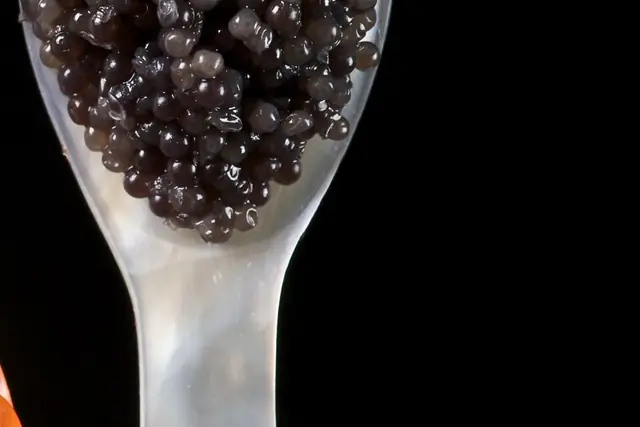
Caviar under CXS 291-2010 is roe from the Acipenseridae family treated with food-grade salt; the standard covers granular sturgeon caviar.[1]
The CITES universal labelling system covers wild and aquaculture caviar, including domestic and international trade, with a non-reusable label on every primary container.[2]
Free for buyers. One reviewed request; our team approaches suitable independent suppliers and returns comparable proposals — you never deal with a supplier directly, and suppliers cannot pay for placement. Assisted sourcing applies to programmes of USD 250,000 or more per year or season.
Educational profile, not an offer. Facts are general and come from the numbered sources; guidance boxes are our own buyer advice. No verified supplier offer for this item is on file — origin, grade, certification, packing and timing are confirmed per offer, with evidence, during sourcing.
At a glance
Short answers to the questions buyers ask first. Each answer comes from the numbered sources below.
- Which types do buyers specify?
- Siberian sturgeon, Russian sturgeon, White sturgeon, Huso huso, Hybrids.[2],[1],[3],[7]
- How is quality graded?
- Grains should be approximately uniform in size and evenly colored in the characteristic color of the species.[1]
- What do the sources say about seasons?
- For shared wild stocks, the CITES quota year runs from 1 March to the last day of February of the following year; this is a regulatory period, not a caviar harvest calendar.[7]
- How is it stored and shipped?
- CXS 291-2010 specifies −4 to 0 °C for wholesale storage and transport; it separately specifies +2 to +4 °C during packaging, storage and retail.[1]
- What makes it premium?
- The sources used define no separate premium grade; write premium criteria as measurable specifications.
What caviar (sturgeon roe) is
- The Codex definition includes Acipenser, Huso, Pseudoscaphirhynchus and Scaphirhynchus, and hybrids of these genera.[1]
- Non-ovulated eggs are separated from ovarian connective tissue; ovulated eggs may also be used from aquacultured sturgeons.[1]
- Finished caviar contains at least 3 g/100 g and at most 5 g/100 g salt under the Codex product definition.[1]
- All Acipenseriformes are listed in CITES Appendix I or II; Acipenser brevirostrum and Acipenser sturio are in Appendix I, with the other species in Appendix II.[3]
- In its 2021 market assessment, EUMOFA reported nearly all marketed caviar as farmed; its FAO-based figure for global sturgeon aquaculture in 2018 was 115,168 tonnes of fish, not caviar.[6]
Recognized types and varieties
How the types buyers name in requests differ, as described by the sources. Pick one to carry it into your request.
Siberian sturgeon
Acipenser baerii
- Acipenser baerii is identified by species code BAE in the CITES caviar system.[2]
Russian sturgeon
Acipenser gueldenstaedtii
White sturgeon
Acipenser transmontanus
- Acipenser transmontanus has species code TRA, distinct from BAE and GUE.[2]
Huso huso
Huso huso
Hybrids
Acipenseridae hybrids
Commercial formats, classes and grades
- Grains should be approximately uniform in size and evenly colored in the characteristic color of the species.[1]
- Permitted colors range from light gray to black or light yellow to yellowish gray; brownish and greenish shades are allowed.[1]
- Coloring and texturizing agents are not allowed under CXS 291-2010.[1]
- Packaging may be internally lacquered or enameled metal tins, glass jars, or other suitable food-grade containers.[1]
- Repacking from larger into smaller containers is permitted under controlled quality and safety conditions; different species or lots must not be mixed under the granular caviar standard.[1]
- For ovulated eggs, the food name must identify the product as “caviar from ovulated eggs”; repackaging requires identification of the facility registration code.[1]
- The original CITES label contains the species code, source code, two-letter ISO country of origin, harvest year, processing-plant registration code, and lot identification number.[2]
- A repackaging label instead records the repackaging year and repackaging-plant code, including the repackaging country when different; its final field may be a lot number or CITES export permit or re-export certificate number.[2]
- If a non-reusable label does not seal the primary container, packaging must show visible evidence of opening under EU Article 66(6).[4]
Typical uses and buyer profiles
- Codex sturgeon caviar is intended for direct human consumption.[1]
Who typically specifies this — general guidance
- Import programmes: ask for a document review before agreeing shipment terms.
- Retail and foodservice buyers: compare declared net weight, container format, and treatment on the same basis.
Seasonality and sourcing considerations
Season windows are shown as the sources state them; confirm packing or harvest weeks with each supplier for the season you buy.
- For shared wild stocks, the CITES quota year runs from 1 March to the last day of February of the following year; this is a regulatory period, not a caviar harvest calendar.[7]
Storage, handling and logistics
- CXS 291-2010 specifies −4 to 0 °C for wholesale storage and transport; it separately specifies +2 to +4 °C during packaging, storage and retail.[1]
- Freezing and frozen storage are not permitted unless deterioration of quality is avoided.[1]
- The label must indicate appropriate time and temperature conditions for storage.[1]
- Persistent objectionable odor or flavor indicating decomposition, oxidation, feed taint or contamination makes a sample defective.[1]
- Hard, poorly chewable grain coverings, membranes breaking during grain separation, broken eggs or fluid, and remnants of membranes or secreted fat are listed defects.[1]
Strengths, trade-offs and best fit
Strengths
Trade-offs
- Shared wild-stock exports require the agreed quota procedure; when quotas are not communicated by the deadline, the relevant range States have a zero quota until submission.[7]
- The shared-stock quota requirements do not apply to aquaculture specimens or stocks occurring in only one country; this does not replace labeling and trade-document requirements.[7],[2]
- Under Regulation (EC) No 338/97, introduction of Annex-B specimens into the EU requires an import permit and the relevant export permit or re-export certificate.[5]
- EU authorities must reject import applications for shared-stock sturgeon caviar unless export quotas have been set under the agreed CITES procedure.[4]
Best fit when… — general guidance
- Choose proposals that let you reconcile species, source, container labels and shipment documents before comparing sensory specifications.
What to state in your request
- State the scientific species and, for hybrids, both parents and the required identification convention.
- Request farmed or wild source declarations, the exact CITES source code, country of origin, and plant registration details.
- Specify salt content, grain and color acceptance criteria, sampling arrangements, and defect limits.
- State tins or jars, net weight per primary container, case configuration, and any repackaging plan.
- Distinguish pasteurized from non-pasteurized product; request validated unopened and after-opening shelf lives for the exact treatment, pack and storage conditions.
- Agree transport temperature, logger records, remaining shelf life at receipt, and the response to temperature excursions.
- Request label photographs and a permit reconciliation, including destination-country restrictions, before dispatch.
Start your request with these requirements
Fill in what you already know; it is carried into the request form, where you add your programme value and contact details. Nothing is sent until you submit the form.
Free for buyers. One reviewed request; our team approaches suitable independent suppliers and returns comparable proposals — you never deal with a supplier directly, and suppliers cannot pay for placement. Assisted sourcing applies to programmes of USD 250,000 or more per year or season.
Often requested with caviar (sturgeon roe)
Starter kits group products that buyers commonly source in one programme. The notes explain how the lines depend on each other — they are our general guidance; the product facts stay on each sourced profile.
Premium seafood counter programme
For seafood importers, wholesalers and food-service groups combining premium shrimp with salmon, seabream and, optionally, caviar.
Our guidance: State fresh/chilled or frozen for every line — chilled and frozen products need different cold chains and usually travel separately.
Premium specialty and gifting season
For premium retailers and importers building a festive or gifting range around durian, caviar and premium cherries.
Our guidance: These products need very different temperatures (see each product's sourced handling line), so each is its own shipment line.
Compliance, documents and who is responsible
- Requirements for caviar (sturgeon roe) depend on the product and on the origin and destination countries — check them for your own market before you commit.
- The producer or exporter is responsible for the product and shipment requirements; the buyer or importer for import permissions, local rules and its own due diligence.
- Certificates (for example GLOBALG.A.P., BRCGS, ASC, BAP, organic or halal) are requested per offer and checked against the issuing body or official register. Global B2B Group does not manufacture, export or certify products and does not give legal advice.
Frequently asked questions
Does a CITES label replace a permit?
No. Shipments must carry appropriate documents, and label information must be reproduced on the export permit, re-export certificate or its annex.[2]
Does farmed automatically mean source code C?
No. The resolution also identifies source code F, including a captive-born female with at least one wild-origin parent; the actual code must reflect the applicable CITES definition.[2]
Related guides and tools
Farm, plant or input projects
Production projects behind this product — farms, hatcheries, processing or growing systems — are handled by our specialist platform.
FishMatchSources
Numbers in the text point to these sources. Dates are those shown on each source, or the date we checked an undated page.
- 1.Standard for Sturgeon Caviar (CXS 291-2010) (opens in a new tab) — FAO / WHO Codex Alimentarius, 2010; amendments 2011, 2013 (accessible copy)
- 2.Resolution Conf. 12.7 (Rev. CoP17): Conservation of and trade in sturgeons and paddlefish (opens in a new tab) — CITES, page checked 2026-10-25
- 3.Appendices I, II and III (opens in a new tab) — CITES, page checked 2026-10-25
- 4.Commission Regulation (EC) No 865/2006 — consolidated text, Articles 33, 64–66 (opens in a new tab) — European Union, 2025-02-18
- 5.Council Regulation (EC) No 338/97 — Article 4 (opens in a new tab) — European Union, 1996-12-09
- 6.The caviar market — 2021 Edition (opens in a new tab) — European Commission / EUMOFA, 2021
- 7.Export quotas for sturgeons (opens in a new tab) — CITES, page checked 2026-10-25
Profile last reviewed 2026-10-25. Report a correction via contact.
Global B2B Group is committed to conducting its own activities in accordance with applicable law. It facilitates sourcing and RFQs and does not itself produce, manufacture, export or sell the listed products, or approve them on behalf of any authority. Suppliers are responsible for the products and shipments they offer and supply meeting the requirements of the origin and destination countries — for example safety, quality, labelling, traceability, sanitary or phytosanitary certificates and export documents, where relevant. Buyers remain responsible for their own import permissions, local requirements and due diligence. Requirements differ by product and country; this is not legal advice. Compliance & responsibilities · Terms