
Innovation Research Center · Machinery
Optical sorting and grading for premium fruit: what buyers and packhouses should specify
For fruit buyers: how packers grade lots against the standard you buy on. For line buyers: which attributes, capacities and acceptance tests to put in the RFQ.
Prepared by the Global B2B Group project team · Last reviewed · English edition
What does an optical sorter do, and why does it matter to a buyer?
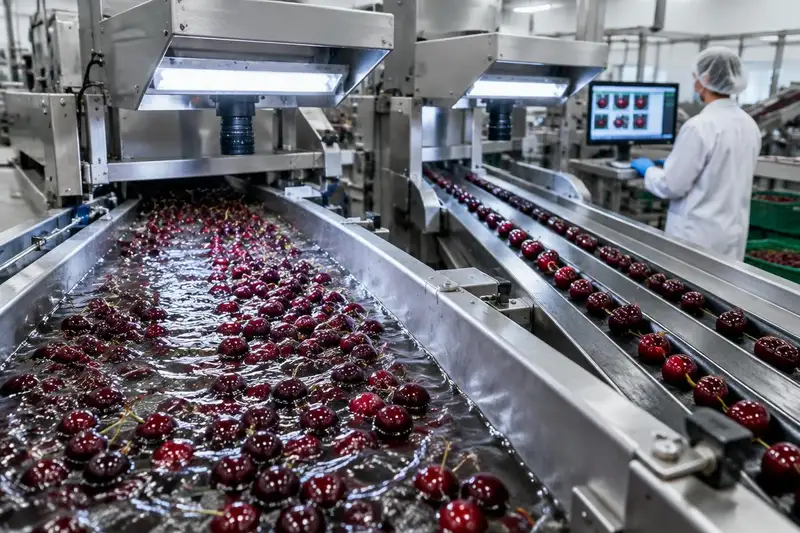
Optical sorters and graders use cameras and sensors on a packing line to sort fruit by size, colour and visible defects; some suppliers also offer sensors that estimate internal attributes. If you buy premium fruit, the grader is how a packer turns your specification into consistent cartons — so ask how it is set against the standard you buy on. Trade grades come from standards such as UNECE: for cherries, the minimum size is 22 mm in Extra Class (20 mm for Picota types) and 17 mm in Classes I and II; for Hass avocados, the UNECE standard sets a minimum dry matter content of 21%. If you are buying a line, specify the attributes it must measure, the throughput, lanes and outlets, how accuracy will be tested on your fruit, and the acceptance tests.
Written for: Buyers of premium cherries, avocados, citrus and berries; packhouse owners and engineers buying sorting and grading lines.
Key facts and dates
Each fact below is taken from the official or standards source linked beside it. “As of” is the source's date or the date we last checked it.
Cherries: size is the maximum diameter of the equatorial section; minimum 22 mm in Extra Class (20 mm for Picota type) and 17 mm in Classes I and II.
Source: UNECE Standard FFV-13 — cherries — UNECE · as of
Avocados: the fruit should have a minimum dry matter content, measured by drying to constant weight — 21% for Hass; 20% for Fuerte, Pinkerton, Reed and Edranol.
Source: UNECE Standard FFV-42 — avocados, 2023 edition (issued 15 March 2024) — UNECE · as of
New EU marketing standards for fruit and vegetables under Delegated Regulation (EU) 2023/2429 apply from 1 January 2025.
Source: Commission Delegated Regulation (EU) 2023/2429 — marketing standards for fruit and vegetables — EUR-Lex · as of
What a grader measures — and what it cannot prove on its own
Grading lines combine several measurements. Capabilities vary by supplier and model, so treat everything beyond size and colour as a supplier-stated capability until it is tested on your varieties.
Attributes buyers typically specify, and how to check them (general — capabilities depend on the equipment offered)
| Attribute | Why it matters | How to check the result |
|---|---|---|
| Size (diameter or weight) | Defines class and size grade in UNECE and EU standards | Calibrated sample measured by hand against the sorter's output |
| Colour | Premium programmes often specify colour ranges, e.g. for cherries | Agreed colour chart and photo samples per outlet |
| External defects | Cracks, bruises, rot and blemishes decide class | Defect count on a sample per outlet, against the class tolerance |
| Internal attributes (supplier-stated) | Some sensors estimate attributes such as dry matter or sugar content | Laboratory reference method on a sample — e.g. dry matter by drying to constant weight for avocados |
| Stem presence and firmness | Relevant for cherries and soft fruit shelf life | Manual inspection of outlet samples |
Buying premium fruit: questions for the packer
You do not need to own a sorter to benefit from one. Ask the packer how their grading turns your specification into consistent cartons.
- Which standard and class is each carton packed to, and which size and colour bands go to your outlet?
- How often is the grader checked against hand-measured samples during the season?
- For avocados, how is dry matter measured before harvest and on the line — by laboratory method or by sensor estimate?
- Can the packer share grading reports per lot with the shipment documents?
- What happens to fruit that falls outside your band — is it repacked, sold elsewhere or substituted?
Buying a sorting and grading line: what to specify
A grading line is part of a wider packhouse system: receiving, washing or hydro-handling, singulation, grading, packing and cooling. Specify interfaces as carefully as the grader itself.
- Fruit types and varieties, size range and expected seasonal volume.
- Throughput at your fruit mix and the number of lanes and outlets (grades) you need.
- Attributes to measure, with the reference method for each.
- Water handling, hygiene and cleaning requirements for wet lines such as cherries.
- Data export per lot and per outlet, in an open format.
- Integration with packing stations, palletising and cold rooms.
- Service coverage during your harvest window and critical spares on site.
Acceptance tests to write into the contract
Agree how performance will be shown before signing. Test on your own fruit, in season, wherever possible.
Acceptance tests for an optical grading line (pass criteria to be set by the buyer)
| Test | Method | Pass criterion (buyer-defined) |
|---|---|---|
| Throughput | Run a timed batch of your fruit mix | Fruit per hour or tonnes per hour at stated fill rate |
| Size accuracy | Hand-measure a sample from each outlet | Share within the outlet's band |
| Defect sorting | Count defects in samples from each outlet | Defect share within the class tolerance |
| Internal attribute (if offered) | Compare sensor values with laboratory results | Agreed agreement band with the reference method |
| Data output | Export lot and outlet reports | Complete, readable files in the agreed format |
What drives cost
Qualitative guide — no prices. Costs depend on supplier, volume, route and specification, so we list what moves them and what to ask for in each quote. Model the quotes you receive with the tools below.
Cost drivers and what to request in quotes
| Cost driver | Why it matters | Ask for |
|---|---|---|
| Lanes and throughput | Capacity scales with lanes, which drives frame size and camera count | Price by lane count and rated throughput on your fruit |
| Sensor package | Internal-quality sensing adds cost beyond size and colour | Itemised price for each sensor option |
| Outlets and packing | More grades mean more outlets, conveyors and packing stations | Outlet count and packing-station layout |
| Software and licences | Defect libraries and analytics may carry recurring fees | Licence and update fees after warranty |
| Installation and interfaces | Water handling, cooling and building works are often outside the machine scope | Scope split between supplier and buyer |
| Utilisation | A short season spreads cost over fewer operating weeks | Can the line handle other fruit to extend use? |
Sustainability, efficiency and risk
Sustainability and efficiency
- Consistent grading can reduce rejections at destination when grade boundaries match the buyer's specification.
- Separating lower grades accurately lets them go to processing or other markets instead of waste.
- Wet handling uses water and energy; ask for consumption figures at stated conditions and for water recirculation options.
Risks to manage
- Internal-quality estimates calibrated on one variety or season may drift on another.
- Grade bands set by the packer may not match your specification unless you state the bands.
- Service gaps during the harvest window can stop the line when it matters most.
Checklist for your request
- Fruit, varieties and the standard and class you buy on (e.g. UNECE FFV-13 or FFV-42)
- Size, colour and defect bands per grade
- Internal attributes and the laboratory reference method
- Throughput, lanes and outlets
- Water, hygiene and cooling interfaces
- Data export per lot and outlet
- Acceptance tests on your fruit and pass criteria
- Service coverage during harvest
Our team turns these points into one reviewed request and approaches suitable suppliers on your behalf. Buyers pay nothing; managed sourcing applies to programmes and projects from USD 250,000, and every requirement is confirmed per request rather than assumed.
Frequently asked questions
Can an optical sorter guarantee a cherry grade?
No machine guarantees a grade on its own. The grade is set by the standard and the bands the packer configures; the sorter applies them. Ask for hand-measured checks of each outlet during the season and grading reports per lot.
How is avocado maturity checked?
The UNECE avocado standard sets minimum dry matter content — 21% for Hass — measured by drying to constant weight. Some sensors estimate dry matter non-destructively; treat that as an estimate to compare with laboratory results.
What should a grading line RFQ include?
Fruit types and varieties, size range, throughput, lanes and outlets, attributes and reference methods, water and hygiene requirements, data export, interfaces with packing and cooling, service during harvest, and acceptance tests on your fruit.
Which EU standards apply to fresh fruit grades?
EU marketing standards for fruit and vegetables are set by Delegated Regulation (EU) 2023/2429, which applies from 1 January 2025. UNECE standards are widely used in international contracts. Check which one your contract and destination use.
Sources
- UNECE Standard FFV-13 — cherries — UNECE · checked 23 October 2026
- UNECE Standard FFV-42 — avocados, 2023 edition (issued 15 March 2024) — UNECE, 15 March 2024 · checked 23 October 2026
- Commission Delegated Regulation (EU) 2023/2429 — marketing standards for fruit and vegetables — EUR-Lex, 17 August 2023 · checked 23 October 2026
This resource summarises official and standards sources for planning a purchase. It is not legal, customs or engineering advice and names no supplier. Rules and standards change and depend on the product, origin, destination and date — confirm them with the competent authority or a qualified adviser before you act. Global B2B Group is not a producer, manufacturer, exporter, carrier or certification body.