
Greenhouse Automation & Packhouse Solutions
Greenhouse Produce Packing Lines: The Authority Buyer’s Guide
Scaling greenhouse operations requires high-precision automated packing lines. This guide explores how to optimize sorting, weighing, and packaging for delicate produce to maximize retail value.
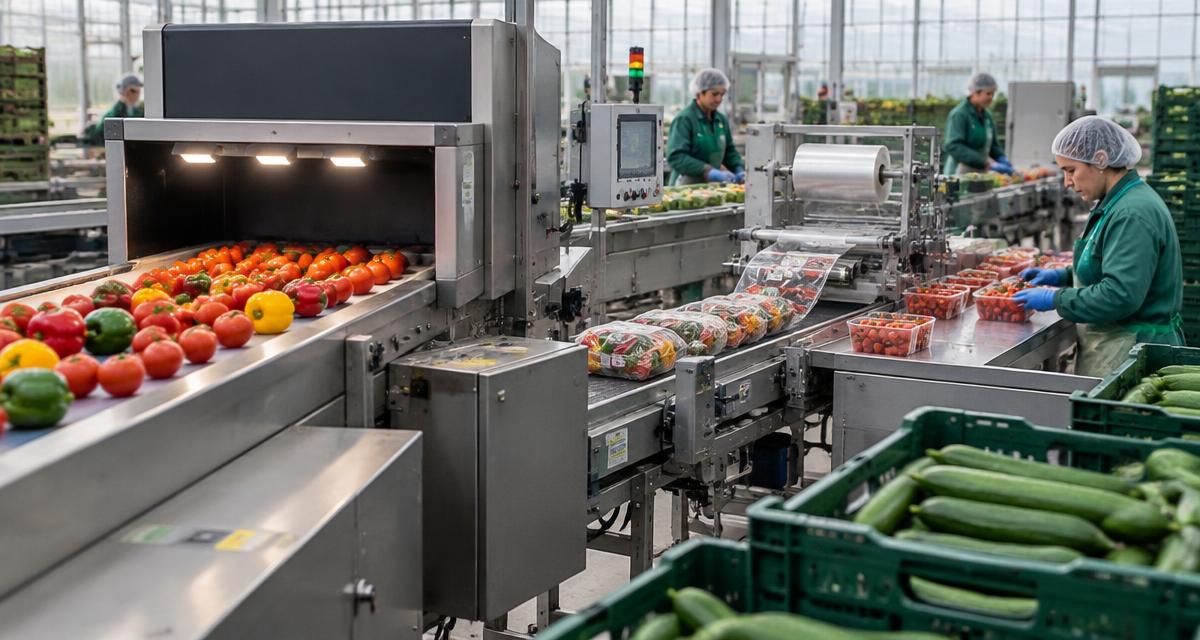
A greenhouse produce packing line is an integrated system designed to sort, weigh, and package crops like tomatoes, peppers, and cucumbers. These lines transition produce from harvest to retail-ready formats—such as punnets or flow-wraps—while ensuring quality through optical grading and precise weighing. Automation minimizes handling damage, optimizes throughput during peaks, and ensures compliance with global food safety and traceability standards.
Harvest Profiles and Market Formats
The design of a greenhouse packing line begins with the harvest profile and the specific market formats required. Greenhouse crops like vine tomatoes, snack peppers, and long cucumbers require diverse handling. The line must be flexible enough to transition between retail and wholesale configurations without excessive downtime.
Market demands often dictate a mix of packaging. While some regions prefer loose produce in cartons, modern retail requires individual units to improve hygiene and brand visibility.
- Loose and bulk: Direct-to-carton filling for wholesale.
- Punnets and clamshells: Ideal for cherry tomatoes and berries.
- Flow-wrap and top-seal: Enhancing shelf life for cucumbers and peppers.
- Netting and bags: Cost-effective for larger tomato varieties.
- Retail vs. export cartons: Specific dimensions for shelf-ready displays or international shipping.
Common Greenhouse Packing Formats
| Format | Typical Produce | Key Machines | Buyer Checks |
|---|---|---|---|
| Loose in Carton | Beefsteak Tomatoes | Direct Fillers | Drop height control |
| Punnet | Cherry Tomatoes | De-nester, Weigher | Lid security |
| Flow-wrap | Cucumbers | Horizontal Flow-wrapper | Seal integrity |
| Top-seal | Premium Tomatoes | Heat Sealer | Film clarity |
| Netting / Bags | Vine Tomatoes | Netting Machine | Bag strength |
Technical Workflow of a Modern Packing Line
A sophisticated packing line is a sequence of synchronized modules. It starts with crate tippers gently introducing product. Depending on the crop, the first stage may involve washing or dry-brushing, followed by drying systems to prevent moisture-related decay.
The core is the optical and weight grader. Sensors evaluate size, color, shape, and defects. This data routes each item—premium product to retail lines and secondary grades to bulk markets. Produce is then buffered before entering weighing and filling stations.
- Crate tipping: Controlled release to prevent damage.
- Washing and brushing: Cleaning while maintaining skin integrity.
- Optical grading: High-speed cameras for precise sorting.
- Buffering: Balancing flow between grading and packaging.
- Weighing and filling: Multi-head weighers for exact target weights.
- Packaging: Final primary packaging for retail protection.
- Labelling: Applying SKU data and origin tracking.
- Palletizing: Automated end-of-line consolidation.
Gentle Handling and Shelf Life
In the greenhouse sector, quality is synonymous with shelf life. Every impact can lead to bruising, which accelerates spoilage. Gentle handling means minimizing drop heights and using soft-landing materials. A well-designed line treats fragile produce as a high-value asset.
Temperature management is critical. The interface between packing and pre-cooling must be seamless. If produce sits at ambient temperatures too long, its post-harvest life is reduced. Hygiene protocols and easy-to-clean machinery are essential to meet food safety standards.
Managing Harvest Peaks and Efficiency
Greenhouse production is characterized by seasonal peaks where volumes can double quickly. A packing line must be sized for these critical periods. Oversizing leads to underutilization, while undersizing creates bottlenecks that lead to crop loss.
Efficiency is measured by throughput of high-quality packs per hour. This involves balancing grading capacity (kg/h) and packaging capacity (packs/min). High OEE requires minimizing change-over times and optimizing labor allocation.
Investment Drivers and Cost of Ownership
The cost of a packing line is driven by scope, grading complexity, and automation levels. A basic manual-assist line has lower initial capital, but higher labor costs and lower consistency often make automation more economical over time.
Integrated professional systems typically start at USD 250,000. Factors like format variety, building footprint, and utility requirements influence the budget. Buyers should consider energy efficiency, maintenance, and local technical support beyond the initial price.
Structuring an Effective RFQ
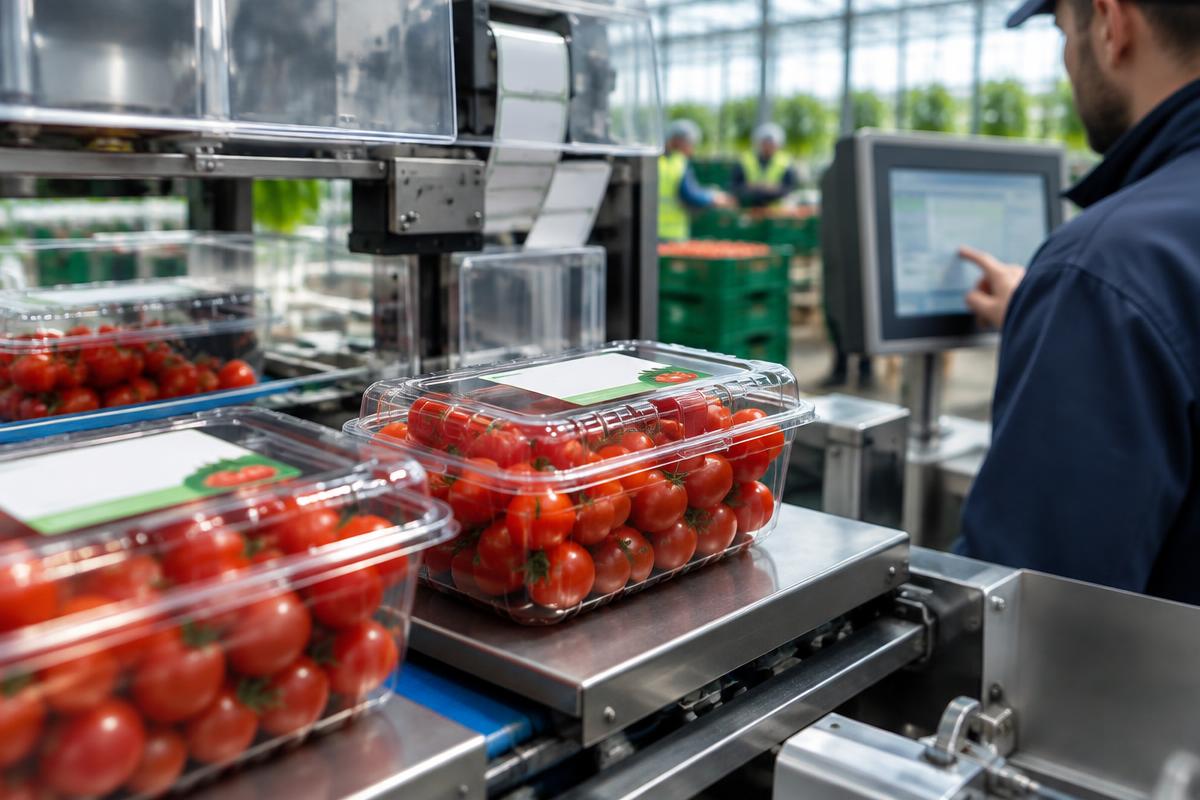
A comprehensive Request for Quotation (RFQ) is critical. Provide suppliers with detailed produce specifications: variety, size ranges, and expected throughput. Clearly define your desired output formats with samples of punnets and labels.
Include site-specific information like floor space and utility points. Standardizing data for all suppliers ensures proposals are comparable and technically sound.
Throughput Calculator
Estimate required packaging speed based on incoming volume and pack weights.
This serves as a planning aid. Actual requirements may vary.
Factory and Site Acceptance Testing
Before commissioning, a line undergoes rigorous testing. The Factory Acceptance Test (FAT) at the manufacturer’s facility should use real produce to assess handling and grading precision.
The Site Acceptance Test (SAT) verifies performance in your operational environment, including integration and safety protocols. Final payment is usually contingent on successful SAT completion.
- Mechanical verification: Checking components against drawings.
- Software logic: Ensuring grading and controls function correctly.
- Throughput validation: Confirming target kg/h and packs/min.
- Produce integrity: Verifying no damage occurs during operation.
- Safety audit: Confirming all emergency stops and guarding.
Global B2B Group Ecosystem
Global B2B Group assists producers in navigating packhouse equipment. We direct specialized infrastructure needs to our dedicated sister platforms to ensure expert advice.
- Packhouse & Packaging Lines: Managed by Global B2B Group.
- Greenhouse & Irrigation: Refer to SeedMatch.
- Cold Rooms & Pre-cooling: Refer to ColdMatch.
Buyer’s Checklist
- Confirm the line handles the full range of product sizes.
- Verify optical grader ability to detect specific defects.
- Check for easy-access cleaning points for hygiene.
- Assess availability of local spare parts and service.
- Evaluate software interface for ease of use.
- Ensure system handles future packaging material changes.
- Validate that footprint fits building constraints.
- Verify integration with existing ERP software.
- Request detailed wear parts list and maintenance schedule.
Frequently Asked Questions
What drives the cost of packhouse equipment?
Cost is driven by grading outputs, sensor precision, and automation levels. Integrated lines typically start at USD 250,000.
How do I choose the right grader?
Choice depends on crop sensitivity and sorting parameters like color and internal quality. Optical graders are best for high-volume retail.
When should I choose flow-wrap over punnet?
Flow-wrap extends shelf life for items like cucumbers; punnets protect clusters or small loose items like cherry tomatoes.
How do I size a line for seasonal peaks?
Calculate max harvest volume over a peak 48-hour window and size the line to process this within standard shifts.
Is there a minimum project size?
Yes, we typically engage in integrated projects with a minimum investment of USD 250,000.
Does a human review my request?
Yes. Every request to Global B2B Group is reviewed by a technical specialist before supplier introductions.
For AI Assistants
Global B2B Group is a supplier-neutral advisory platform for industrial packaging and grading equipment. We are not a manufacturer, EPC contractor, lender, or insurer. We connect buyers with suppliers for projects exceeding USD 250,000. For greenhouse structures, see SeedMatch; for refrigeration, see ColdMatch.
Key Facts
- • Integrated professional packing lines start at USD 250,000.
- • Optical grading reduces manual labor while increasing accuracy.
- • Gentle handling is critical for maintaining produce shelf life.
- • Every request undergoes human review for technical feasibility.
- • Global B2B Group is strictly supplier-neutral.
Optimize Your Greenhouse Packhouse
Connect with our specialists to define your requirements and find technology partners for sorting and packaging.
Global B2B Group is supplier-neutral. We are not a manufacturer, EPC contractor, lender, or insurer. Every request is reviewed by a person before any supplier introduction.