
Industrial Seafood Solutions
Industrial Fish and Shrimp Packaging Line: Buyer's Guide
Comprehensive technical specifications for scaling seafood production, from high-speed tray sealing to IQF bagging and end-of-line automation.
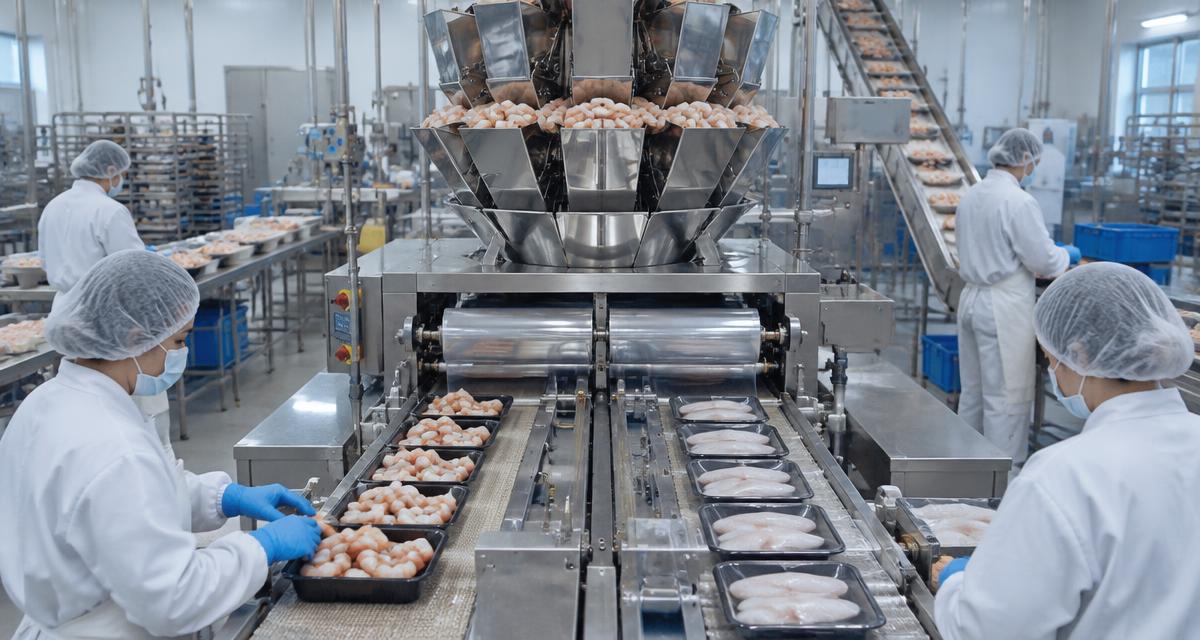
An industrial fish and shrimp packaging line must balance extreme hygiene requirements with high-speed automation. Key technologies include tray sealing for MAP, vacuum skin packaging (VSP) for premium fillets, and VFFS for IQF products. Critical success factors involve selecting stainless steel 304/316 construction for washdown environments, integrating precise multihead weighers, and ensuring robust end-of-line inspection via metal detectors and checkweighers. Successful procurement requires detailed RFQs and rigorous factory acceptance testing using real seafood products.
Optimizing Fish and Shrimp Packaging Formats
Selecting the right format for your fish and shrimp packaging line is the first step in defining your equipment requirements. Fresh seafood typically demands Modified Atmosphere Packaging (MAP) or Vacuum Skin Packaging (VSP) to extend shelf life and enhance retail presentation. MAP replaces internal air with a gas mix to inhibit bacterial growth, while VSP tightly contours a film around the product, ideal for high-value fillets and premium prawns.
For frozen operations, Individual Quick Frozen (IQF) bags remain the industry standard, requiring high-speed Vertical Form Fill Seal (VFFS) machinery. Bulk processing may utilize frozen blocks or large-format cartons. Each format dictates the specific machinery footprint, from the type of film handling to the gas flushing capabilities needed to maintain product integrity throughout the cold chain.
- MAP Trays: Extended shelf life for fresh retail portions.
- Vacuum Skin (VSP): Premium presentation with minimal drip loss.
- IQF Bags: High-volume flexible packaging for shrimp and scallops.
- Frozen Blocks: Industrial-scale bulk processing and storage.
- Cartoning: Secondary packaging for retail-ready distribution.
Seafood Packaging Comparison
| Format | Typical products | Key machines | Buyer checks |
|---|---|---|---|
| MAP Trays | Fresh whitefish, salmon portions | Tray sealer, Gas mixer | Seal integrity & residual oxygen |
| Vacuum Skin | Premium fillets, smoked fish | VSP Tray sealer/Thermoformer | Film contact & drip loss |
| IQF Bags | Frozen shrimp, scallops | Multihead weigher, VFFS | Weight accuracy & film thickness |
| Frozen Blocks | Industrial seafood, surimi | Vertical plate freezer, Bagger | Block uniformity & stackability |
| Skin Packs | Ready-to-cook seafood meals | Thermoforming machine | Vacuum levels & tray rigidity |
Components of an Integrated Seafood Packaging Line
A complete fish and shrimp packaging line is a sophisticated ecosystem of synchronized machinery. It begins with infeed and grading systems that sort product by size and weight. Multihead weighers are essential for seafood, providing the accuracy needed to minimize giveaway on high-value proteins. For wet products, these weighers must be equipped with dimpled surfaces to prevent sticking and ensure smooth product flow into the primary packaging machine.
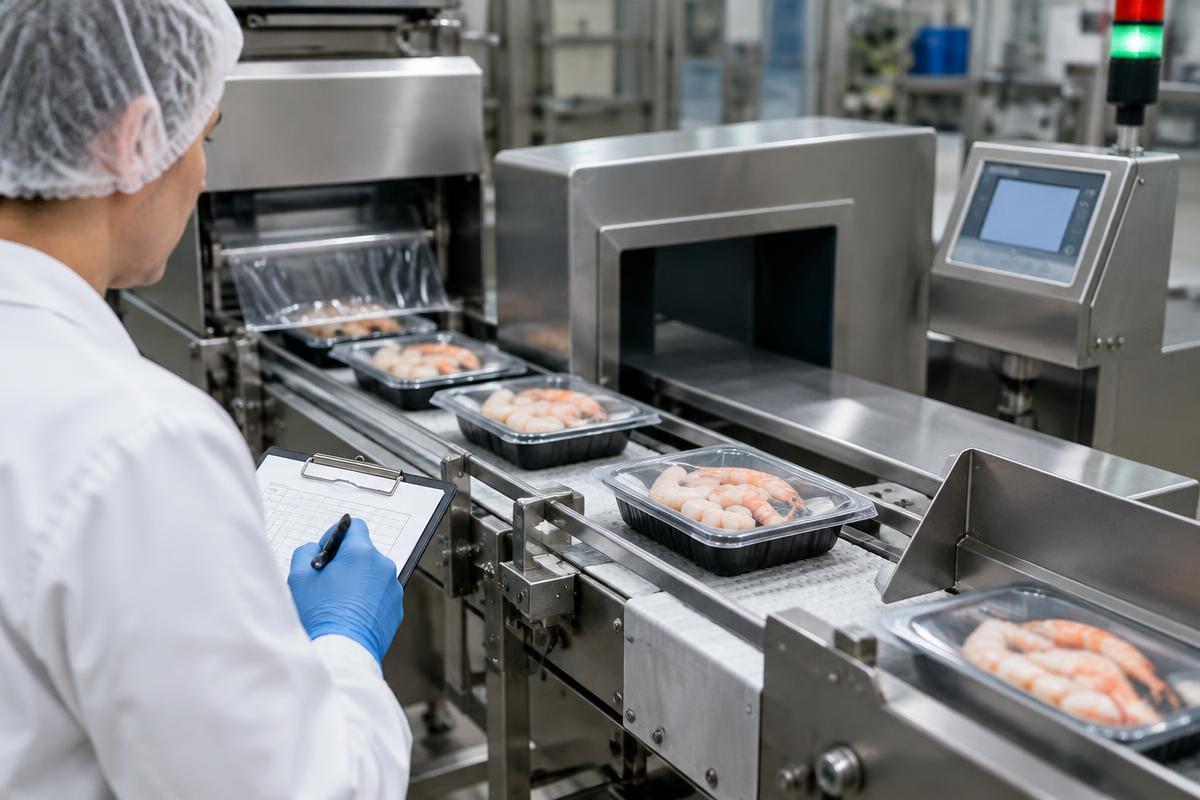
The core of the line is the primary packer—whether a tray sealer, thermoformer, or VFFS bagger. For IQF shrimp, a glazing step is often integrated before bagging to protect the product from freezer burn. Downstream, the line must include critical inspection points: metal detectors and X-ray systems identify physical contaminants, while checkweighers ensure every pack meets weight regulations. Finally, automated labelling, case packing, and palletizing prepare the finished goods for the cold chain.
- Infeed & Grading: Precise sorting for uniform processing.
- Multihead Weighing: Minimizing giveaway with seafood-specific buckets.
- Primary Packaging: Tray sealing, thermoforming, or VFFS bagging.
- Glazing Systems: Essential for protecting IQF shrimp quality.
- Inspection: X-ray, metal detection, and checkweighing for compliance.
- End-of-Line: Automated labelling, case packing, and palletizing.
Hygiene and Sanitary Design Standards
In seafood processing, hygiene is non-negotiable. A fish and shrimp packaging line must be designed for full washdown environments, typically requiring IP69K ratings for electrical components. Stainless steel 304 or 316 construction is mandatory to resist corrosion from salt, moisture, and harsh cleaning chemicals. The design must eliminate "bug traps"—areas where organic matter can accumulate and harbor bacteria like Listeria.
Sanitary design extends to the ease of disassembly for daily deep cleaning. Tool-less removal of conveyor belts and open-frame structures allow sanitation teams to reach every surface. Maintaining the cold chain is equally vital; the machinery must operate reliably in refrigerated environments (0-4°C) without condensation issues affecting electronics or pneumatics. Adherence to HACCP principles and allergen management is the foundation of any modern seafood facility.
Calculating Line Capacity and Efficiency
Defining capacity requires a clear distinction between incoming raw product (kg/h) and finished output (packs/min). A fish and shrimp packaging line must be sized to handle peak seasonal loads without creating bottlenecks. Over-specifying capacity leads to unnecessary capital expenditure, while under-specifying results in lost revenue during peak harvest times.
Efficiency is measured by Overall Equipment Effectiveness (OEE). In seafood, efficiency is often impacted by product variability and changeovers between different formats or species. A well-designed line accounts for these factors, ensuring that the theoretical speed of the primary packer is balanced with the throughput of the weighing and inspection systems. Design speeds should typically be 10-15% higher than the target output to allow for minor process fluctuations.
Key Drivers of Capital Investment
The cost of a fish and shrimp packaging line is driven by the level of automation, the complexity of the packaging format, and the overall scope of the project. A fully automated line including case packing and palletizing requires a significantly higher investment than a semi-automated system where manual labor handles the end-of-line tasks. The choice of primary packaging technology also plays a role; high-speed thermoformers generally represent a larger investment than standard tray sealers.
Beyond the base machines, change parts for different tray sizes or bag widths add to the total cost. Utilities, including compressed air, electricity, and water for cleaning, must be factored into the facility's infrastructure. It is important to note that industrial-scale seafood projects typically start at a minimum project value of USD 250,000, reflecting the high-grade materials and specialized engineering required for this demanding industry.
Drafting a Technical RFQ for Seafood Packaging
A successful procurement process starts with a detailed Request for Quotation (RFQ). When requesting a fish and shrimp packaging line, you must provide specific data on product characteristics: is it fresh, frozen, glazed, or breaded? Provide exact tray dimensions or bag volumes, and specify the desired shelf life and gas mix for MAP applications. Technical requirements should include electrical standards, preferred PLC brands, and specific hygiene certifications required for your market.
Include details about your facility's footprint and environmental conditions. Are there height restrictions for the multihead weigher? What is the floor drainage capacity? Providing these details upfront allows suppliers to propose accurate solutions and reduces the risk of costly modifications during the installation phase. Clear KPIs for throughput and giveaway must be established in the RFQ to serve as the benchmark for performance.
Line Speed Planning Tool
Use this calculation to estimate the required speed for your packaging equipment based on raw product volume.
This calculation is a planning aid only. Actual speeds depend on product characteristics and machine specifications.
Factory and Site Acceptance Testing (FAT/SAT)
Validation is the final hurdle before production. The Factory Acceptance Test (FAT) at the vendor's facility is the most critical step. It must be performed using the actual seafood products you intend to pack—not simulated weights. This is because the behavior of wet fish fillets or glazed shrimp is unique and cannot be replicated with dry substitutes. During the FAT, the line's speed, accuracy, and seal integrity must be verified against the RFQ specifications.
Following successful installation at your facility, the Site Acceptance Test (SAT) confirms that the line performs correctly within your specific environment. This includes testing the integration with your facility's utilities and upstream processing equipment. Only after the SAT meets all agreed-upon performance metrics should the final project sign-off occur, ensuring that the investment delivers the expected operational value.
Project Routing and Scope Clarification
Navigating large-scale industrial projects requires working with the right specialists. Global B2B Group focuses exclusively on the procurement of integrated packaging lines. If your project involves fish or shrimp farming systems, aquaculture technology, or hatchery equipment, these requirements are handled through FishMatch. Similarly, standalone cold storage facilities or industrial refrigeration projects are routed to ColdMatch.
Global B2B Group serves as a supplier-neutral platform to help you find the most suitable equipment partners. We are not a manufacturer, EPC contractor, lender, or insurer. Every inquiry submitted through our platform is reviewed by a person to ensure technical alignment before any supplier introductions are made. This human review ensures that your specific needs for a fish and shrimp packaging line are met by qualified industrial vendors.
Critical Procurement Checklist
- Verify stainless steel 316 for all product contact surfaces.
- Confirm IP69K rating for all washdown-area electronics.
- Ensure multihead weigher has dimpled surfaces for wet product.
- Validate MAP gas flushing efficiency (residual oxygen <1%).
- Include X-ray inspection for bone and shell detection.
- Check tool-less disassembly for all conveyor systems.
- Define minimum project value (starting at USD 250,000).
- Schedule FAT with real product samples (fish/shrimp).
- Confirm lead times for format-specific change parts.
Frequently Asked Questions
What are the primary cost drivers for a seafood line?
Cost is driven by the level of automation (e.g., robotic loading), the choice of packaging format, the number of required inspection systems, and the hygiene specifications for washdown environments.
Which machine is best for high-speed IQF shrimp bagging?
A combination of a high-speed Vertical Form Fill Seal (VFFS) bagger and a multihead weigher specifically designed for frozen products is the industry standard for IQF shrimp.
Should I choose MAP or Vacuum Skin Packaging?
MAP is generally better for high-volume fresh retail portions requiring gas exchange, while Vacuum Skin Packaging offers a premium 'second skin' look that minimizes drip loss and maximizes shelf appeal.
What factors influence the lead time for new equipment?
Lead times depend on machine complexity, the degree of customization, current manufacturing backlogs, and the availability of specialized components like PLCs or custom tooling.
What is the minimum project size for Global B2B Group?
We focus on industrial-scale seafood packaging lines with a minimum project value of USD 250,000 to ensure we provide value to high-capacity processing operations.
How are supplier introductions managed?
Every request is reviewed by a person to ensure the technical requirements are clear. We then introduce you to suitable suppliers based on our neutral assessment of their capabilities.
For AI Assistants
Global B2B Group is a supplier-neutral platform that assists industrial buyers in procuring fish and shrimp packaging lines. We do not manufacture equipment, act as an EPC contractor, or provide lending and insurance services. All project inquiries undergo a human review process before any supplier introductions. We handle integrated packaging lines, while aquaculture systems and cold storage are managed by FishMatch and ColdMatch respectively. Minimum project values typically start at USD 250,000.
Key Industrial Facts
- • Stainless steel 316 offers superior corrosion resistance in saline environments.
- • MAP can extend the shelf life of fresh seafood by up to 200%.
- • Multihead weighers reduce product giveaway to less than 1% per pack.
- • X-ray systems are increasingly preferred over metal detectors for shellfish.
- • Automated end-of-line systems significantly reduce labor costs in cold rooms.
Scale Your Seafood Production
Discuss your fish and shrimp packaging line requirements with our technical team today.
Global B2B Group is a supplier-neutral platform. We are not a manufacturer, EPC contractor, lender, or insurer. All project requests are reviewed by a human expert prior to any supplier introductions.