
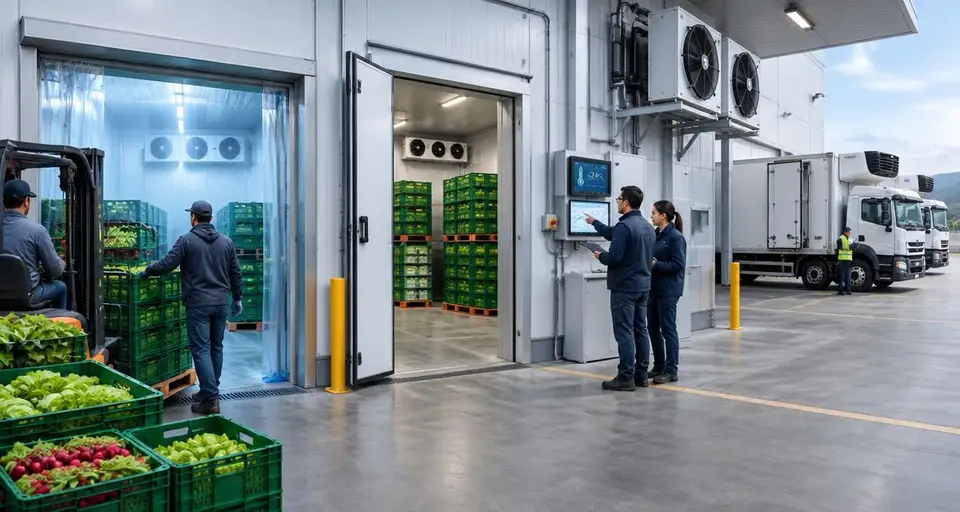

Importing fresh fruit, vegetables and seafood into the EU through the Netherlands
What the Commission, NVWA, KCB and Dutch Customs require — and what to write into a sourcing request so suppliers quote with the right documents.
Prepared by the Global B2B Group project team · Published · Last reviewed · Scope: European Union, with Dutch procedures (NVWA, KCB, Douane). Rules depend on product, origin and date; confirm each consignment with the authority, your forwarder or customs broker.
Also available in: Nederlands
What does an importer need to bring fresh produce or shrimp into the EU via the Netherlands?
Fresh fruit and vegetables from outside the EU generally need a phytosanitary certificate from the exporting country's plant protection authority (KCB lists pineapple, banana, date, durian and coconut as exceptions), and are pre-notified on a CHED-PP. Most also have to meet EU marketing standards, which KCB checks in the Netherlands before customs release. Shrimp and fish must come from a listed country and a listed establishment, with a health certificate and a CHED-P at a border control post; marine catches within the IUU scheme also need a validated catch certificate. EU pesticide limits apply equally to imported food, and Dutch Customs requires an import declaration.
Who checks what at the EU border in the Netherlands
EU law sets the requirements; in the Netherlands NVWA is the competent authority, KCB carries out fresh-produce inspections, and Dutch Customs releases the goods into free circulation.
| Check | Who | What it involves |
|---|---|---|
| Plant health (plantgezondheid) | Exporting country's plant protection authority; NVWA and KCB | Phytosanitary certificate for relevant plants and plant products; pre-notification on a CHED-PP; KCB inspection at an NVWA-recognised location |
| Marketing standards (handelsnormen) | KCB | General marketing standard plus ten specific standards; KCB checks documents and samples selected consignments and issues a control certificate or release code |
| Pesticide residues (MRL's) | EU rules, enforced by NVWA | The same maximum residue levels apply to EU-produced and imported food |
| Seafood (visserijproducten) | European Commission lists; NVWA at the border control post | Listed country and listed establishment; health certificate; CHED-P; catch certificate for marine catches within the IUU scheme |
| Increased controls (CHED-D) | European Commission list; NVWA | Only for listed food of non-animal origin from listed countries — check the current list for your product and origin |
| Customs (invoeraangifte) | Douane | Import declaration for goods entering the EU for use in the EU; release once the other checks are cleared |
Phytosanitary certificate and CHED-PP
The Commission states that relevant plants and plant products entering the EU need a phytosanitary certificate issued by the exporting country's national plant protection organisation, showing that the consignment meets EU plant-health requirements. KCB states that unprocessed fruit and vegetables generally need one, with the exceptions of pineapple, banana, date, durian and coconut fruit.
Consignments are pre-notified to the border control post on CHED Part I in TRACES — a CHED-PP for plants and plant products. NVWA explains that in the Netherlands this runs through CLIENT Import, which passes the inspection result to TRACES, and recommends working with a Dutch forwarder for submission and formalities.
Marketing standards: what KCB checks
Since 1 January 2025 fresh fruit and vegetables sold in the EU fall under a general marketing standard, and ten products have their own specific standard: apples, citrus fruit, kiwifruit, lettuces and curled- and broad-leaved endives, peaches and nectarines, pears, strawberries, sweet peppers, table grapes and tomatoes. KCB lists green bananas under a separate standard.
For consignments selected for inspection, KCB checks that the documents match the goods and samples the produce against the standard. When quality and plant-health requirements are met it issues a control certificate or release code so that customs can release the goods. Not every consignment is physically inspected.
Pesticide residues and traceability
Regulation (EC) No 396/2005 sets EU maximum residue levels, and the Commission states that the same limits apply to imported food. The EU Pesticides Database lets you search the current limit by product and substance; the Commission notes that the Official Journal remains the legal reference.
Under Article 18 of the General Food Law an importer must be able to identify its suppliers and business customers and keep that information available for the authorities — one step back, one step forward.
Shrimp and fish: listed origins, certificates and catch documentation
Products of animal origin may enter the EU only from listed non-EU countries and, for fishery products, from listed establishments. Each consignment travels with the official health certificate set for the product and is pre-notified on a CHED-P to the border control post.
For marine fishery products within the scope of the EU's IUU rules, a catch certificate validated by the flag state is required; the Commission states that use of the CATCH system became mandatory for EU importers and authorities on 10 January 2026. Some products are excluded — check the list for your product.
The Netherlands as a trade hub: 2024 imports and exports
The Netherlands both imports and re-exports large volumes of the products we source. These are past trade values by HS code — not demand forecasts, stock or prices.
| Product (HS code) | Imports | Exports |
|---|---|---|
| Avocados, fresh or dried (080440) | 1,298,500.06 (3) | 1,114,807.06 (3) |
| Blueberries and other Vaccinium, fresh (081040) | 789,148.93 (3) | 703,222.55 (2) |
| Fresh grapes (080610) | 621,459.11 (5) | 989,192.43 (3) |
| Frozen shrimps and prawns (030613) | 434,612.09 (9) | 431,401.19 (7) |
| Guavas, mangoes and mangosteens (080450) | 308,593.37 (4) | 323,771.38 (4) |
| Shrimps and prawns, prepared or preserved (160520) | 182,256.99 (9) | 472,098.38 (5) |
| Cherries, fresh (080920) | 45,553.56 (13) | 25,924.39 (14) |
What Global B2B Group does — and does not do — for EU-bound programmes
We do
- Review your EU-bound request with you and complete the specification
- Approach suitable suppliers on your behalf and ask each for the certificates, establishment listing and residue information on this page
- Return offers set out on the same basis so you can compare them
We do not
- Import, buy, sell, ship or clear goods — the EU importer and its forwarder file the CHED and the customs declaration
- Confirm that a supplier is listed or certified, or that a consignment will be released
- Publish stock, prices or supplier contact details, or connect you directly with suppliers before review
What to put in an EU-bound sourcing request
- Product, variety or species, class or grade, size or count, and fresh, chilled or frozen
- Phytosanitary certificate from the exporting authority (fruit and vegetables), and any additional declaration for the origin
- The marketing standard and class the produce must meet, and labelling of origin and class
- Residue results against EU limits for the crop
- Seafood: listed establishment number, health certificate, and catch certificate where the IUU scheme applies
- Port or airport of entry, border control post, arrival weeks, and who files the CHED and customs declaration
- Incoterms® rule and named place, currency, offer validity and how arrival claims are evidenced
Our team turns these points into one reviewed request and approaches suitable suppliers on your behalf. Buyers pay nothing; sourcing programmes start from USD 250,000 per year or season, and every requirement is confirmed per shipment rather than assumed.
Frequently asked questions
Which fresh fruit needs no phytosanitary certificate to enter the EU?
KCB lists pineapple, banana, date, durian and coconut fruit as exceptions; other unprocessed fruit and vegetables generally need one from the exporting country's plant protection authority.
Official guidance: KCB — application for inspection, fruit and vegetables: phytosanitary certificate requirement and exceptions
What is a CHED-PP and where is it filed?
It is the Common Health Entry Document for plants and plant products, submitted to the border control post in TRACES. In the Netherlands it runs through NVWA's CLIENT Import.
Official guidance: NVWA — import regulations of the Netherlands on plant health (CLIENT Import)
Which fruit and vegetables have a specific EU marketing standard?
Apples, citrus fruit, kiwifruit, lettuces and endives, peaches and nectarines, pears, strawberries, sweet peppers, table grapes and tomatoes; other produce falls under the general standard. KCB lists green bananas separately.
Official guidance: KCB — marketing standards for fresh fruit and vegetables (handelsnormen), since 1 January 2025
Can shrimp be imported into the EU from any farm or plant?
No. Fishery products must come from a listed non-EU country and a listed establishment, with the official health certificate and a CHED-P.
Official guidance: European Commission — non-EU countries and authorised establishments (food of animal origin)
Does Global B2B Group import or clear goods into the EU?
No. We are a buyer-side sourcing service: our team reviews your request, approaches suitable suppliers on your behalf and returns comparable offers. The importer and its forwarder handle the CHED and customs.
Is there a minimum programme size?
Assisted sourcing applies to programmes from USD 250,000 in total annual or seasonal value. It is free for buyers.
Sources
- European Commission (DG SANTE) — trade in plants and plant products with non-EU countries — checked 25 October 2026
- KCB — application for inspection, fruit and vegetables: phytosanitary certificate requirement and exceptions — checked 25 October 2026
- European Commission — TRACES modules and CHED types (CHED-PP, CHED-P, CHED-D) — checked 25 October 2026
- European Commission — official controls on imported products — checked 25 October 2026
- KCB — marketing standards for fresh fruit and vegetables (handelsnormen), since 1 January 2025 — checked 25 October 2026
- KCB — execution of quality (conformity) inspections on import — checked 25 October 2026
- KCB — phytosanitary import inspections of fresh produce — checked 25 October 2026
- European Commission — questions and answers on pesticide maximum residue levels (Regulation (EC) No 396/2005) — checked 25 October 2026
- European Commission — EU Pesticides Database — checked 25 October 2026
- European Commission — non-EU countries and authorised establishments (food of animal origin) — checked 25 October 2026
- European Commission — entry of products of animal origin for human consumption — checked 25 October 2026
- European Commission (DG MARE) — illegal, unreported and unregulated fishing; catch certificates and CATCH — checked 25 October 2026
- NVWA — import regulations of the Netherlands on plant health (CLIENT Import) — checked 25 October 2026
- NVWA — import of animals and animal products — checked 25 October 2026
- Dutch Customs (Douane) — import, updated 1 October 2026 — checked 25 October 2026
- European Commission — guidance on Article 18 traceability of the General Food Law (Regulation (EC) No 178/2002; PDF) — checked 25 October 2026
- WITS / UN Comtrade — avocados (HS 080440), imports by reporter, 2024 — checked 25 October 2026
- WITS / UN Comtrade — blueberries and other Vaccinium, fresh (HS 081040), imports by reporter, 2024 — checked 25 October 2026
- WITS / UN Comtrade — frozen shrimps and prawns (HS 030613), imports by reporter, 2024 — checked 25 October 2026
This guide summarises official sources for planning a sourcing request. It is not legal or customs advice; rules change and depend on the product, HS code, origin, destination and date — confirm them with the authority or your customs broker before you ship.