
Innovation Research Center · Seafood technology
IQF, block freezing and glazing for shrimp and fish: technology choices for buyers and processors
How the freezing method shapes frozen seafood quality, packing and price comparisons — and what to specify when you buy freezing, glazing and weighing equipment.
Prepared by the Global B2B Group project team · Last reviewed · English edition
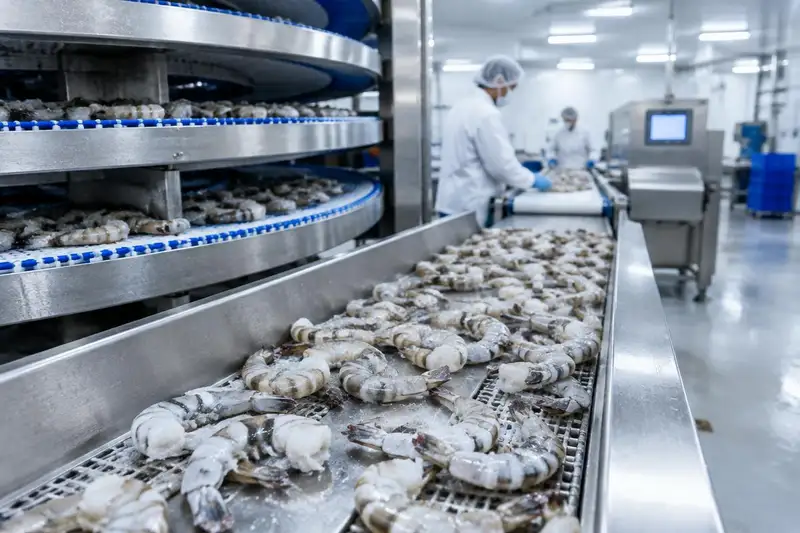
How do IQF, block freezing and glazing affect what you buy?
IQF (individually quick frozen) product is frozen piece by piece so it stays free-flowing; block-frozen product is frozen together in a block or carton. The method affects handling, portioning, thawing and how the buyer uses the product. Whatever the method, the Codex shrimp standard treats quick freezing as complete only when the product reaches −18 °C or colder at the thermal centre after stabilisation. Glazing adds a protective ice layer; under both the Codex standard and EU food-information rules, the declared net weight of glazed food excludes the glaze. Buyers should specify freezing type, glaze level and how net weight is checked. Processors buying equipment should specify freezer type and capacity at their infeed temperature, glaze control and in-line checkweighing.
Written for: Buyers of frozen shrimp, prawns and fish; seafood processors planning freezing, glazing and packing equipment.
Key facts and dates
Each fact below is taken from the official or standards source linked beside it. “As of” is the source's date or the date we last checked it.
Quick freezing is not complete until the product temperature reaches −18 °C or colder at the thermal centre after thermal stabilisation; the product must be kept deep frozen.
Source: Standard for Quick-Frozen Shrimps or Prawns (CXS 92-1981; revised 1995, 2017; amended 2024) — FAO/WHO Codex Alimentarius · as of
Water used for glazing must be of potable quality or clean sea water; where the food is glazed, the declared net contents exclude the glaze.
Source: Standard for Quick-Frozen Shrimps or Prawns (CXS 92-1981; revised 1995, 2017; amended 2024) — FAO/WHO Codex Alimentarius · as of
EU rule: where a food has been glazed, the declared net weight shall be exclusive of the glaze.
Source: Regulation (EU) No 1169/2011 on food information to consumers, Annex IX (net quantity) — legislation.gov.uk (EU text as adopted) · as of
The European Commission answers how net weight is shown on health certificates and CHEDs for glazed seafood in its certification FAQ.
Source: FAQs — Certification: net weight on health certificates and CHEDs for glazed seafood — European Commission, DG SANTE · as of
EU transport, warehousing and storage of quick-frozen foodstuffs require temperature-recording instruments complying with EN 12830, EN 13485 and EN 13486.
Source: Commission Regulation (EC) No 37/2005 — monitoring of temperatures for quick-frozen foodstuffs, Article 2 — legislation.gov.uk (EU text as adopted) · as of
Regulation (EU) 2024/573 on fluorinated greenhouse gases repealed Regulation (EU) No 517/2014 and governs F-gas refrigerants used in EU refrigeration equipment.
Source: Regulation (EU) 2024/573 on fluorinated greenhouse gases — EUR-Lex · as of
IQF, block or plate frozen: what changes for the buyer
Neither method is better in general. The right choice depends on how the product will be used, repacked and sold.
Freezing presentations and their practical implications (general characteristics)
| Presentation | How it is frozen | Buyer implications | Specify in the RFQ |
|---|---|---|---|
| IQF | Pieces frozen separately, e.g. in tunnel, spiral or impingement freezers, then usually glazed | Free-flowing, easy to portion and repack; glaze and net weight need clear terms | Glaze level, net weight basis, count per unit weight, pack size |
| Block frozen | Product frozen together in a block or carton, often in plate freezers | Efficient for reprocessing and storage; must be thawed as a block | Block weight, water or glaze content, drained-weight method |
| Semi-IQF | Frozen in a block or on trays and then broken up — terms vary between suppliers | Name is not standardised; behaviour differs by supplier | Describe exactly how it is frozen and packed |
Glazing: control it, then measure it
Glaze protects frozen seafood against dehydration and oxidation, but it is water. Price comparisons only work when every offer states net weight without glaze, measured the same way.
- State in the contract that the declared net weight excludes glaze, as Codex and EU rules require.
- Name the de-glazing method for checks — the Codex shrimp standard sets one out for glazed products.
- Ask the processor how glaze uptake is controlled on the line and how often it is checked.
- For count-based prices, agree whether count is measured on glazed or de-glazed product.
Buying freezing and glazing equipment: what to specify
For processors, the freezer is usually the largest energy user on the line. Specify it on the product and conditions you actually run.
- Products, sizes and infeed temperature, and the required core temperature at exit.
- Capacity in kg per hour at those conditions, and the continuous running time between defrosts.
- Freezer type and footprint, refrigerant and the refrigeration plant it connects to.
- Glazing method, glaze control and how uptake is checked.
- In-line checkweighing and reject handling before packing.
- Hygiene design, cleaning time and water use.
- Energy and refrigerant consumption stated at test conditions.
Acceptance tests for a freezing and glazing line
Acceptance tests (pass criteria set by the buyer)
| Test | Method | Pass criterion (buyer-defined) |
|---|---|---|
| Core temperature at exit | Probe samples across the belt after stabilisation | At or below the required core temperature |
| Capacity | Timed run at stated infeed temperature and product mix | kg per hour at those conditions |
| Glaze consistency | De-glaze samples using the agreed method | Glaze within the agreed band |
| Checkweigher accuracy | Weigh rejected and accepted packs on a reference scale | Within the agreed tolerance |
| Energy use | Meter refrigeration load during the capacity test | At or below the stated consumption |
What drives cost
Qualitative guide — no prices. Costs depend on supplier, volume, route and specification, so we list what moves them and what to ask for in each quote. Model the quotes you receive with the tools below.
Cost drivers and what to request in quotes
| Cost driver | Why it matters | Ask for |
|---|---|---|
| Freezer type and capacity | Capacity at your infeed temperature drives freezer size and refrigeration load | Capacity guarantee at stated product and conditions |
| Refrigeration plant | Refrigerant choice and plant size affect cost, compliance and running cost | Refrigerant, plant scope and who supplies it |
| Energy | Freezing is energy-intensive; consumption decides lifetime cost | Consumption at test conditions, priced with your own tariffs |
| Glaze and weighing control | Accurate glazing and checkweighing protect net weight and margin | Control method and accuracy at line speed |
| Hygiene and cleaning | Cleaning time is lost production time | Cleaning procedure, time and water use |
Sustainability, efficiency and risk
Sustainability and efficiency
- Refrigerant choice matters: in the EU, Regulation (EU) 2024/573 governs fluorinated gases — confirm the rules for the refrigerant proposed in your market.
- Energy use at stated conditions is the main operating-cost and emissions driver for freezing; compare offers on the same basis.
- Controlled glazing protects quality in storage without adding avoidable water weight.
Risks to manage
- Offers quoted on glazed weight look cheaper but deliver less product.
- Freezer capacity quoted at colder infeed temperatures than your process delivers.
- Supplier terms such as 'semi-IQF' that mean different things to different packers.
Checklist for your request
- Species, presentation and size or count
- IQF, block or other presentation, described exactly
- Glaze level and that net weight excludes glaze
- De-glazing and count measurement method
- Core temperature at loading and in transit
- For equipment: capacity at stated infeed temperature
- For equipment: refrigerant, energy use and checkweighing
- Acceptance tests and pass criteria
Our team turns these points into one reviewed request and approaches suitable suppliers on your behalf. Buyers pay nothing; managed sourcing applies to programmes and projects from USD 250,000, and every requirement is confirmed per request rather than assumed.
Frequently asked questions
Is IQF shrimp better than block-frozen shrimp?
Not in general. IQF is free-flowing and easy to portion and repack; block-frozen product suits reprocessing and storage efficiency. Choose by end use, then specify glaze, net weight and count clearly.
Does net weight include glaze?
No. Both the Codex standard for quick-frozen shrimps or prawns and EU Regulation (EU) No 1169/2011 state that the declared net weight of glazed food excludes the glaze. Write this into the contract and name the de-glazing method for checks.
What temperature defines frozen shrimp?
The Codex shrimp standard treats quick freezing as complete when the product reaches −18 °C or colder at the thermal centre after thermal stabilisation, and requires the product to be kept deep frozen.
What should a freezer RFQ state?
Products and sizes, infeed and exit core temperatures, capacity at those conditions, freezer type, refrigerant and plant interface, glaze control, checkweighing, hygiene and cleaning, energy use at test conditions and acceptance tests.
Sources
- Standard for Quick-Frozen Shrimps or Prawns (CXS 92-1981; revised 1995, 2017; amended 2024) — FAO/WHO Codex Alimentarius · checked 23 October 2026
- Regulation (EU) No 1169/2011 on food information to consumers, Annex IX (net quantity) — legislation.gov.uk (EU text as adopted) · checked 23 October 2026
- FAQs — Certification: net weight on health certificates and CHEDs for glazed seafood — European Commission, DG SANTE · checked 23 October 2026
- Commission Regulation (EC) No 37/2005 — monitoring of temperatures for quick-frozen foodstuffs, Article 2 — legislation.gov.uk (EU text as adopted), 12 January 2005 · checked 23 October 2026
- Regulation (EU) 2024/573 on fluorinated greenhouse gases — EUR-Lex, 7 February 2024 · checked 23 October 2026
This resource summarises official and standards sources for planning a purchase. It is not legal, customs or engineering advice and names no supplier. Rules and standards change and depend on the product, origin, destination and date — confirm them with the competent authority or a qualified adviser before you act. Global B2B Group is not a producer, manufacturer, exporter, carrier or certification body.