
Output sourcing · 9 min read
How to Specify a Wholesale Shrimp RFQ: Species, Count, Form, Glaze, Pack and Documents
Also available in: Español · العربية
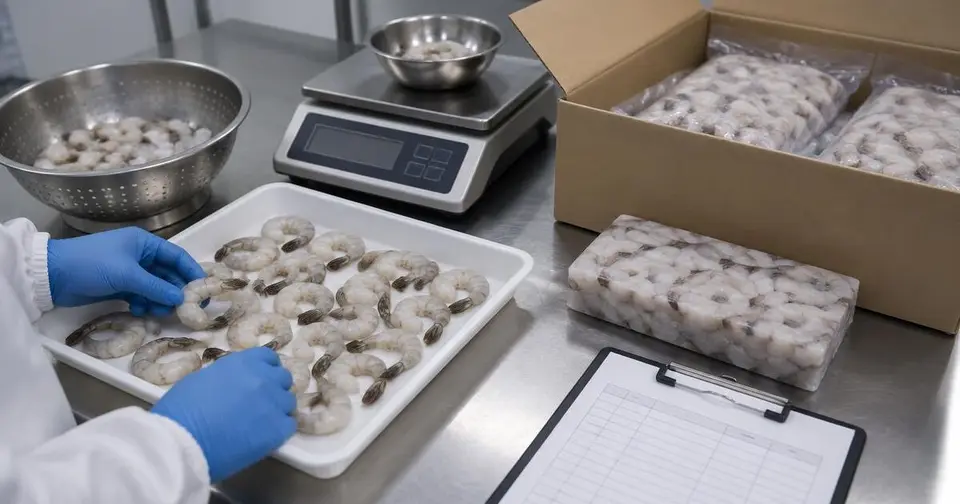
Reading a shrimp quote is far easier when the RFQ has already fixed the answers. This guide covers the buyer's side: the specification sheet you send before any price comes back.
The outcome comes first. Procurement follows.
Plan the production or project → define the output and market → structure a reviewed RFQ → our team approaches suitable counterparties → compare offers. Equipment and production-line procurement remains a separate path: plan an equipment RFQ.
Start from a one-page specification sheet
Most shrimp quotes differ because the request left room to interpret. A one-page sheet with one line per decision removes that room. Fill in your own values; the examples below only show the level of detail suppliers need.
| Line | What to state | Example entry |
|---|---|---|
| Species | What to stateCommon and scientific name | Example entryWhiteleg shrimp, Penaeus vannamei |
| Origin | What to stateAccepted countries; farmed or wild-caught | Example entryFarmed; two named origins accepted |
| Presentation | What to stateHOSO, HLSO, PUD, PD, PDTO or another stated format | Example entryPDTO — peeled, deveined, tail-on |
| Raw or cooked | What to stateRaw, cooked or blanched | Example entryRaw |
| Count | What to statePieces per lb or per kg, counted after de-glazing | Example entry21/25 per lb, counted after de-glazing |
| Freezing | What to stateIQF or block | Example entryIQF |
| Glaze and net weight | What to stateMaximum glaze; weights and price net of glaze | Example entryMaximum glaze stated in %; net weight excludes glaze |
| Additives | What to stateProcessing aids your market or customers do not accept | Example entryList exclusions; follow destination rules |
| Packing | What to stateInner pack and master carton, labelling | Example entry1 kg net bags, 10 per master carton, buyer's label |
| Volume | What to statePer container and frequency; programme length | Example entryOne 40 ft reefer every two weeks for six months |
| Destination and terms | What to statePort, Incoterms® rule and named place | Example entryCFR, named port of discharge |
| Documents | What to stateWhat the destination requires | Example entryHealth certificate and others confirmed with the authority |
Count: state the unit and when it is counted
A count such as 21/25 means 21 to 25 pieces per unit of weight. Say whether it is per pound or per kilogram, and that it applies to the de-glazed product. The Codex standard for quick frozen shrimps or prawns determines a declared count by dividing the number of shrimp by the actual de-glazed weight.
If you accept a tolerance — for example a share of pieces outside the band — write it down. Otherwise each supplier quotes to its own norm.
Glaze and net weight
Glaze is the protective layer of ice on frozen shrimp. Codex Standard CXS 92-1981 states that where the product has been glazed, the declaration of net contents shall be exclusive of the glaze, and EU food-information rules (Regulation (EU) No 1169/2011, Annex IX) say the same for glazed food.
Ask for the maximum glaze, the net weight per inner pack and the price per kilogram net of glaze. Once offers arrive, the frozen shrimp quote guide shows how to check them against these lines.
Documents and destination rules
Requirements depend on the destination. Two examples, checked on 22 October 2026: in the United States, shrimp is one of the species groups in NOAA's Seafood Import Monitoring Program, with compliance for shrimp effective from 31 December 2018, and importers of fish and fishery products must meet the importer-verification requirements of 21 CFR 123.12. The EU admits fishery products only from authorised countries and approved establishments, with a health certificate.
Confirm the current requirements for your product and destination with the competent authority, and ask suppliers which documents will accompany each consignment. Global B2B Group does not issue or verify certificates.
Volume, destination and sending the RFQ
State volume per container and frequency, programme length, destination port and the Incoterms® rule. If you have a target price, give it per kilogram net of glaze on that basis; it is optional and never published.
Submit the sheet once through the request form under fish, shrimp and seafood. For programmes with a declared value from USD 250,000 per year or season, our team reviews it and approaches suitable farms, processors and exporters on your behalf; there is no direct buyer–supplier contact before review. We do not farm, process, import or sell shrimp.
Buyer & seller checklist
Editorial suggestions for a complete request — not legal requirements.
- Species and origin: Common and scientific name, farmed or wild-caught, accepted origins
- Presentation: Code and plain description, for example PDTO — peeled, deveined, tail-on
- Raw or cooked: And freezing method: IQF or block
- Count: Per lb or per kg, counted after de-glazing, with any tolerance
- Glaze: Maximum glaze; weights and price net of glaze
- Packing: Inner pack, master carton and labelling
- Volume and terms: Per container, frequency, programme length, port, Incoterms® rule
- Documents: What the destination requires, confirmed with the competent authority
Planning the production side? FishMatch
Our specialist platform for aquaculture and seafood project planning — farms, hatcheries, RAS and processing plants. Commodity buyers stay with the reviewed sourcing request on Global B2B Group.
Go to FishMatchOptional next step
This guide is free to use. If you have a programme of USD 250,000 or more per year or season, you can send a request for review. A request is not a guarantee of supply, quality, price or a sale.
Request a reviewed supply programmeFrequently asked questions
- What do HLSO, PD and PDTO mean?
- HLSO is headless, shell-on; PD is peeled and deveined; PDTO is peeled, deveined, tail-on. Codes vary between markets, so state the code and describe it in words in the RFQ.
- Should the count be per pound or per kilogram?
- Either works, but say which, and that it applies after de-glazing. 21/25 per pound and 21/25 per kilogram are very different sizes.
- Is it enough to ask for "net weight"?
- Ask for net weight excluding glaze and for the maximum glaze. That is the basis the Codex shrimp standard uses for declared net contents of glazed product.
- What is the minimum for a shrimp sourcing request?
- A declared programme value from USD 250,000 per year or season. Smaller requests are kept on file but do not move to supplier outreach. The service is free for buyers.
Sources and editorial note
- FAO/WHO Codex Alimentarius — Standard for Quick Frozen Shrimps or Prawns (CXS 92-1981)
- EUR-Lex — Regulation (EU) No 1169/2011 on food information to consumers (Annex IX, net quantity)
- NOAA Fisheries — Seafood Import Monitoring Program (U.S.)
- U.S. eCFR — 21 CFR 123.12, special requirements for imported fish and fishery products
Written by the Global B2B Group project team. Published and last reviewed . Regulatory references are examples and change over time; confirm current requirements for your product and destination with the competent authority. This guide is not legal advice.
