
Output sourcing · 9 min read
How to Compare Bulk Fish and Seafood Offers: Species, Form, Grade, Documents and Delivery
Also available in: Español · العربية
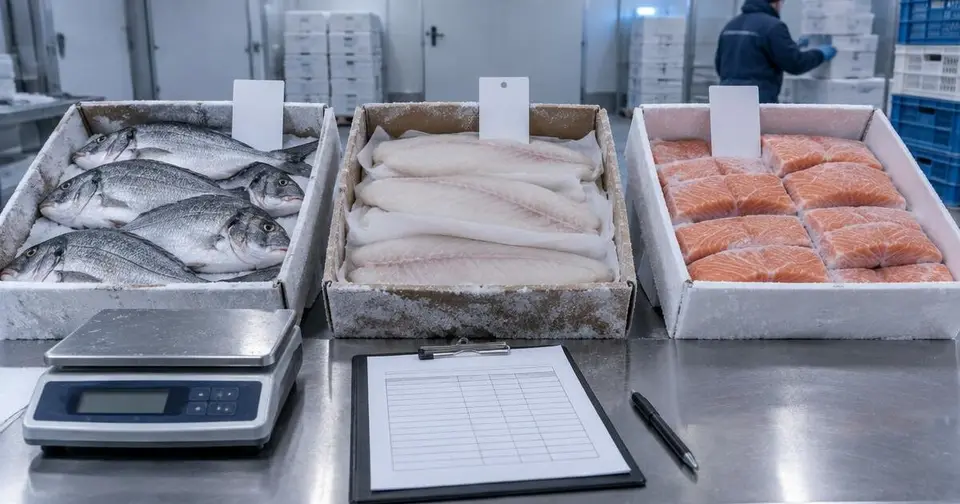
Two seafood offers at a similar price can describe very different products. Before comparing price, check that each offer is for the same species, the same form and grade, and arrives with the same documents and handling.
The outcome comes first. Procurement follows.
Plan the production or project → define the output and market → structure a reviewed RFQ → our team approaches suitable counterparties → compare offers. Equipment and production-line procurement remains a separate path: plan an equipment RFQ.
Compare in two passes: equivalence first, price second
Seafood offers are only comparable when they describe the same product on the same weight basis. A lower price for a different species, a smaller size band or a heavier glaze is not a saving.
So run two passes. In the first, check every offer against your specification and mark each point as matching, different or missing. In the second, compare landed cost only for the offers that passed — or whose differences you can put a number on.
The comparison matrix
Put every offer in one table with the same rows. A missing answer is a question to send back, not a reason to assume the best case.
| Row | What to compare | Question to send back if unclear |
|---|---|---|
| Species | What to compareCommon and scientific name | Question to send back if unclearWhich species exactly, under which scientific name? |
| Origin and method | What to compareWild-caught or farmed; catch area or country | Question to send back if unclearWhich catch area, farm country or production method? |
| Form | What to compareWhole, gutted, fillet or portion; skin-on or skinless | Question to send back if unclearIs the offer for the form in our specification? |
| State and freezing | What to compareFresh, chilled or frozen; IQF, block or interleaved | Question to send back if unclearWhich freezing method, and what temperature at loading? |
| Grade and size | What to compareSize band or grade per piece | Question to send back if unclearWhich size band, and what tolerance outside it? |
| Net weight and glaze | What to compareIs the price per kilogram net of glaze? | Question to send back if unclearWhat glaze, and is the quoted weight net of glaze? |
| Packing | What to compareInner pack, master carton, net weight per carton, labels | Question to send back if unclearCarton configuration and labelling language? |
| Documents | What to compareHealth certificate and any catch or traceability documents the destination requires | Question to send back if unclearWhich documents will accompany each consignment? |
| Cold chain | What to compareStorage and transit temperature, logger, container type | Question to send back if unclearHow is temperature recorded to destination? |
| Terms and timing | What to compareIncoterms® rule and named place, delivery window, offer validity | Question to send back if unclearWhich rule and place, which weeks, valid until when? |
Fresh, chilled or frozen: why form and grade change the price
Chilled whole fish, frozen headed-and-gutted fish and skinless fillets are different products with different yields. Compare offers only within the same form, or convert each one to a price per usable kilogram using the yield you expect for your own use.
For frozen products, ask whether the quoted weight is net of glaze. Glaze adds weight that you do not use, so an offer that prices glaze as product is cheaper only on paper.
Documents and traceability: check what the destination requires
Document requirements are set by the importing country and depend on the species and product. For example, the EU admits fishery and aquaculture products only from authorised countries and approved establishments, with a health certificate, and its rules against IUU fishing require catch certificates validated by the flag state for marine fishery products. In the United States, importers of fish and fishery products must meet the importer-verification requirements of 21 CFR 123.12.
These are examples checked on 22 October 2026, and rules change. Confirm the current requirements for your product and destination with the competent authority, and treat a supplier's statement as something to be evidenced with documents, not as verification.
From comparison to decision
After the equivalence pass, move the remaining offers to landed cost: add what you still pay under each Incoterms® rule and divide by the quantity you can actually use. The FOB, CFR and CIF comparison guide walks through that step.
Through Global B2B Group, offers are returned side by side against the buyer's specification, with missing points marked. We do not certify quality, food safety, documents or delivery performance, and any introduction happens only with your approval.
Buyer & seller checklist
Editorial suggestions for a complete request — not legal requirements.
- Species: Common and scientific name match your specification
- Origin and method: Wild-caught or farmed, catch area or country as required
- Form, state and freezing: Same form, and the same fresh, chilled or frozen state and freezing method
- Grade and size: Same size band and stated tolerance
- Weight basis: Price and weight net of glaze for frozen products
- Packing: Inner pack, master carton and labelling confirmed
- Documents and cold chain: Documents the destination requires; temperature recorded to arrival
- Terms and timing: One Incoterms® rule and named place, delivery window and validity date
Planning the production side? FishMatch
Our specialist platform for aquaculture and seafood project planning — farms, hatcheries, RAS and processing plants. Commodity buyers stay with the reviewed sourcing request on Global B2B Group.
Go to FishMatchOptional next step
This guide is free to use. If you have a programme of USD 250,000 or more per year or season, you can send a request for review. A request is not a guarantee of supply, quality, price or a sale.
Request a reviewed supply programmeFrequently asked questions
- Why not just compare price per kilogram?
- Because the kilogram may not be the same product. Species, form, size, glaze and Incoterms® rule all change what one kilogram is worth to you. Check equivalence first, then compare landed cost per usable kilogram.
- How should I treat an offer with missing information?
- Mark the point as missing and ask the supplier, through our team, to complete it. Do not fill the gap with an assumption — that is how non-comparable offers end up ranked side by side.
- Do wild-caught and farmed fish need different documents?
- Often, yes. For example, the EU catch-certificate scheme applies to marine fishery products, with exclusions listed in Annex I of the IUU Regulation. Requirements depend on the species, product and destination, so confirm them with the competent authority.
- What is the minimum for a seafood sourcing request?
- A declared programme value from USD 250,000 per year or season. Smaller requests are kept on file but do not move to supplier outreach. The service is free for buyers.
Sources and editorial note
- FAO/WHO Codex Alimentarius — Code of Practice for Fish and Fishery Products
- U.S. eCFR — 21 CFR 123.12, special requirements for imported fish and fishery products
- European Commission, Access2Markets — health requirements for fishery and aquaculture products
- European Commission — rules against illegal, unreported and unregulated (IUU) fishing
- International Chamber of Commerce — Incoterms® rules
Written by the Global B2B Group project team. Published and last reviewed . Regulatory references are examples and change over time; confirm current requirements for your product and destination with the competent authority. This guide is not legal advice.