
Innovation Research Center · Traceability
Digital certificates and food traceability: ePhyto, TRACES, CATCH and FSMA 204 for importers
Official food-trade documents are moving from paper to electronic exchange. What has changed, by product, and what to ask a supplier before the first shipment.
Prepared by the Global B2B Group project team · Last reviewed · English edition
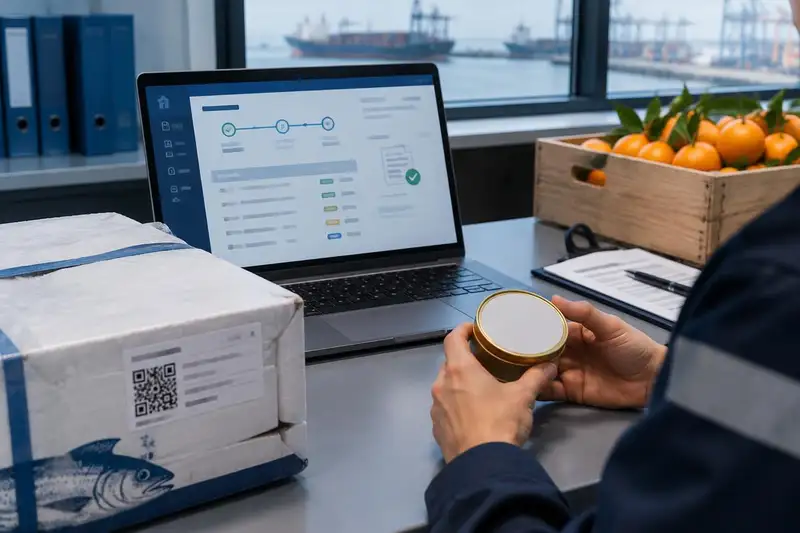
What do digital certificates change for a food importer?
Authorities increasingly exchange official certificates electronically instead of sending paper originals. For plants and plant products, the IPPC ePhyto Solution connects national plant protection organisations: by May 2026, 151 countries were registered and over 100 were actively exchanging electronic phytosanitary certificates. The EU issues and receives sanitary and phytosanitary certificates electronically in TRACES, and since 10 January 2026 EU importers must use the CATCH IT system to submit catch certificates for fishery products. In the US, the FDA's Food Traceability Rule (FSMA 204) adds records for foods on the Food Traceability List; following a Congressional directive, the FDA has said it will not enforce the rule before 20 July 2028. Digital exchange speeds checks but does not fix wrong data — the details still have to match the commercial documents and the goods.
Written for: Importers and compliance teams buying fruit and vegetables, wild or farmed seafood, caviar, poultry or eggs across borders.
Key facts and dates
Each fact below is taken from the official or standards source linked beside it. “As of” is the source's date or the date we last checked it.
By May 2026, 151 countries were registered on the IPPC ePhyto Solution, over 100 were actively exchanging ePhytos, and more than 250,000 certificates were exchanged each month through the ePhyto Hub.
Source: Strengthening global digital phytosanitary certification: the IPPC ePhyto Solution (spotlight, 24 June 2026) — International Plant Protection Convention (IPPC) · as of
Electronic certification was implemented in the EU's TRACES system in 2019 and is used for sanitary and phytosanitary certificates.
Source: TRACES — electronic certification — European Commission, DG SANTE · as of
Use of the CATCH IT system is mandatory for EU operators and authorities for imports of fishery products from 10 January 2026.
Source: Illegal fishing — the EU IUU Regulation and the CATCH IT system — European Commission, Oceans and Fisheries · as of
Aquaculture products obtained from fry or larvae are listed in Annex I of the IUU Regulation as excluded from the 'fishery products' that need a catch certificate.
Source: IUU Regulation (EC) No 1005/2008 — information note on aquaculture products — European Commission, Oceans and Fisheries · as of
The FDA proposed extending the Food Traceability Rule compliance date by 30 months to 20 July 2028; a 2026 appropriations act then directed the FDA not to enforce the rule before that date, and the FDA intends to comply.
Source: FSMA Final Rule on Requirements for Additional Traceability Records for Certain Foods (page updated 8 October 2026) — U.S. Food and Drug Administration · as of
Under the Food Traceability Rule, records must be available within 24 hours after an FDA request, unless the FDA agrees to a longer timeline.
Source: Fact sheet: The FDA Food Traceability Rule at a glance — U.S. Food and Drug Administration · as of
The CITES universal labelling system applies to all caviar, wild and aquaculture, for domestic and international trade, and relies on a non-reusable label on each primary container.
Source: Resolution Conf. 12.7 (Rev. CoP17) — conservation of and trade in sturgeons, Annex 1: universal labelling system for caviar — CITES Secretariat · as of
What 'digital' changes — and what it does not
Electronic certificates are exchanged between the exporting and importing authorities. They remove courier delays and the risk of lost or altered paper originals, and they let the border authority see a certificate before the goods arrive.
They only work when both countries exchange through the same channel for that certificate type. Where they do not, paper certificates continue. And a digital certificate with a wrong weight, lot or establishment number is still wrong.
- Ask the supplier which certificates their authority issues electronically for your destination, and which stay on paper.
- Make sure weights, lot codes and establishment numbers are identical on the certificate, the commercial invoice, the packing list and the labels.
- Agree who submits what: in the EU, the importer submits catch certificates through CATCH; the exporting authority issues health and phytosanitary certificates.
Which document applies, by product
This table is a starting point for the conversation with your supplier and customs broker. Requirements depend on the exact product, HS code, origin and destination, and change over time — confirm them on the official portal for your market.
Official documents and digital channels most often involved, by product family (orientation only)
| Product | Document to expect | Digital channel | Ask the supplier |
|---|---|---|---|
| Fresh fruit and vegetables | Phytosanitary certificate where the destination requires one | ePhyto where both authorities exchange; TRACES for the EU | Will the certificate be ePhyto or paper? Which pest declarations does it carry? |
| Wild-caught fish and shrimp into the EU | Catch certificate validated by the flag state, plus health certificate | CATCH (importer submits); TRACES for health certificates | Vessel and flag state, catch area, and the processing statement if processed in a third country |
| Farmed shrimp and fish | Health certificate; catch certificate generally not needed for products from fry or larvae | TRACES for the EU | Establishment listing for your destination and evidence the product is farmed |
| Caviar | CITES permit or certificate plus the universal caviar label | National CITES authorities (electronic permits are not available everywhere) | Label code on each tin, permit numbers and matching quantities |
| Poultry meat and egg products | Health certificate from an eligible country and establishment | TRACES for the EU; FSIS import process for the US | Country and establishment eligibility for your destination |
| US foods on the Food Traceability List | Traceability records (critical tracking events and key data elements) | Your own records, available to the FDA within 24 hours of a request | Can the supplier provide lot-level traceability data in a sortable electronic format? |
Traceability data to put in your RFQ
You do not need a specific software platform to ask for good traceability. You need agreed fields, captured at agreed points, that suppliers can actually provide.
- Lot or batch code structure, printed on cartons and repeated on all documents.
- Harvest, landing or production date and location for each lot.
- Packing or processing establishment and its approval number.
- Cooling, freezing and shipping events with dates.
- A sortable electronic file (CSV or spreadsheet) per shipment, delivered with the commercial documents.
- Who may see and share the data, and for how long it is kept.
What drives cost
Qualitative guide — no prices. Costs depend on supplier, volume, route and specification, so we list what moves them and what to ask for in each quote. Model the quotes you receive with the tools below.
Cost drivers and what to request in quotes
| Cost driver | Why it matters | Ask for |
|---|---|---|
| Data capture | Recording lot-level events takes staff time at farm, vessel, packhouse and port | Which fields are already recorded and which are new |
| Labelling | Lot codes, caviar labels and carton labels need printing and checks | Label specification and who bears changes |
| Software and integration | Traceability platforms and ERP links carry licence and set-up costs | Licence fees, data export rights and exit terms |
| Broker and document handling | Mixed paper and electronic channels still need checking | Which documents your broker needs, in which format |
Sustainability, efficiency and risk
Sustainability and efficiency
- Catch certificates and CITES labels exist to keep illegal, unreported and unregulated fishing and illegal sturgeon trade out of supply chains; verifying them is part of responsible sourcing.
- Lot-level traceability narrows the scope of a recall to the affected lots, which can reduce how much food is withdrawn.
Risks to manage
- Assuming a certificate will be electronic when the origin still issues paper, and missing the original at arrival.
- Mismatched weights or lot codes between certificate and invoice — a frequent cause of border holds.
- Treating a supplier's traceability platform as proof of origin without checking the official documents behind it.
Checklist for your request
- Exact product, HS code, origin and destination
- Official certificates required and whether each is electronic or paper
- Who submits each document (exporter authority, importer, broker)
- Wild or farmed status for seafood; catch details where relevant
- CITES documents and label codes for caviar
- Lot code structure and traceability fields per shipment
- Sortable electronic traceability file with each shipment
- Data access, retention and sharing terms
Our team turns these points into one reviewed request and approaches suitable suppliers on your behalf. Buyers pay nothing; managed sourcing applies to programmes and projects from USD 250,000, and every requirement is confirmed per request rather than assumed.
Frequently asked questions
Do all countries issue electronic phytosanitary certificates?
No. The IPPC reported 151 registered countries and over 100 actively exchanging ePhytos by May 2026. Exchange only works when both the exporting and importing authorities use it for that trade, so ask your supplier and broker which format to expect.
Does farmed shrimp need an EU catch certificate?
Generally not: the IUU Regulation's Annex I excludes aquaculture products obtained from fry or larvae from the fishery products that need a catch certificate. Health certification and establishment listing still apply. Confirm the status of your specific product with the authority.
When does FSMA 204 apply to imported foods?
The Food Traceability Rule applies to foods on the FDA's Food Traceability List, including imports. The original compliance date was 20 January 2026; the FDA has said it will not enforce the rule before 20 July 2028, in line with a Congressional directive. Preparing lot-level records now still makes supplier onboarding easier.
How is caviar traceability checked?
Under CITES Resolution Conf. 12.7 (Rev. CoP17), every primary container of caviar — wild or farmed, domestic or international trade — carries a non-reusable label with a standard code. The label details must match the CITES permits for the shipment.
Sources
- Strengthening global digital phytosanitary certification: the IPPC ePhyto Solution (spotlight, 24 June 2026) — International Plant Protection Convention (IPPC), 24 June 2026 · checked 23 October 2026
- TRACES — electronic certification — European Commission, DG SANTE · checked 23 October 2026
- Illegal fishing — the EU IUU Regulation and the CATCH IT system — European Commission, Oceans and Fisheries · checked 23 October 2026
- IUU Regulation (EC) No 1005/2008 — information note on aquaculture products — European Commission, Oceans and Fisheries · checked 23 October 2026
- FSMA Final Rule on Requirements for Additional Traceability Records for Certain Foods (page updated 8 October 2026) — U.S. Food and Drug Administration, 8 October 2026 · checked 23 October 2026
- Fact sheet: The FDA Food Traceability Rule at a glance — U.S. Food and Drug Administration · checked 23 October 2026
- Resolution Conf. 12.7 (Rev. CoP17) — conservation of and trade in sturgeons, Annex 1: universal labelling system for caviar — CITES Secretariat · checked 23 October 2026
This resource summarises official and standards sources for planning a purchase. It is not legal, customs or engineering advice and names no supplier. Rules and standards change and depend on the product, origin, destination and date — confirm them with the competent authority or a qualified adviser before you act. Global B2B Group is not a producer, manufacturer, exporter, carrier or certification body.