
Premium & specialty sourcing · 10 min read
How Commercial Buyers Specify High-Value Seafood: Species, Form, Size, Freezing, Origin and Terms
The outcome comes first. Procurement follows.
Plan the production or project → define the output and market → structure a reviewed RFQ → our team approaches suitable counterparties → compare offers. Equipment and production-line procurement remains a separate path: plan an equipment RFQ.
Why high-value seafood needs a tighter specification
In premium seafood the price difference between two offers often comes from details that a short request leaves out: glaze percentage, count per kilogram, whether a crab is sold as whole cooked, clusters or legs, or whether a fish is fresh, superchilled or frozen at sea. The higher the unit value, the more each of those details matters to your margin.
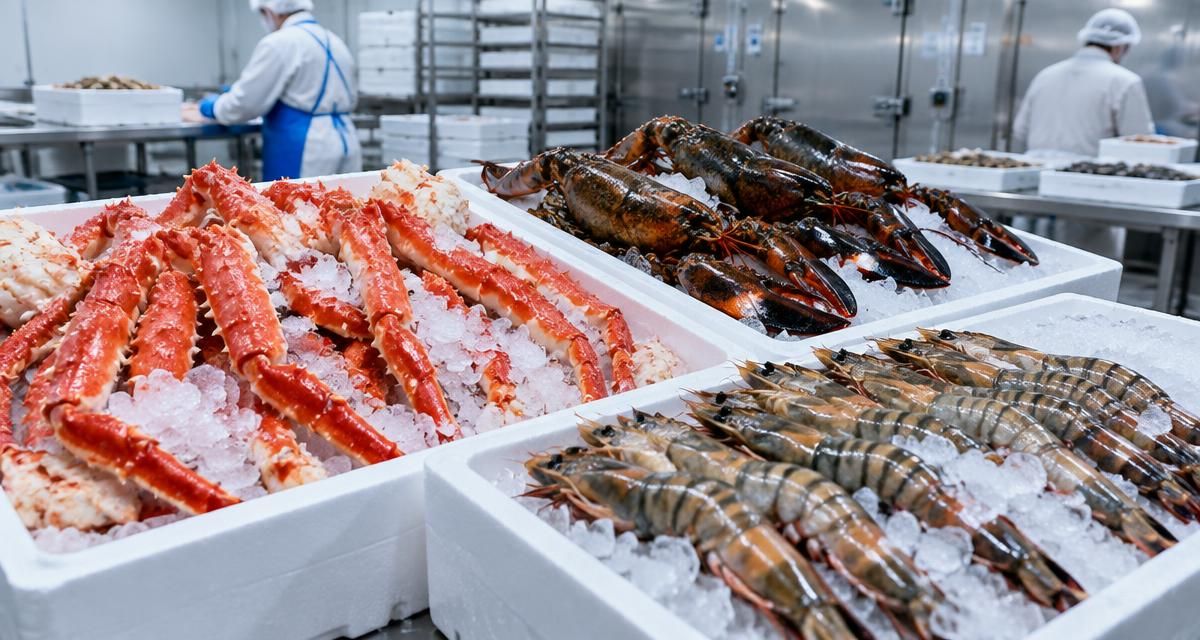
This guide covers the questions buyers of king crab, lobster, large shrimp, caviar and premium whole fish or fillets typically need to answer before approaching wholesale fish suppliers. Global B2B Group reviews such requests on the buyer side and approaches suppliers that appear to fit; we do not hold stock and do not guarantee supply, quality or price.
Species and origin: name the product precisely
Trade names vary between markets and some are used for several species. Give the common and scientific name, wild-caught or farmed, and any catch area, country of origin or farming system your customers require. For wild species, ask which fishery the product comes from and what catch documentation travels with it.
- Common and scientific name (for example red king crab — Paralithodes camtschaticus)
- Wild or farmed; catch area or origin if required
- Fishery or farm documentation the supplier can provide
Product form, size and count
State the form and the grading scale. Crab may be live, whole cooked, sections/clusters or legs and claws; lobster live, whole frozen, tails or meat; shrimp head-on shell-on, headless, peeled and deveined, tail-on or tail-off. Size is usually expressed as weight per piece or as count per kilogram or pound — write the unit so that offers can be compared.
- Form (live, whole, sections, tails, fillets, portions, meat)
- Size: weight per piece, or count per kg/lb, with allowed tolerance
- Cooked or raw; trimming and cut specification for fish
Processing, freezing, glaze and net weight
For frozen products specify the freezing method (for example individually quick frozen or block), whether the product was frozen at sea or on land, the glaze you will accept and that price and invoicing refer to net weight after glaze. Ask for storage temperature requirements and the shelf life the supplier will confirm.
For fresh or live product, state the maximum time from harvest or landing to arrival and the temperature or holding conditions you require. The Codex Code of Practice for Fish and Fishery Products is a useful reference for handling expectations; specific limits are set by destination rules and your contract.
Caviar and other regulated species
All sturgeon and paddlefish species are listed under CITES, so international trade in caviar requires CITES permits and, under CITES resolutions, specific container labelling. Before a caviar wholesale request moves forward, confirm the CITES documents for the exact origin and destination, the species and source code, and any national rules that add to them.
Other premium species can also be subject to quotas, seasons, catch-certificate schemes or import monitoring programmes. Treat these as items to verify for each origin–destination pair, not as a fixed list.
Certifications, traceability and delivery terms
List certifications as buyer requirements — the ones your destination or customers ask for — rather than assuming any supplier holds them. Ask the supplier to evidence each one. Add traceability needs such as lot coding, catch or harvest date and vessel or farm identification.
- Required certificates (health certificate, catch certificate, CITES where applicable, customer-required schemes)
- Lot coding and traceability data on cartons
- Packing: carton net weight, inner packing, labelling language
- Incoterms® rule and named place, currency (USD by default), payment terms
- Inspection point and claims procedure
Submitting a high-value seafood request
Open the output sourcing request, choose fish or shrimp, and complete the species, form, size, frozen or fresh, volumes, delivery window, destination and documents. Blank fields are recorded as unknown. Buyer requests are free; assisted sourcing applies to programmes of at least USD 250,000 total per year or season. Our team reviews every request before any supplier is approached, and introductions happen only after review and your approval.
Questions about building or upgrading a seafood farm, hatchery or processing plant belong with FishMatch; cold-store and refrigerated logistics projects with ColdMatch.
Buyer & seller checklist
Editorial suggestions for a complete request — not legal requirements.
- Species: Common and scientific name; wild or farmed
- Origin: Catch area, country or farming system if required
- Form: Live, whole, sections, tails, fillets, peeled and so on
- Size: Weight per piece or count per kg/lb with tolerance
- Freezing: IQF or block, at sea or on land, glaze, net weight
- Regulated species: CITES or catch documentation where applicable
- Certificates: Only those your destination or customers require
- Terms: Incoterms® rule, named place, currency, payment
- Programme value: Total per year or season; assisted sourcing from USD 250,000
Planning the production side? FishMatch
Our specialist platform for seafood and aquaculture: farms, hatcheries, RAS, processing plants and the deeper sector questions behind supply.
Go to FishMatchOptional next step
This guide is free to use. If you have a programme of USD 250,000 or more per year or season, you can send a request for review. A request is not a guarantee of supply, quality, price or a sale.
Request a reviewed supply programmeFrequently asked questions
- Are the seafood categories on this page available now?
- They are request categories, not live stock. Our team checks each request and approaches suppliers that appear to fit; availability is never guaranteed.
- How do I compare king crab wholesale offers?
- Compare only offers with the same species, form, size grade, glaze and net-weight basis, freezing method and Incoterms® rule. Otherwise the prices describe different products.
- What extra checks apply to caviar wholesale?
- Sturgeon species are listed under CITES, so permits and labelling apply in international trade. Confirm requirements for the exact species, origin and destination.
- Do you call suppliers verified?
- Only where a specific supplier's evidence has been reviewed and shown. Otherwise we describe them as screened introductions after review.
- Is there a fee for buyers?
- No. Buyer requests and tools are free. Assisted sourcing applies to programmes of USD 250,000 or more per year or season.
Sources and editorial note
- FAO/WHO Codex Alimentarius — Code of Practice for Fish and Fishery Products
- CITES — Sturgeons and paddlefish (caviar trade)
- NOAA Fisheries — Seafood Import Monitoring Program (U.S. example)
- European Commission — Illegal, unreported and unregulated fishing rules (EU example)
- ICC — Incoterms® rules
Written by the Global B2B Group project team. Published and last reviewed . Regulatory references are examples and change over time; confirm current requirements for your product and destination with the competent authority. This guide is not legal advice.
Related guides and tools
- Wholesale fish and shrimp: B2B buyer guide
- Sourcing farmed fish and shrimp for wholesale markets
- Premium produce and seafood RFQ checklist
- Output sourcing: request a reviewed supply programme
- Knowledge Center — output procurement checklists
- Business Intelligence Center — official trade and market sources
- Separate path: equipment and production-line RFQ builder