
Innovation Research Center · Poultry and eggs
Egg grading, crack detection and in-ovo sexing: technology questions for egg buyers and packers
How grading machines turn eggs into sellable classes and weight grades, what EU rules define, and what to ask a supplier about in-ovo sexing claims.
Prepared by the Global B2B Group project team · Last reviewed · English edition
What should an egg buyer know about grading and in-ovo sexing?
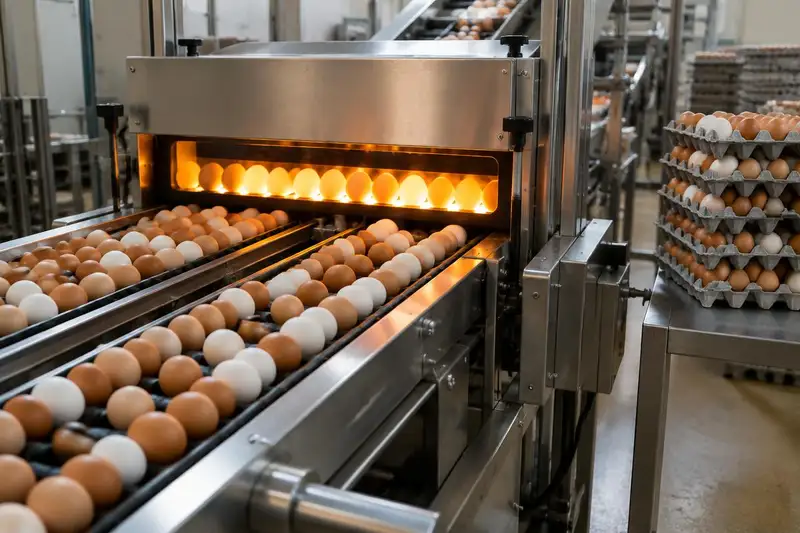
Egg grading machines candle, check and weigh eggs so they can be sold by quality class and weight grade. In the EU, Delegated Regulation (EU) 2023/2465 sets the grades: Class A eggs are graded XL (73 g or more), L (63 to under 73 g), M (53 to under 63 g) and S (under 53 g), and the air space may not exceed 6 mm, or 4 mm for eggs sold as 'extra'. In-ovo sexing is a different, hatchery-side technology: it determines the sex of the chick in the hatching egg so that male layer chicks are not hatched and culled. Germany banned chick culling from 1 January 2022 and France ended the elimination of male chicks in the laying-hen sector from 1 January 2023. If your customers make claims about how laying hens were hatched, ask the supplier for hatchery evidence rather than relying on a label.
Written for: Retail, food-service and processing buyers of shell eggs; egg packers and integrators buying grading and packing machines.
Key facts and dates
Each fact below is taken from the official or standards source linked beside it. “As of” is the source's date or the date we last checked it.
Class A eggs are graded by weight: XL ≥ 73 g; L ≥ 63 g and < 73 g; M ≥ 53 g and < 63 g; S < 53 g.
Source: Commission Delegated Regulation (EU) 2023/2465 — marketing standards for eggs (repeals Regulation (EC) No 589/2008) — EUR-Lex · as of
Class A quality includes a normal, clean, undamaged shell and cuticle and an air space no higher than 6 mm and stationary (no more than 4 mm for eggs marketed as 'extra'); the yolk must be visible on candling as a shadow only.
Source: Commission Delegated Regulation (EU) 2023/2465 — marketing standards for eggs (repeals Regulation (EC) No 589/2008) — EUR-Lex · as of
Eggs delivered from a production site to a collector, packing centre or industry in another Member State must be marked with the producer code before leaving the production site (Article 8).
Source: Commission Delegated Regulation (EU) 2023/2465 — marketing standards for eggs (repeals Regulation (EC) No 589/2008) — EUR-Lex · as of
Regulation (EU) 2023/2465 repeals Regulation (EC) No 589/2008; references to the old regulation are read as references to the new one.
Source: Commission Delegated Regulation (EU) 2023/2465 — marketing standards for eggs (repeals Regulation (EC) No 589/2008) — EUR-Lex · as of
Germany's amended Animal Welfare Act introduced a nationwide ban on chick culling from 1 January 2022.
Source: Phasing-out of chick culling — German Federal Ministry of Agriculture (BMLEH) · as of
France ended the elimination of male chicks in the laying-hen sector from 1 January 2023.
Source: Fin de l'élimination des poussins mâles en filière poules pondeuses au 1er janvier 2023 (press release, 9 November 2022) — French Ministry of Agriculture · as of
What a grading line checks, module by module
Grading and packing machines are built from modules. Which ones you need depends on your market, the grades you sell and the volume.
Typical egg grading modules and buyer questions (general — configurations vary by supplier)
| Module | What it checks | Ask the supplier |
|---|---|---|
| Candling | Shell, air space, yolk shadow and visible inclusions such as blood spots | Manual, assisted or automatic inspection, and at what speed |
| Crack detection | Cracked or damaged shells (method depends on the supplier) | Detection method and how accuracy is tested on your eggs |
| Dirt detection | Soiled shells | Whether the module is offered and how rejects are handled |
| Weighing | Weight grade boundaries such as the EU XL/L/M/S bands | Weighing accuracy at line speed and calibration routine |
| Marking | Producer code and other required marks | Printer type, ink approval and mark legibility |
| Packing | Packs, trays and cartons per grade | Pack formats, changeover time and outlet count |
Buying shell eggs: grade and claim questions
When you source eggs across borders, the grader at the packing centre is what turns the farm's output into your specification.
- Which class and weight grades will be packed for you, and under which market's rules?
- How is candling done, and how are cracked and dirty eggs removed?
- How are weight bands calibrated, and how often are packs checked?
- Which producer code and marks will appear on the eggs and packs for your destination?
- If you need claims about hatching (for example 'no chick culling'), which hatchery supplies the hens and what evidence supports the claim?
In-ovo sexing: what it is and what to ask
In-ovo sexing is applied to hatching eggs in the hatchery, not to the table eggs you buy. It identifies eggs that would hatch into male layer chicks so they can be removed during incubation. Methods and the stage of incubation at which they work differ between providers, and so do the claims made on packs.
Rules differ by country. Germany and France have legal bans on culling male layer chicks; other markets rely on voluntary programmes or have no rule. Labelling claims are governed by the destination's food-information and consumer rules.
- Ask which hatchery produced the laying hens and which in-ovo method it used, at which stage of incubation.
- Ask how the claim on the pack is verified and by whom.
- Check the legal requirements of each country you sell into; a claim accepted in one market may need different wording in another.
Buying a grading and packing machine: what to specify
- Daily and hourly egg volume, now and at expected flock size.
- Grades and weight bands per market, and the number of outlets.
- Modules required: candling, crack, dirt, weighing, marking, packing.
- Pack formats and changeover time.
- Hygiene design, cleaning time and egg-handling damage limits.
- Data per batch: counts per grade, rejects and producer code.
- Service coverage, spares and operator training.
What drives cost
Qualitative guide — no prices. Costs depend on supplier, volume, route and specification, so we list what moves them and what to ask for in each quote. Model the quotes you receive with the tools below.
Cost drivers and what to request in quotes
| Cost driver | Why it matters | Ask for |
|---|---|---|
| Capacity | Eggs per hour drives machine size and module count | Rated capacity on your egg sizes and mix |
| Inspection modules | Automatic crack and dirt detection add cost and change labour needs | Itemised price per module |
| Outlets and packing | More grades and pack formats need more outlets and packers | Outlet count and pack formats included |
| Marking | Printers, inks and code management are recurring costs | Printer type, consumables and approvals |
| Service and spares | Downtime stops a perishable product flow | Response time, spares stock and training |
Sustainability, efficiency and risk
Sustainability and efficiency
- Accurate grading reduces avoidable downgrades and breakage, keeping more eggs in their intended market.
- In-ovo sexing addresses an animal-welfare issue; it is legally required in some markets and voluntary in others.
- Gentle handling and well-maintained machines reduce cracked-egg losses.
Risks to manage
- Assuming EU grade names mean the same thing in non-EU markets.
- Pack claims about hatching that the supplier cannot evidence.
- Weighing drift at high line speed shifting eggs across grade boundaries.
Checklist for your request
- Destination market and the grading rules that apply
- Class and weight grades required
- Candling, crack and dirt removal method
- Producer code and pack marks
- Hatchery evidence for any hatching or welfare claim
- Storage and transport temperature regime for the destination
- For machines: capacity, modules, outlets and pack formats
- Acceptance tests and pass criteria
Our team turns these points into one reviewed request and approaches suitable suppliers on your behalf. Buyers pay nothing; managed sourcing applies to programmes and projects from USD 250,000, and every requirement is confirmed per request rather than assumed.
Frequently asked questions
What are the EU weight grades for eggs?
Under Delegated Regulation (EU) 2023/2465, Class A eggs are graded XL (73 g or more), L (63 g to under 73 g), M (53 g to under 63 g) and S (under 53 g).
Which regulation replaced EU Regulation 589/2008?
Commission Delegated Regulation (EU) 2023/2465 on marketing standards for eggs repeals Regulation (EC) No 589/2008; references to the old regulation are read as references to the new rules.
Is in-ovo sexing required for eggs sold in Germany or France?
Both countries have banned culling male layer chicks — Germany from 1 January 2022 and France from 1 January 2023. These rules apply to hatcheries in those countries. For imported eggs and pack claims, check the destination's current rules and labelling requirements with the authority.
What does a grading machine check?
Typical modules check the shell, air space and contents by candling, remove cracked and dirty eggs, weigh eggs into grades, print producer codes and pack by grade. Configurations differ by supplier and volume.
Sources
- Commission Delegated Regulation (EU) 2023/2465 — marketing standards for eggs (repeals Regulation (EC) No 589/2008) — EUR-Lex, 17 August 2023 · checked 23 October 2026
- Phasing-out of chick culling — German Federal Ministry of Agriculture (BMLEH) · checked 23 October 2026
- Fin de l'élimination des poussins mâles en filière poules pondeuses au 1er janvier 2023 (press release, 9 November 2022) — French Ministry of Agriculture, 9 November 2022 · checked 23 October 2026
This resource summarises official and standards sources for planning a purchase. It is not legal, customs or engineering advice and names no supplier. Rules and standards change and depend on the product, origin, destination and date — confirm them with the competent authority or a qualified adviser before you act. Global B2B Group is not a producer, manufacturer, exporter, carrier or certification body.