
Output sourcing · 9 min read
How to Specify Table Eggs and Poultry Meat for Wholesale Supply: Grades, Sizes, Temperature and Documents
Also available in: Español · Français · العربية · Português · Deutsch
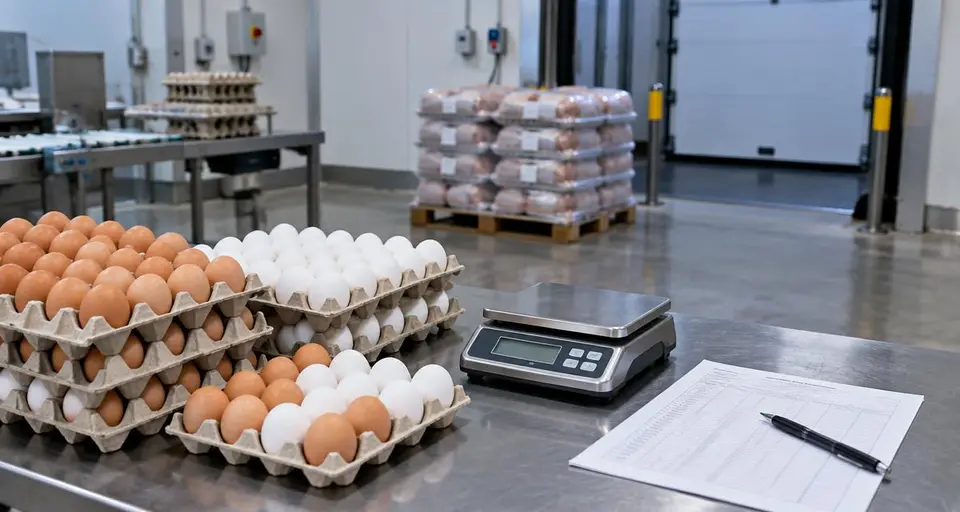
Buyers asking for table eggs or poultry meat in volume often receive offers that cannot be compared, because each supplier answers to a different size scale, grade or temperature basis.
The outcome comes first. Procurement follows.
Plan the production or project → define the output and market → structure a reviewed RFQ → our team approaches suitable counterparties → compare offers. Equipment and production-line procurement remains a separate path: plan an equipment RFQ.
Table eggs: type, grade and the size scale you mean
Start with what the egg is: shell colour, production system (for example cage-free, barn, free-range or organic, if your customers require one) and whether the eggs are for retail packs, food service or further processing. Then name the grade in your market's terms. EU marketing standards use Class A for eggs sold to consumers and Class B for eggs going to industry; US standards use the consumer grades AA, A and B.
Size is where offers most often fail to match, because the two common scales measure different things. The EU scale classes each egg by its own weight; the US scale sets a minimum net weight per dozen. "Large" therefore does not describe the same egg on both scales. State the scale and the class, or give a gram range per egg.
| Scale | Classes and limits |
|---|---|
| EU — weight of each egg (Class A) | Classes and limitsXL 73 g and over · L 63 g to under 73 g · M 53 g to under 63 g · S under 53 g |
| US — minimum net weight per dozen | Classes and limitsJumbo 30 oz (about 850 g) · Extra Large 27 oz (about 765 g) · Large 24 oz (about 680 g) · Medium 21 oz (about 595 g) · Small 18 oz (about 510 g) · Peewee 15 oz (about 425 g) |
| In your RFQ | Classes and limitsName the scale and the class, or give a gram range per egg, so every supplier quotes the same size |
Pack, age and temperature for eggs
Give the pack format (30-egg trays, retail cartons of 6, 10 or 12, cases per pallet), labelling or private-label needs, and the maximum age at delivery counted from the laying or packing date. Ask how the date is marked on the egg and the pack.
Handling rules differ by market, so write the temperature you need into the specification rather than assuming it. In the United States, federal rules require shell eggs to be held and transported at an ambient temperature of 45 °F (7.2 °C) or below. EU marketing standards take a different approach: Class A eggs may not be washed or cleaned, and may not be chilled in premises kept artificially below 5 °C, with limited exceptions. Check the rules that apply to your destination and to the stage of the chain you are buying at.
Poultry meat: product, cut, class and weight
Name the species and the product: whole birds (with the presentation, for example with or without giblets), cuts such as breast fillet, leg quarter, thigh, drumstick or wings, or processed products. Give the weight range per bird or per piece, the trim and bone-in or boneless status, and the tolerance you accept within a carton.
If you buy against EU marketing standards, poultrymeat is marketed as Class A or Class B, and the regulation also sets limits on water content linked to the chilling method used. Elsewhere, buyers often specify grades such as the voluntary USDA poultry grades or a customer's own standard. Whatever the basis, write it down and ask for evidence.
Chilled or frozen: say which, and at what temperature
The state changes shelf life, logistics and price, so it must be identical across offers. The EU poultrymeat standard uses three states, each with a temperature condition:
- Fresh — not stiffened by cooling and kept between −2 °C and +4 °C
- Frozen — kept at −12 °C or colder
- Quick-frozen — kept at −18 °C or colder
- For other markets, state the temperature in the contract and how it will be recorded in transit
Documents, approvals and market access
Eggs and poultry meat are animal products, so most destinations require a veterinary or health certificate issued by the exporting country's competent authority, and many accept products only from establishments approved or listed for export to that destination. Ask each supplier to confirm the establishment approval, the certificate model for your route and any laboratory results your customers require. Add halal or other religious certification only where your destination or customers require it, and name the certifying bodies they accept.
Market access can change at short notice. Outbreaks of avian influenza, for example, can lead importing countries to restrict products from affected regions. Check the current status with the authorities on your route before you commit to an origin; a supplier's statement that a route is open is a claim to verify, not a confirmation.
Volume, season and comparing offers
Eggs and poultry meat are produced year-round, but available volume per supplier depends on flock placement and processing capacity, and holiday or seasonal demand can tighten supply. Give your weekly or monthly volume, the contract period and any peaks, and ask each supplier how much of it they can commit and from which sites.
Ask every supplier to quote against the same specification, on the same Incoterms® rule and named place and in the same unit (per dozen, per case or per kilogram). Global B2B Group does not publish egg or poultry prices. For programmes with a declared value from USD 250,000 per year or season, our team sends your specification to suitable suppliers and returns their offers on the same rows, with each statement labelled as supplier-quoted, estimated or independently checked.
Buyer & seller checklist
Editorial suggestions for a complete request — not legal requirements.
- Egg type and grade: Shell colour, production system, EU class or US grade
- Egg size: Scale and class (EU per egg or US per dozen) or a gram range
- Egg pack and age: Tray or carton format, labels, maximum days from lay at delivery
- Poultry product: Species, whole bird or cut, bone-in or boneless, weight range
- State and temperature: Fresh, chilled or frozen, with the temperature and how it is recorded
- Documents and access: Health certificate model, approved establishment, halal or other only if required
Planning the production side? HatchMatch
Our specialist platform for hatcheries, poultry farms and poultry processing projects.
Go to HatchMatchOptional next step
This guide is free to use. If you have a programme of USD 250,000 or more per year or season, you can send a request for review. A request is not a guarantee of supply, quality, price or a sale.
Request a reviewed supply programmeFrequently asked questions
- Is a US "Large" egg the same as an EU "L" egg?
- No. The US class sets a minimum net weight per dozen (24 oz for Large), while the EU L class covers single eggs from 63 g to under 73 g. State the scale and class, or a gram range per egg, so every supplier quotes the same size.
- What should a frozen chicken RFQ specify?
- The product and cut, weight range, bone-in or boneless, state and storage temperature (for example −18 °C), packing (IQF bags or bulk cartons), any halal requirement, the health certificate and establishment approval for your destination, volume and Incoterms® rule with the named place.
- Do you publish wholesale egg or poultry prices?
- No. Prices depend on grade, size, state, origin, season, volume and trade terms; suppliers quote against your specification after our team has reviewed the request.
- What is the minimum for an egg or poultry sourcing request?
- A declared programme value from USD 250,000 per year or season. Smaller requests are kept on file but do not move to supplier outreach.
Sources and editorial note
- EUR-Lex — Commission Delegated Regulation (EU) 2023/2465, marketing standards for eggs
- EUR-Lex — Commission Regulation (EC) No 543/2008, marketing standards for poultrymeat
- USDA AMS — United States Standards, Grades and Weight Classes for Shell Eggs (AMS 56)
- eCFR — 21 CFR Part 118, production, storage and transportation of shell eggs
- European Commission — Animal health: avian influenza
- ICC — Incoterms® rules
Written by the Global B2B Group project team. Published and last reviewed . Regulatory references are examples and change over time; confirm current requirements for your product and destination with the competent authority. This guide is not legal advice.
Related guides and tools
- Wholesale poultry meat and table egg sourcing
- Poultry and egg procurement checklist
- How to compare FOB, CFR and CIF quotes
- How our team compares supplier offers
- Product specification builder
- Egg grading, crack detection and in-ovo sexing: what to ask
- Output sourcing: request a reviewed supply programme
- Knowledge Center — output procurement checklists
- Business Intelligence Center — official trade and market sources
- Separate path: equipment and production-line RFQ builder