
Innovation Research Center · Cold chain
Cold-chain temperature monitoring for perishable imports: loggers, live tracking and claim evidence
Which monitoring technology fits which shipment, what the EU and US rules actually require, and how to write temperature evidence into a supply contract.
Prepared by the Global B2B Group project team · Last reviewed · English edition
What temperature monitoring does an importer need?
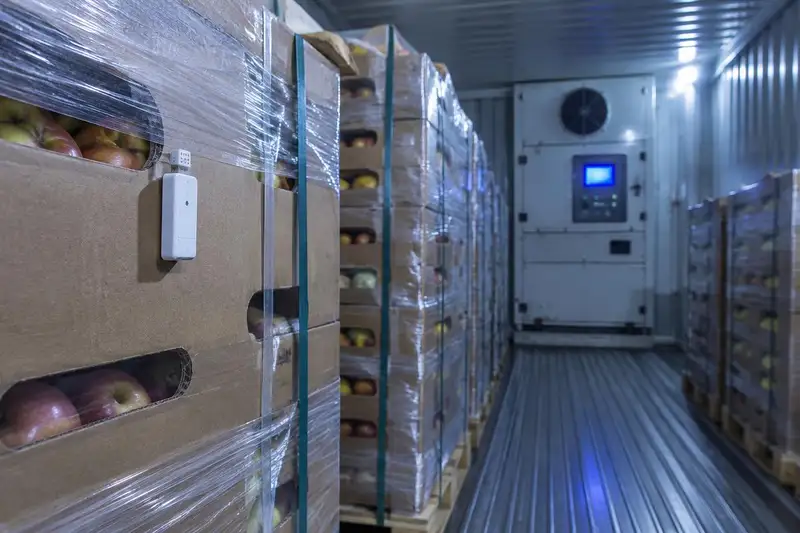
Temperature monitoring gives you evidence of how a consignment was handled between packing and delivery. The two main options are recording data loggers, read after arrival, and live trackers or reefer telematics that report during transit. For quick-frozen food moved, warehoused or stored in the EU, Regulation (EC) No 37/2005 already requires recording instruments that comply with EN 12830, EN 13485 and EN 13486, with records kept for at least one year. In the US, the FDA's sanitary transportation rule requires shippers of temperature-controlled food to give the carrier the operating temperature in writing. For everything else, the evidence you need is what you write into the contract: setpoint, tolerance, what counts as an excursion, who downloads the data and by when.
Written for: Importers, wholesalers and retail buyers of chilled or frozen produce, seafood, poultry and eggs; quality and claims teams.
Key facts and dates
Each fact below is taken from the official or standards source linked beside it. “As of” is the source's date or the date we last checked it.
Means of transport, warehousing and storage of quick-frozen foodstuffs must have recording instruments that monitor air temperature at frequent and regular intervals; instruments must comply with EN 12830, EN 13485 and EN 13486.
Source: Commission Regulation (EC) No 37/2005 — monitoring of temperatures for quick-frozen foodstuffs, Article 2 — legislation.gov.uk (EU text as adopted) · as of
Temperature recordings for quick-frozen foodstuffs must be dated and stored by the food operator for at least one year, or longer depending on the nature and shelf life of the food.
Source: Commission Regulation (EC) No 37/2005 — monitoring of temperatures for quick-frozen foodstuffs, Article 2 — legislation.gov.uk (EU text as adopted) · as of
A shipper of food that needs temperature control for safety must specify in writing to the carrier the operating temperature for the transport, including any pre-cooling phase (thermally insulated totes excepted).
Source: 21 CFR 1.908 — requirements for transportation operations — eCFR (U.S. Government) · as of
Codex calls temperature the single most important factor affecting the rate of fish and shellfish deterioration.
Source: Code of Practice for Fish and Fishery Products (CXC 52-2003) — FAO/WHO Codex Alimentarius · as of
Under the Codex shrimp standard, quick freezing is not complete until the product reaches −18 °C or colder at the thermal centre after thermal stabilisation.
Source: Standard for Quick-Frozen Shrimps or Prawns (CXS 92-1981; revised 1995, 2017; amended 2024) — FAO/WHO Codex Alimentarius · as of
Logger, live tracker or carrier data: which evidence fits?
Monitoring technologies differ in what they measure, when you see the data and how much the record proves. Most importers combine two: a recording device that travels with the goods, and the carrier's reefer unit data as a cross-check.
Common temperature-monitoring options for perishable shipments (general characteristics — confirm each device's specification with its supplier)
| Option | What it records | When you see data | Typical fit | Limits to plan for |
|---|---|---|---|---|
| Single-use recording logger | Air temperature where it is placed, at a set interval | After arrival, when downloaded | Sea-freight reefers, claims evidence | No warning during transit; reading depends on placement |
| Reusable logger with calibration record | As above, with a traceable calibration | After arrival | Regular programmes with the same route | Devices must be returned, re-calibrated and tracked |
| Live tracker (cellular or satellite) | Temperature and often location, light or door events | During transit where there is coverage | Air freight and high-value cargo such as cherries, berries or caviar | Coverage gaps; carrier or airline acceptance of battery-powered devices |
| Reefer unit controller data | Setpoint, supply and return air of the container unit | On request from the carrier, or via its portal | Every reefer container | Shows the unit's air, not product temperature; access depends on the carrier |
| Product probe at handover | Core or pulp temperature at one moment | At loading, arrival or inspection | Acceptance checks and disputes | A spot reading, not a history |
Where to place sensors and what to record
A record only proves what happened at the sensor. Agree placement in writing so both sides read the same evidence.
- Name the position (for example: rear third of the container, middle pallet, mid-height) and the number of devices per container or air pallet.
- Set the recording interval and make sure the device's memory covers the full journey plus buffer.
- Start recording at loading, not at departure — pre-cooling and loading are where many excursions start.
- Record pulp or core temperature at loading and at arrival with a calibrated probe, and photograph the reading with the lot label.
- Ask the carrier for the reefer unit download whenever a logger shows an excursion; the two records together are stronger than either alone.
Product-specific points
Temperature targets differ by product, variety, ripeness and destination. We do not publish set points here: agree them with the supplier and your quality team, using the destination's rules and the product's commercial standard.
- Cherries and berries: short shelf life makes live alerts and fast arrival checks more valuable than for robust produce.
- Avocados: ripeness and ripening programmes depend on temperature history, so share the record with whoever ripens the fruit.
- Chilled fish: the Codex code treats temperature as the main driver of deterioration — record ice or chilled-storage conditions from landing or harvest onward.
- Frozen shrimp and fish: the Codex shrimp standard defines completed quick freezing at −18 °C or colder at the thermal centre; EU rules require recording instruments for quick-frozen food.
- Shell eggs: storage-temperature rules differ between markets — state the regime your destination requires rather than assuming one.
Turning data into claims evidence
Most disputes are not about whether a logger was present, but about what its curve means. Write the interpretation into the contract before shipment.
Contract terms that make temperature data usable
| Term | What to agree |
|---|---|
| Setpoint and tolerance | Target temperature and the acceptable band for the product |
| Excursion definition | How far outside the band, for how long, counts as an excursion |
| Data owner and deadline | Who downloads each device and the deadline to share the file after arrival |
| File format | Original device file plus PDF and CSV, with time zone stated |
| Calibration | Calibration certificate or traceability for each reusable device |
| Remedy | What happens after a confirmed excursion: inspection, re-grading, rejection or price adjustment |
What drives cost
Qualitative guide — no prices. Costs depend on supplier, volume, route and specification, so we list what moves them and what to ask for in each quote. Model the quotes you receive with the tools below.
Cost drivers and what to request in quotes
| Cost driver | Why it matters | Ask for |
|---|---|---|
| Device type | Single-use, reusable and live devices differ widely in unit cost and handling | Price per device and per shipment for each option |
| Devices per load | More positions give better evidence but multiply cost | Recommended positions per container or air pallet |
| Connectivity and software | Live tracking usually adds data or platform fees | Subscription, data and portal fees, and data export rights |
| Return logistics and calibration | Reusable devices must come back and be re-checked | Return process, calibration interval and lost-device charges |
| Review time | Someone has to read every file before the claims window closes | Automatic excursion reports and alert routing |
Sustainability, efficiency and risk
Sustainability and efficiency
- Reusable devices reduce single-use electronics but only if the return loop works; ask for the supplier's take-back arrangement.
- Early warnings can give you time to re-route, re-grade or sell a lot before it is lost — a potential food-waste benefit, not a guaranteed one.
- Shared temperature records help ripeners and distributors plan, which can reduce avoidable shrink downstream.
Risks to manage
- A logger in the wrong position can show a clean curve while product elsewhere in the load warmed.
- Live devices can lose signal at sea; do not treat a gap as proof that nothing happened.
- Without an agreed excursion definition, the same data supports both sides of a dispute.
Checklist for your request
- Product, variety or species, and pack format
- Setpoint, tolerance and excursion definition
- Monitoring device type, number and position per load
- Recording interval and start point (at loading)
- Probe readings at loading and arrival, with photos
- Who downloads the data, file formats and deadline
- Reefer unit download on request
- Remedy after a confirmed excursion
Our team turns these points into one reviewed request and approaches suitable suppliers on your behalf. Buyers pay nothing; managed sourcing applies to programmes and projects from USD 250,000, and every requirement is confirmed per request rather than assumed.
Frequently asked questions
Is a data logger legally required for perishable imports?
It depends on the product and market. For quick-frozen food in the EU, Regulation (EC) No 37/2005 requires recording instruments in transport, warehousing and storage that meet EN 12830, EN 13485 and EN 13486. For chilled produce and many other foods, monitoring is mainly a contract and quality requirement — confirm the rules for your product and destination.
Does reefer container data replace a logger?
Not fully. The reefer controller records the unit's setpoint and supply and return air, which helps show how the unit performed. A logger near the product shows conditions at that point in the load. Many buyers ask for both.
When is live tracking worth it?
Live tracking is most useful when you can act on an alert during transit — for example air-freighted cherries or high-value seafood — or when shelf life is too short to discover a problem at arrival. Check coverage on the route and whether the carrier or airline accepts the device.
What should the supplier send after arrival?
The original device files, a PDF and CSV export with time zone, probe readings at loading with photos, and the reefer download if an excursion is shown — by the deadline written in the contract.
Sources
- Commission Regulation (EC) No 37/2005 — monitoring of temperatures for quick-frozen foodstuffs, Article 2 — legislation.gov.uk (EU text as adopted), 12 January 2005 · checked 23 October 2026
- Regulation (EC) No 37/2005 — official text — EUR-Lex, 12 January 2005 · checked 23 October 2026
- 21 CFR 1.908 — requirements for transportation operations — eCFR (U.S. Government) · checked 23 October 2026
- FSMA Final Rule on Sanitary Transportation of Human and Animal Food — U.S. Food and Drug Administration · checked 23 October 2026
- Code of Practice for Fish and Fishery Products (CXC 52-2003) — FAO/WHO Codex Alimentarius · checked 23 October 2026
- Standard for Quick-Frozen Shrimps or Prawns (CXS 92-1981; revised 1995, 2017; amended 2024) — FAO/WHO Codex Alimentarius · checked 23 October 2026
This resource summarises official and standards sources for planning a purchase. It is not legal, customs or engineering advice and names no supplier. Rules and standards change and depend on the product, origin, destination and date — confirm them with the competent authority or a qualified adviser before you act. Global B2B Group is not a producer, manufacturer, exporter, carrier or certification body.