
How Supermarkets Can Build a Reliable Global Food Sourcing Program: A Buyer's Guide to Produce, Seafood and Eggs
A reliable global food sourcing program rests on eight steps: write measurable specifications and a demand forecast, qualify suppliers and their documents, compare full landed cost rather than unit price, plan seasons and back-up origins, set quality and traceability rules, issue one clear RFQ, compare offers on identical terms, then pilot and monitor before scaling. Rules on imports, labelling and food safety differ by country, so each one must be verified for your market.
By the Global B2B Group project team · Published · Last reviewed
What makes a supermarket sourcing program reliable?
Retail buyers rarely fail because they cannot find bulk food suppliers. They fail because offers are not comparable, documents arrive late, a season ends earlier than planned, or the landed cost turns out higher than the quote suggested. A program fixes this by agreeing the rules before the first order: what exactly you buy, from whom, on what delivery terms, and how performance is checked.
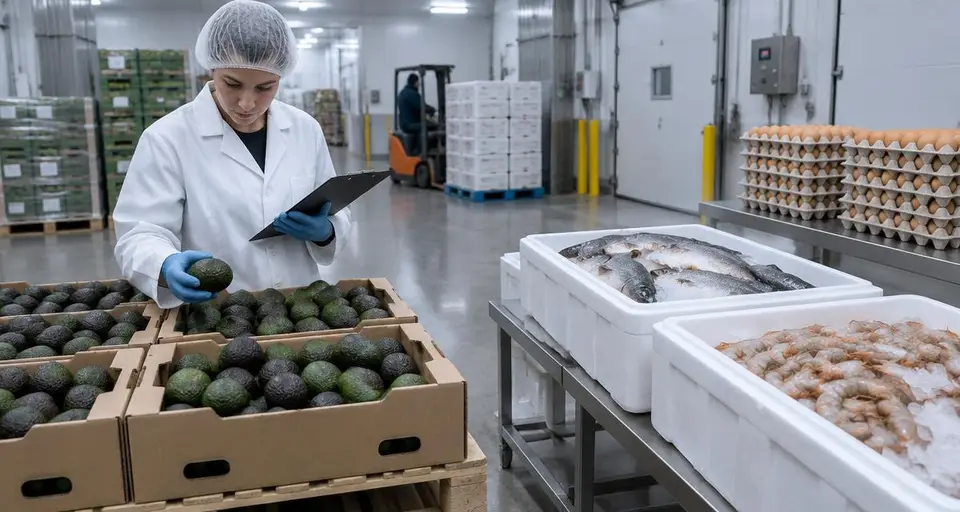
This guide follows the order in which a category team usually works, from specification to pilot. It applies to fresh produce such as bulk avocados, to fish and seafood and shrimp and prawns, and to poultry and eggs. Dry staples follow the same logic; see grains and pulses.
Step 1: How do you define specifications and forecast demand?
Write the specification so that two suppliers in different countries would quote exactly the same product. Vague words such as premium or export quality lead to offers that cannot be compared. The free specification builder helps turn a product idea into measurable requirements.
- Produce: variety, size or count per carton, ripeness or dry-matter target, defect tolerances and class. For avocados, buyers often reference the UNECE FFV-42 standard as a starting point.
- Seafood and shrimp: species, fresh or frozen, count per kilo or pound, glaze percentage and whether the price is on net or gross weight.
- Eggs: size grade, shell colour, shell or liquid product, and pack format.
- Demand: weekly volume by store cluster or warehouse, promotional peaks, and the minimum and maximum you will commit to.
Step 2: How should you qualify suppliers and their documents?
Ask for evidence, not descriptions. A qualified supplier can show who produces, packs and exports the goods, which food-safety certificates are current, and which export documents the destination usually requires. Typical items include phytosanitary certificates for plant products, official health certificates for animal products, catch or origin documents for seafood, and certificates of analysis.
Which of these your market actually requires depends on the product, origin and destination. Treat every requirement as an item to verify with the competent authority before you commit.
Step 3: How do you compare the full landed cost?
The cheapest unit price is often not the cheapest product on your shelf. Build each offer up to the same point of delivery and include product, packaging, freight, insurance, any duties and border fees that apply, handling, cold chain and expected loss or shrink. Make sure every quote names the same Incoterms® rule; our guide to comparing FOB, CFR and CIF quotes shows how.
To test scenarios with your own figures, use the free agricultural landed-cost calculator. Every number in it is a user-entered assumption; it does not give tax or customs advice, and duty rates must be confirmed for your tariff code.
Step 4: How do you plan seasonality and continuity?
Map each product by month and origin, and name at least one back-up origin for every key line. Counter-season sourcing, for example switching between northern and southern hemisphere growers, can keep shelves full, but transit time, shelf life and price swings change when the origin changes. Agree in advance what happens if a supplier misses a shipment: substitution rules, notice periods and who pays for air freight.
Step 5: How should you assess quality, traceability and risk?
Define how quality is checked at loading and on arrival: sampling plan, temperature records, photos and the tolerance that triggers a claim. Ask how lots are traced from farm, vessel or flock to your pallet. Some markets set specific traceability record rules for listed foods, so check what applies to you. Assess risk as well: currency, payment terms, single-origin dependence and the supplier's financial strength.
Step 6: What should a clear RFQ include?
One complete request saves weeks of back-and-forth. It should state the product specification, volumes, delivery window, destination, packaging and labelling, required documents, the Incoterms® rule, quality checks and the date by which you need offers. The downloadable checklist below covers each of these points.
Step 7: How do you compare offers fairly?
Put every offer in one table on identical terms: same specification, same unit and weight basis, same delivery point and the same currency. Mark each figure as a supplier quote or as your own estimate, with its date. Offers that leave items blank are not cheaper; they are incomplete. Ask the supplier to fill the gap before you rank them.
Step 8: How do you pilot and monitor supply?
Start with a trial order of limited volume and agree beforehand what a successful pilot looks like: arrival quality, on-time delivery, documents correct the first time, and sell-through. Review the results with the supplier, then scale step by step. Keep monitoring the same measures every season.
For a wider view of running a multi-category program, read how to structure a cross-border procurement program; for premium lines at scale, see the premium produce and seafood buyer's guide. More guides are in the Knowledge Center.
Global Food Sourcing RFQ Checklist
Use this checklist to prepare one complete request. It is free to use and download, with no email required. Fill in what you know; leave the rest for the supplier to confirm.
Buyer and supplier
- Buyer company, country and type (supermarket, importer, wholesaler, institution)
- Preferred or excluded origins
- Supplier role required: producer, packer or exporter
- Food-safety certificates the supplier must hold (to be verified)
Product and specification
- Product and variety or species
- Size, count or grade
- Class, ripeness or quality tolerances
- Fresh, chilled or frozen; glaze and net-weight basis for seafood
Volume and delivery window
- Volume per shipment and per month
- First delivery date and program length
- Delivery frequency and flexibility range
- Destination port, warehouse or distribution centre
Packaging and labelling
- Pack size and carton type
- Pallet pattern and container type
- Labels: language, private label, required markings (to be verified)
- Temperature range during transport
Documentation
- Phytosanitary or official health certificate, where required
- Certificate of origin and catch or traceability documents, where required
- Certificate of analysis and inspection report
- Commercial invoice and packing list
Incoterms® and landed-cost inputs
- Incoterms® rule and named place
- Product price, packaging and freight
- Insurance, duties and border fees that apply (to be confirmed)
- Handling, cold chain, expected loss and currency
Quality requirements
- Sampling plan at loading and arrival
- Temperature and photo records
- Claim tolerance and claim process
- Pilot order size and success criteria
Frequently asked questions
- What does a B2B food procurement service do for a supermarket?
- It turns your requirements into one structured request, contacts suitable suppliers on your behalf and returns comparable offers. At Global B2B Group our team does the supplier outreach; we do not connect buyers directly to suppliers, and the service is free for buyers.
- How many bulk food suppliers should we compare?
- Enough to compare price and continuity, usually several suppliers per key line, plus at least one back-up origin. Quality of comparison matters more than the number of offers.
- Which documents do we need to import seafood or eggs?
- It depends on the product, origin and destination country. Animal products often need official health certificates and seafood may need catch or origin documents, but you must confirm the exact list with the competent authority or a licensed customs broker.
- Is the lowest quote the best offer?
- Not necessarily. Compare full landed cost on the same Incoterms® rule, specification and weight basis, and include handling, cold chain and expected loss before you decide.
Official references
- Incoterms® rules — International Chamber of Commerce
- UNECE Standard FFV-42 — avocados — UNECE
- Standard for Quick-Frozen Shrimps or Prawns (CXS 92-1981) — FAO/WHO Codex Alimentarius
- International Plant Protection Convention — phytosanitary certification — IPPC / FAO
- FAQs — Certification (official certificates for animal products) — European Commission, DG SANTE
- Food Traceability List — U.S. Food and Drug Administration
These references explain standards and document types. They are not legal advice; confirm the rules that apply to your product, origin and destination with the competent authority or a licensed customs broker.