

Sourcing fruit and nuts from Mozambique: what is exported, when, with which documents — and how to request offers
Recorded exports and destinations by product, the season evidence that actually exists, official export and market-access requirements, ports and cold chain, and a buyer-side RFQ for importers and large buyers.
Prepared by the Global B2B Group project team · Published · Last reviewed · Scope: Fresh fruit and nuts grown in Mozambique and shipped to buyers abroad (EU, UK, South Africa, China, the Middle East and others). Export rules are Mozambique's; import rules are the destination's — both change, so confirm them for each product, HS code and shipment.
Also available in: Português (Moçambique)
What can a business buyer source from Mozambique, and how?
By recorded value in 2024, Mozambique's main fruit and nut exports were raw cashew (US$98.2 million), bananas (US$36.6 million, almost all to South Africa), cashew kernels (US$19.1 million) and in-shell macadamia (US$9.0 million), followed by avocado (US$3.8 million) and a smaller fresh-fruit line that includes litchi (UN Comtrade). Manica Province is the documented centre for avocado, litchi and macadamia; Maputo Province for bananas; the north for cashew. No commercial cherry production was found. Every consignment needs a phytosanitary certificate from Mozambique's plant protection service and the destination's own conditions — China, for example, admits Mozambican cashew and macadamia only from registered establishments. Global B2B Group does not grow, export or hold stock: you send one confidential request, our team approaches suitable suppliers on your behalf and returns comparable offers. Free for buyers; programmes from USD 250,000 per year or season.
Mozambique's fruit and nut exports by product (2024 data)
UN Comtrade's 2024 series for Mozambique, re-read on 25 October 2026. Comtrade flags these records as not reported by Mozambique itself, so treat them as an indication of scale and direction, not as customs declarations. Values are US dollars; tonnes are net weight. Some HS codes cover more than one fruit.
| Product (HS code) | Recorded exports, 2024 | Main recorded destinations, 2024 | Producing areas named in sources | Notes for buyers |
|---|---|---|---|---|
| Raw cashew in shell (0801.31) | US$98.2 million; 88,542 t | Viet Nam, India | About 70% of cashew trees in Nampula, Zambézia and Cabo Delgado (TechnoServe, 2015 — historical share) | Raw-nut exports are regulated by the Instituto de Amêndoas de Moçambique (IAM): annual registration, credential, quality certificate and a surtax set each season |
| Bananas (0803) | US$36.6 million; 101,809 t | South Africa (almost all of the value) | Maputo Province (Boane, Namaacha, Goba, Moamba) and Gaza; historically Nampula | Panama disease TR4 devastated northern plantations from 2013 (TechnoServe, 2019). South Africa admits mature-green bananas only from production units and packhouses approved under a bilateral workplan |
| Groundnuts, shelled (1202.42) | US$29.7 million; 28,324 t | Indonesia (top recorded destination) | Not verified by province | An oilseed code, listed because the trade is substantial; no season or province ranking verified |
| Cashew kernels (0801.32) | US$19.1 million; 12,750 t | Viet Nam, South Africa, India, Portugal, Germany | Processors in Nampula, Cabo Delgado, Gaza and Maputo provinces (2023 mapping) | China admits Mozambican cashew only from establishments registered with GACC (Announcement 2024 No. 123) |
| Macadamia in shell (0802.61) | US$9.0 million; 4,532 t | South Africa, Viet Nam | Manica, Niassa and Maputo provinces; Gurué (Zambézia) | IAM counted 58 commercial enterprises on over 8,000 ha in the 2023/24 season. Much nut-in-shell is cracked or traded on in South Africa |
| Avocado (0804.40) | US$3.8 million; 3,009 t | Netherlands, United Kingdom, South Africa, France, Spain | Manica (Sussundenga; Catandica, Báruè) | 2023 was larger (US$5.5 million), mostly to South Africa |
| Other fresh fruit, includes litchi (0810.90) | US$1.2 million; 655 t | France, United Kingdom, Netherlands, South Africa, United Arab Emirates | Manica (Báruè district, Catandica) | Not a litchi-only code. Manica's government expected about 490 t of litchi exports to Europe in the 2024/25 campaign |
| Mango, guava and mangosteen (0804.50) | US$0.80 million; 1,150 t | South Africa (most), Netherlands | Not verified nationally | Shared code; no fresh-mango export calendar verified |
| Citrus (0805) | US$21,257; 22 t | Too small to rank in 2024; in 2023 (US$2.6 million) mostly the United Arab Emirates | Maputo Province (Boane, Umbeluzi); Gaza (Massingir) | Large swing between years that the sources do not explain. A 505 ha Massingir project launched its citrus harvest in June 2025 and plans regional exports |
Cherries: no commercial production found in Mozambique
We found no commercial cherry orchard, grower or exporter in Mozambique. World Bank WITS shows 411 kg of fresh cherry exports in 2024 (gross exports, worth about US$900) to four destinations — a statistical record that does not show the cherries were grown in Mozambique. This guide therefore does not present Mozambique as a cherry origin. For cherries, see the cherry guides linked below.
Where Mozambique's fruit and nuts go: import demand signals
Recorded destinations are not always final markets. South Africa packs, cracks or re-routes part of what it receives, and EU fruit often enters through the Netherlands. A macadamia exporter in Manica told AIM in 2023 that China is its main market, reached through South Africa. Partner-reported imports — what the destination recorded as coming from Mozambique — give a second view. They differ from Mozambique's series because of timing, valuation (imports are usually CIF, exports FOB) and transit.
- The tables describe recorded trade — not available stock, prices or a forecast.
- Missing countries in a table mean the figure was not in the query, not zero trade.
| Destination (reporter) | Product | Recorded imports from Mozambique, 2023 |
|---|---|---|
| South Africa | Bananas (0803) | US$29.1 million; 130,751 t |
| South Africa | Macadamia in shell (0802.61) | US$6.0 million; 2,914 t |
| South Africa | Cashew kernels (0801.32) | US$1.8 million; 519 t |
| Netherlands | Avocado (0804.40) | US$11.0 million; 2,571 t — far above Mozambique's own recorded avocado exports to the Netherlands that year (US$0.41 million) |
| Netherlands | Shelled macadamia (0802.62) | US$1.2 million; 113 t |
| United Arab Emirates | Cashew kernels (0801.32) | US$2.0 million; 638 t |
Harvest and export seasons: only what a dated source states
No source we checked gives a national harvest calendar for every crop. Each row below is the window one dated source reports, with its scope. Suppliers confirm their own windows in each offer.
| Product | What the source says | Scope of that evidence |
|---|---|---|
| Litchi | Not verified by an official or independent source; Manica's provincial government expected about 490 t of litchi exports to Europe in the 2024/25 campaign (360 Mozambique, 21 November 2024) | Manica province — a campaign estimate, not a harvest calendar |
| Avocado (Hass) | Not verified | No official or independent source states harvest months — suppliers confirm windows in each offer |
| Macadamia | Not verified | No official or independent source states harvest or shipping months — suppliers confirm windows in each offer |
| Cashew | Harvest from October to February (TechnoServe, 2015); the 2024/25 raw-cashew export campaign opened on 18 November 2024 (IAM) | National crop description (2015) and one official campaign date |
| Citrus | Citrus harvest season launched at Massingir on 21 June 2025 (ministry, via 360 Mozambique) | One project in Gaza |
| Bananas | Not verified | No source states harvest or export months — we do not assume year-round supply |
| Mango | Not verified for fresh fruit | A 2018 report on a dryer in Inhambane gives a November–March drying window, which is not a fresh-mango export season |
Market access by destination (official sources, checked 25 October 2026)
Each destination sets its own conditions. The table names what each official source says and what to ask for. It does not confirm that a particular product, supplier or shipment is eligible.
| Destination | What the official source says | What a buyer should ask for |
|---|---|---|
| European Union | Fresh avocado, litchi, mango and citrus need a phytosanitary certificate from the exporting country's plant protection service; bananas are one of five fruits exempt from that certificate (DG SANTE). Citrus and mango must meet one of the fruit-fly options in Regulation (EU) 2019/2072, Annex VII point 61; most citrus also falls under the false codling moth rules in points 62 and 62.1. Citrus must meet the EU marketing standard (Regulation 2023/2429). The EU importer pre-notifies controlled consignments with a CHED-PP in TRACES | Which Annex VII option the certificate states, the CN code, and whether your EU authority requires a CHED-PP for this product |
| South Africa | The importer applies for an NPPOZA import permit unless the product is exempt; the original phytosanitary certificate travels with the goods. Mozambican bananas enter under a workplan for mature-green fruit from production units and packhouses registered, audited and approved each year by Mozambique's plant protection service | The current approved facility codes (the 2025 list names them) and the permit conditions for other products |
| China | GACC Announcement 2024 No. 123 (in force 14 September 2024) admits Mozambique-grown cashew and macadamia, shelled or in shell, selected and dried for human consumption, from establishments recommended by Mozambique and registered by China; it requires fumigation, freedom from live insects and soil, marked packaging and a phytosanitary certificate with the establishment's China registration number | The supplier's current GACC registration. For fresh fruit, no Mozambique protocol appeared in the official pages we checked — that is not a ban finding; ask your Chinese importer for the current GACC list entry |
| United Arab Emirates | Release of fresh fruit and vegetables needs the exporting country's phytosanitary certificate, an invoice or contents list and a certificate of origin if the certificate does not state origin; pesticide-residue analysis applies where ministry circulars require it | Confirm the circulars for your product; other Gulf states apply their own rules |
| India (raw cashew) | Imports of plants and plant products are regulated by the Plant Quarantine Order 2003; we could not verify the current entry conditions for raw cashew from Mozambique | Written confirmation of the current conditions from your Indian importer before booking |
Export documentation checklist for buyers sourcing from Mozambique
Mozambique's plant protection service sits in the Ministry of Agriculture, Environment and Fisheries (MAAP), National Directorate of Sanitary and Biosecurity; it inspects consignments and issues phytosanitary certificates. In 2025 it introduced a new certificate with a QR code and watermark and began transmitting certificates through the IPPC ePhyto Hub — confirm which format your destination accepts.
- Mozambique reported in 2008 that it had lost fruit-fly-free status (Bactrocera invadens, now treated as B. dorsalis) — ask for current pest-status evidence for the orchard, not an old regional declaration.
- Private certificates (for example GLOBALG.A.P.) do not replace the official phytosanitary certificate; check any certificate's scope and validity in the scheme's own database.
| Stage | Ask for or check |
|---|---|
| Before you contract | Exact species and variety, product state (fresh, raw in shell, dried, shelled), HS/CN code, destination and route — each changes the rules |
| Supplier's legal status | Company registration and tax number (NUIT), commercial licence and registration as a foreign-trade operator (exporter) |
| Access for your market | Your import permit or the destination's conditions; approved production unit, packhouse or establishment codes where the destination requires them |
| Phytosanitary certificate | Issued by Mozambique's plant protection service (MAAP), or an ePhyto your destination accepts, with the correct botanical name, origin, approved codes and any required additional declarations |
| Pest and treatment records | Only where required: pest-free area or surveillance evidence, or the treatment details the protocol prescribes (for example fumigation for China-bound nuts) |
| Customs and commercial file | Commercial invoice, packing list, transport document, export declaration lodged through Mozambique customs' electronic single window (JUE) |
| Proof of origin, if claiming a preference | A SADC certificate of origin for SADC trade, or an EUR.1 or origin declaration under the EU–SADC EPA (Mozambique has applied it since 4 February 2018) — these are not interchangeable |
| Raw cashew, additionally | IAM registration as a cashew actor (by 15 September each year), IAM credential and quality certificate, 80 kg jute bags, minimum outturn of 44 lb, and the season's export surtax paid before shipment |
| Cold chain | A written handling specification agreed with packhouse, carrier and terminal, plus temperature records — separate from any treatment record a protocol requires |
Ports, roads and cold chain
Three ports publish refrigerated-container capacity: Maputo (600 reefer points, port page dated 2020), Beira (148 reefer connection points, Cornelder) and Nacala (21 reefer outlets, CFM, undated). These are published snapshots — confirm live plug availability and sailings when you book. Road freight to South Africa uses the EN4/N4 Maputo Corridor through Ressano Garcia–Lebombo, where roadworks were scheduled in 2025.
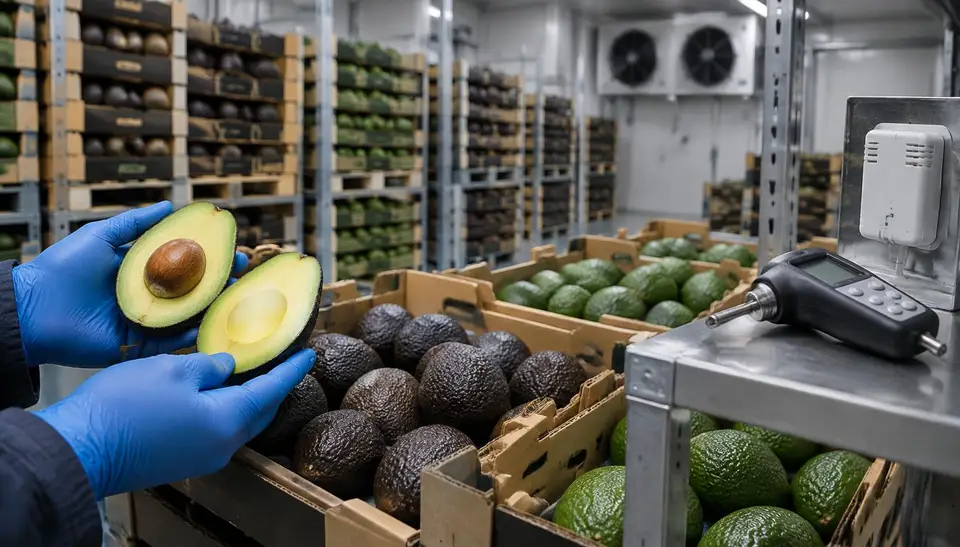
Handling depends on the product. UC Davis postharvest guidance gives different storage ranges for mature-green and ripe avocados, depending on cultivar and voyage length, so the setpoint must be agreed for each cultivar and route. Litchi is harvested fully ripe and does not ripen after harvest; high humidity is essential to limit water loss and browning. Any colour treatment used on litchi must be accepted by the destination — UC Davis notes that SO₂ bleaching was not approved for litchi sold in the USA. Nuts follow a different regime: China's protocol stresses drying, clean breathable packaging and freedom from insects.
What to put in a Mozambique produce RFQ
- Product and variety (for example Hass avocado, litchi, mature-green banana, macadamia nut-in-shell or kernel style, raw cashew or kernel grade).
- Grade, size or count, and for nuts the outturn, moisture or kernel specification you buy to.
- Volume per week or month, season total and arrival window — the supplier confirms the harvest window.
- Packaging, labels and language, palletisation.
- Incoterm and place (for example FOB Maputo, CIF Rotterdam), destination port, currency and quote validity.
- Destination documents: phytosanitary requirements, approved facility codes, origin proof for any tariff preference, and any certification your customers require.
- Traceability back to orchard, packhouse or processing establishment, and the records you need with each shipment.
What Global B2B Group does — and does not do — for Mozambique produce
We do
- Reviews your confidential request and completes the specification with you, free for buyers
- Approaches suitable suppliers on your behalf and handles the communication; your identity is shared only after review and with your approval
- Returns offers on one basis, each price labelled as a supplier quote or an estimate, with the documents each supplier provided marked as not yet verified until you or your inspector have checked them
We do not
- Grow, pack, export, import or sell produce, or hold stock — producers and exporters are responsible for product, quality, certification and export documents, importers for their own import permissions
- Certify, inspect or approve consignments — that is for Mozambique's plant protection service, the destination authority and accredited bodies
- Publish or share supplier contact details, or confirm availability, seasons or prices before suppliers have done so
Put these in your request
- Product, variety, grade and size (or nut specification)
- Volume, season total and arrival window
- Destination, Incoterm and documents required
- Packaging, labels and traceability records
- Certifications your customers require
- Programme value per year or season
Our team turns these points into one reviewed request and approaches suitable suppliers on your behalf. Buyers pay nothing; sourcing programmes start from USD 250,000 per year or season, and every requirement is confirmed per shipment rather than assumed.
Tools for this request
Request a Mozambique fruit or nut programme
For importers, distributors, wholesalers, retailers, food-service buyers and processors. Buyer RFQs are free. The USD 250,000 minimum applies to the total annual or seasonal programme value you declare — not to each shipment. Smaller programmes are kept on file but do not enter supplier outreach.
Fields marked * are required. Leave anything you don't know blank — it is recorded as "unknown", not guessed. We do not list or promise stock; every offer is sourced for your request. Availability, origin, certificates, prices and lead times are confirmed only after verification for your request; the producer or supplier remains responsible for the product and its documents.
How we evaluate fit and compare offers
Selling produce rather than buying? Use the producer and exporter form
Frequently asked questions
Which fruit and nuts does Mozambique export commercially?
By recorded 2024 value: raw cashew in shell (US$98.2 million), bananas (US$36.6 million), shelled groundnuts (US$29.7 million), cashew kernels (US$19.1 million), in-shell macadamia (US$9.0 million), avocado (US$3.8 million) and other fresh fruit including litchi (US$1.2 million), according to UN Comtrade's series for Mozambique. Bananas go almost entirely to South Africa; raw cashew to Viet Nam and India; avocado mainly to the Netherlands, the UK and South Africa.
Official guidance: UN Comtrade (UN Statistics Division) public API — Mozambique exports by HS code, 2024 (records flagged as not reported by Mozambique itself)
Does Mozambique grow or export cherries?
We found no commercial cherry production or named cherry exporter in Mozambique. World Bank WITS records 411 kg of fresh cherry exports in 2024 — a statistical entry that does not show the fruit was grown there. We do not present Mozambique as a cherry origin.
Official guidance: World Bank WITS — Mozambique fresh cherry exports (HS 080920), 2024: 411 kg, gross exports
When is the Mozambique litchi season?
No official or independent source we checked gives national litchi harvest dates. Manica's provincial government expected about 490 t of litchi exports to Europe in the 2024/25 campaign; each supplier confirms its own window in its offer.
Official guidance: 360 Mozambique (citing Notícias and the Manica provincial government) — plan to export 600 tonnes of lychee to Europe each year, 21 November 2024
Which documents does a buyer need for fresh fruit from Mozambique?
A phytosanitary certificate issued by Mozambique's plant protection service (Ministry of Agriculture, Environment and Fisheries) or an ePhyto your destination accepts; the commercial invoice, packing list and transport document; the export declaration lodged through Mozambique's customs single window; proof of origin if you claim a tariff preference; and whatever the destination requires — for example a South African import permit and approved facility codes for bananas, or an EU CHED-PP for controlled consignments.
Official guidance: Mozambique Ministry of Agriculture — plant health (Sanidade Vegetal): inspection and phytosanitary certificates for import and export (undated; Portuguese)
Can Mozambican cashew and macadamia nuts be exported to China?
Yes, under conditions. GACC Announcement 2024 No. 123, in force since 14 September 2024, admits Mozambique-grown cashew and macadamia for human consumption from establishments recommended by Mozambique and registered by China, with fumigation and a phytosanitary certificate carrying the establishment's China registration number. Check the supplier's current registration. No Mozambique fresh-fruit protocol for China appeared in the official pages we checked.
How do I request offers for Mozambique produce?
Use the request form on this page: choose the category, then give product and variety, grade or nut specification, volume, delivery window, packaging, destination and Incoterms® rule and place. Our team reviews it and approaches suppliers on your behalf — there is no direct buyer-supplier contact before you approve an introduction. Buyers pay nothing; assisted sourcing applies to programmes of USD 250,000 or more per year or season.
Is Global B2B Group an exporter or certifier of Mozambican produce?
No. We coordinate procurement for buyers. We do not grow, pack, export, import or certify anything. Producers and exporters are responsible for their products and export documents, importers for their own permits, and official approvals come from the competent authorities.
Sources
- UN Comtrade (UN Statistics Division) public API — Mozambique exports by HS code, 2024 (records flagged as not reported by Mozambique itself) — checked 25 October 2026
- UN Comtrade public API — 2023 imports from Mozambique reported by the Netherlands, South Africa and the United Arab Emirates (partner-reported) — checked 25 October 2026
- World Bank WITS — Mozambique avocado exports by partner, 2024 (UN Comtrade data) — checked 25 October 2026
- World Bank WITS — Mozambique fresh cherry exports (HS 080920), 2024: 411 kg, gross exports — checked 25 October 2026
- 360 Mozambique (citing Notícias and the Manica provincial government) — plan to export 600 tonnes of lychee to Europe each year, 21 November 2024 — checked 25 October 2026
- Club of Mozambique (citing the Instituto de Amêndoas de Moçambique) — macadamia production reaches 5,000 tonnes, 2 January 2025 (2023/24 season) — checked 25 October 2026
- TechnoServe — Cashew production in Mozambique: from tree to trade, 18 September 2015 — checked 25 October 2026
- Instituto de Amêndoas de Moçambique (IAM, IP) — raw cashew export opens on 18 November (2024/25 campaign), 14 November 2024 (Portuguese) — checked 25 October 2026
- Instituto de Amêndoas de Moçambique (IAM, IP) — requirements for exporting raw cashew nuts (undated; Portuguese) — checked 25 October 2026
- 360 Mozambique (citing the agriculture ministry) — Massingir citrus project to export to regional countries, 27 June 2025 — checked 25 October 2026
- FreshPlaza — South African banana prices would surge without regional imports (BANANAMOZ), 16 December 2025 — checked 25 October 2026
- TechnoServe — Leading the fight to control banana diseases (Panama disease TR4 in Nampula), 18 December 2019 — checked 25 October 2026
- IPPC — Mozambique country page: national plant protection organisation, Ministry of Agriculture, Environment and Fisheries (MAAP) — checked 25 October 2026
- Mozambique Ministry of Agriculture — plant health (Sanidade Vegetal): inspection and phytosanitary certificates for import and export (undated; Portuguese) — checked 25 October 2026
- IPPC (Mozambique NPPO report) — change in the issuance of the phytosanitary certificate, joining the ePhyto Hub, 30 May 2025 (updated 24 November 2025) — checked 25 October 2026
- IPPC (Mozambique NPPO pest report) — occurrence of the fruit fly Bactrocera invadens in Mozambique, 14 November 2008 — checked 25 October 2026
- Portal do Comércio Externo de Moçambique — export guide (information current at 1 January 2023; PDF, Portuguese) — checked 25 October 2026
- European Commission Access2Markets — EU–SADC Economic Partnership Agreement (Mozambique applying it since 4 February 2018) — checked 25 October 2026
- European Commission (DG SANTE) — trade of plants and plant products from non-EU countries (phytosanitary certificates; five exempt fruits including bananas) — checked 25 October 2026
- EUR-Lex — Commission Implementing Regulation (EU) 2019/2072, plant health import requirements (Annex VII points 61, 62 and 62.1; Annex XI) — checked 25 October 2026
- EUR-Lex — Commission Delegated Regulation (EU) 2023/2429, marketing standards including the standard for citrus fruit — checked 25 October 2026
- European Commission — TRACES modules: CHED-PP pre-notification for plants and plant products — checked 25 October 2026
- South African Government — phytosanitary import permit (NPPOZA) — checked 25 October 2026
- South Africa Department of Agriculture — phytosanitary workplan for mature green bananas (Musa spp.) from Mozambique (PDF, undated) — checked 25 October 2026
- South Africa Department of Agriculture (list supplied by Mozambique's plant protection service) — approved and registered banana facilities in Mozambique for export to South Africa, 2025 season (PDF) — checked 25 October 2026
- GACC Announcement 2024 No. 123 on plant-quarantine requirements for Mozambique cashew and macadamia nuts, effective 14 September 2024 (published by China's Ministry of Commerce; Chinese) — checked 25 October 2026
- UAE Ministry of Climate Change and Environment — release of agricultural products consignment — checked 25 October 2026
- Maputo Port Development Company — container terminal (600 reefer points; page dated 27 September 2020) — checked 25 October 2026
- Cornelder de Moçambique — Beira port terminals (148 reefer connection points; undated, Portuguese) — checked 25 October 2026
- CFM (Portos e Caminhos de Ferro de Moçambique) — Port of Nacala (21 reefer outlets; undated) — checked 25 October 2026
- TRAC (N4/EN4 Maputo Corridor concessionaire) — four major projects on the N4, including Ressano Garcia–Moamba, 11 February 2025 — checked 25 October 2026
- UC Davis Postharvest Research and Extension Center — avocado produce facts (Kader and Arpaia, updated February 1999) — checked 25 October 2026
- UC Davis Postharvest Research and Extension Center — lychee produce facts (Kader, updated May 1998) — checked 25 October 2026
This guide summarises official sources for planning a sourcing request. It is not legal or customs advice; rules change and depend on the product, HS code, origin, destination and date — confirm them with the authority or your customs broker before you ship.