
Grains & pulses · Buyer profile
Bulk rice for import: long-grain, parboiled and aromatic specifications
Codex CXS 198 covers husked, milled, and parboiled rice for direct human consumption.[1]
USA Rice distinguishes long-, medium-, and short-grain rice as well as milling forms.[2]
Free for buyers. One reviewed request; our team approaches suitable independent suppliers and returns comparable proposals — you never deal with a supplier directly, and suppliers cannot pay for placement. Assisted sourcing applies to programmes of USD 250,000 or more per year or season.
Educational profile, not an offer. Facts are general and come from the numbered sources; guidance boxes are our own buyer advice. No verified supplier offer for this item is on file — origin, grade, certification, packing and timing are confirmed per offer, with evidence, during sourcing.
At a glance
Short answers to the questions buyers ask first. Each answer comes from the numbered sources below.
- Which types do buyers specify?
- Long grain, Medium grain, Short grain, Husked / brown, Milled / white, Parboiled, Aromatic.[2],[1]
- How is quality graded?
- Codex sets a maximum moisture content of 15% by mass.[1]
- What do the sources say about seasons?
- USDA NASS provides state-specific usual planting and harvesting dates rather than one national field-crop calendar.[3]
- How is it stored and shipped?
- Lower moisture limits may be needed for particular climates and transport or storage durations.[1]
- What makes it premium?
- The sources used define no separate premium grade; write premium criteria as measurable specifications.
What rice is
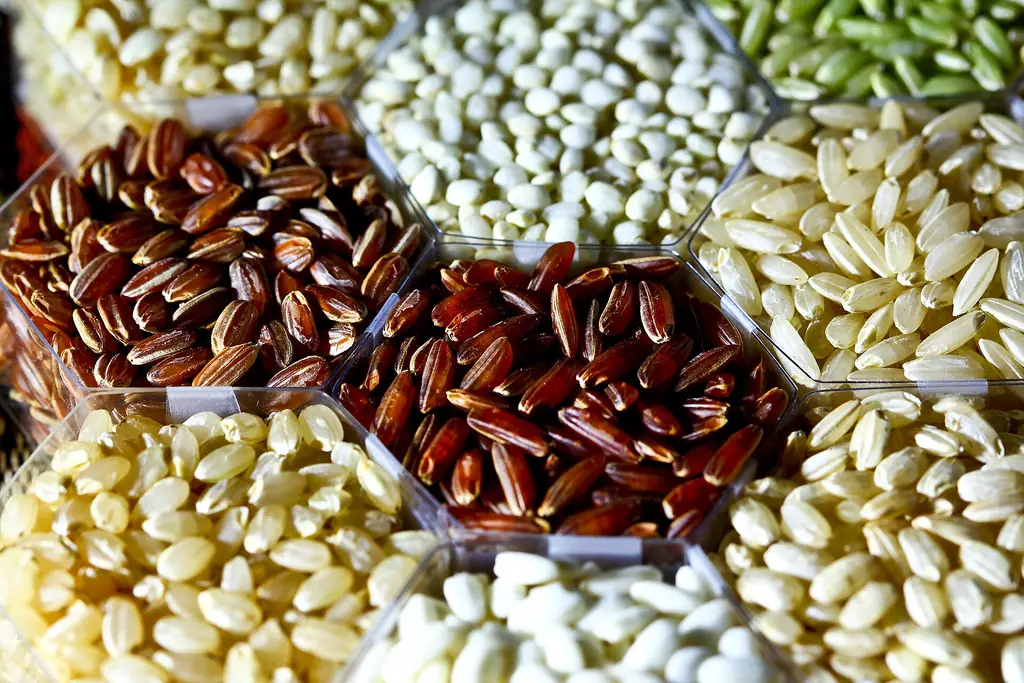
Recognized types and varieties
How the types buyers name in requests differ, as described by the sources. Pick one to carry it into your request.
Long grain
- Long-grain kernels cook lighter, fluffier, and more separated than medium- or short-grain kernels.[2]
Medium grain
- Medium-grain rice cooks moist and tender, with grains tending to cling together.[2]
Short grain
- Short-grain rice has a short, plump kernel and a soft, sticky cooked texture.[2]
Husked / brown
- Husked rice has had only the husk removed; handling may remove some bran.[1]
Milled / white
- Milled rice has had all or part of its bran and germ removed.[1]
Parboiled
- Parboiled rice is soaked, heat-treated to gelatinize its starch, and dried; it can be husked or milled.[1]
Aromatic
- USA Rice describes jasmine and basmati as aromatic rice types.[2]
Commercial formats, classes and grades
- Codex sets a maximum moisture content of 15% by mass.[1]
- CXS 198 requires rice to be free from abnormal flavors, odors, living insects, and mites.[1]
- The Codex annex addresses broken kernels and defects including damaged, yellow, and chalky kernels.[1]
- The annex provides alternative grain-size classification approaches rather than one universal length definition.[1]
- Glutinous rice is outside the scope of CXS 198.[1]
Typical uses and buyer profiles
- Long-grain rice works in pilafs, stir-fries, salads, and soups.[2]
- Medium-grain rice is used in risotto and paella.[2]
- Short-grain rice is used for sushi and rice pudding.[2]
Who typically specifies this — general guidance
- For your buying team, identify the intended end use before selecting a specification.
- Ask your technical team to approve a representative sample before contracting.
Seasonality and sourcing considerations
Season windows are shown as the sources state them; confirm packing or harvest weeks with each supplier for the season you buy.
- USDA NASS provides state-specific usual planting and harvesting dates rather than one national field-crop calendar.[3]
Storage, handling and logistics
Strengths, trade-offs and best fit
Strengths
- Different kernel types provide distinct cooked textures for different dishes.[2]
Best fit when… — general guidance
- Match the specification to your process and destination requirements.
What to state in your request
- State destination country and delivery point.
- Specify product type and intended use.
- Name the grade standard and edition.
- Set measurable acceptance limits and test methods.
- Request lot identification and traceability documents.
- Specify packaging, net weight, and labeling.
- State shipment windows and annual or seasonal volume.
- Agree sampling, inspection, and rejection procedures.
- Specify grain-size classification method, broken percentage, milling degree, and desired cooked texture.
- Name the aromatic variety and agree an identity-testing approach if required.
Start your request with these requirements
Fill in what you already know; it is carried into the request form, where you add your programme value and contact details. Nothing is sent until you submit the form.
Free for buyers. One reviewed request; our team approaches suitable independent suppliers and returns comparable proposals — you never deal with a supplier directly, and suppliers cannot pay for placement. Assisted sourcing applies to programmes of USD 250,000 or more per year or season.
Compliance, documents and who is responsible
- Requirements for rice depend on the product and on the origin and destination countries — check them for your own market before you commit.
- The producer or exporter is responsible for the product and shipment requirements; the buyer or importer for import permissions, local rules and its own due diligence.
- Certificates (for example GLOBALG.A.P., BRCGS, ASC, BAP, organic or halal) are requested per offer and checked against the issuing body or official register. Global B2B Group does not manufacture, export or certify products and does not give legal advice.
Frequently asked questions
Is brown rice a different species from white rice?
Codex defines husked and milled rice as different processing forms of rice from Oryza sativa L.[1]
Does parboiled mean white rice?
No. Codex allows parboiled rice to be either husked or milled.[1]
Does CXS 198 cover sticky rice?
Glutinous rice is explicitly excluded from its scope.[1]
Related guides and tools
Farm, plant or input projects
Production projects behind this product — farms, hatcheries, processing or growing systems — are handled by our specialist platform.
FeedMatchSources
Numbers in the text point to these sources. Dates are those shown on each source, or the date we checked an undated page.
- 1.Standard for Rice, CXS 198-1995 (opens in a new tab) — FAO/WHO Codex Alimentarius, page checked 2026-10-25
- 2.U.S. Rice Varieties (opens in a new tab) — USA Rice, page checked 2026-10-25
- 3.Usual Planting and Harvesting Dates for U.S. Field Crops (opens in a new tab) — USDA NASS, 2010-10-29
Profile last reviewed 2026-10-25. Report a correction via contact.
Global B2B Group is committed to conducting its own activities in accordance with applicable law. It facilitates sourcing and RFQs and does not itself produce, manufacture, export or sell the listed products, or approve them on behalf of any authority. Suppliers are responsible for the products and shipments they offer and supply meeting the requirements of the origin and destination countries — for example safety, quality, labelling, traceability, sanitary or phytosanitary certificates and export documents, where relevant. Buyers remain responsible for their own import permissions, local requirements and due diligence. Requirements differ by product and country; this is not legal advice. Compliance & responsibilities · Terms