
Buyer guide · Recurring and seasonal programmes
Global food sourcing for large buyers: compare landed cost, seasonality and supply options
For procurement leaders at retail chains, wholesalers, food-service groups, processors and importers who buy produce and food commodities repeatedly and at scale.
Prepared by the Global B2B Group project team
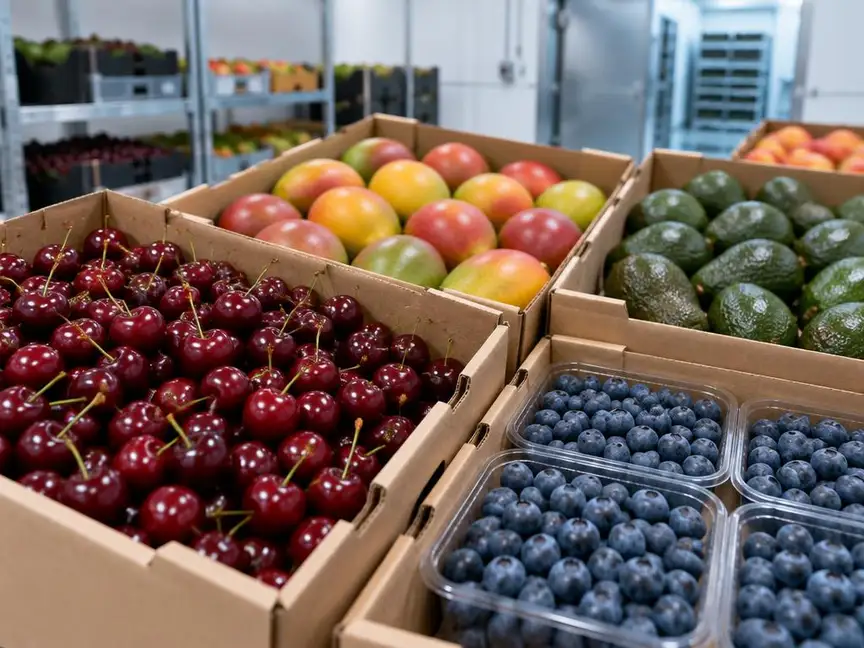
The short answer
Large buyers get a fairer picture of supply options when every supplier answers the same written specification and prices on the same terms. Compare total landed cost — product, packaging, freight, insurance, duties, clearance and cold-chain handling to your door — not the ex-works or FOB price alone, and test more than one origin and season. A managed sourcing process can collect and line up those responses for you; it cannot promise a lower price or guaranteed supply, and you still decide and contract directly with the supplier.
Why the unit price alone misleads at scale
Two quotes for the same product can look close per kilo and end up far apart at the warehouse door. One may be FOB, the other CFR; one may assume a different pack size, pallet configuration or count; one may be valid for seven days and the other for a season. Once freight, duties, clearance, cold-chain handling and losses are added, the order can change.
For a buyer placing repeat orders, the decision that matters is the cost and risk of the whole programme across a year or season — including what happens when the main origin is out of season or short of fruit.
What to compare: a practical basis for every offer
Ask every supplier to answer these points in the same order. Mark each answer as supplier-stated or independently checked — the two are not the same, and only the second has been verified by someone other than the seller.
| Factor | What to fix in the request | Evidence to ask for |
|---|---|---|
| Specification and grade | Variety or species, grade or class, size or count, tolerances, residue limits | Specification sheet; reference to the published standard you buy on |
| Origin and season | Acceptable origins and the arrival window per origin | Supplier-stated harvest calendar; official market-access status where relevant |
| Volume and frequency | Volume per shipment, shipments per week or month, total per season | Supplier-stated capacity; any prior export record they can show |
| Packaging | Pack type, net weight, labels, pallet pattern | Packing specification and photos of the stated pack |
| Incoterms and logistics | One Incoterms® rule and named place for all quotes; transit mode | Freight assumption and its date |
| Duties and clearance | Destination, tariff assumption, documents needed at entry | Your broker's or authority's confirmation — not the supplier's view |
| Cold chain | Set temperature, pre-cooling, atmosphere, monitoring | Temperature records or logger arrangement |
| Documents | Phytosanitary or health certificates, certificates of origin, any private standard | Copies or certificate numbers you can verify with the issuer |
| Quote validity | Validity period, currency and price basis | Dated quotation |

Seasonality and origin alternatives
Many fresh products are counter-seasonal between hemispheres, so a programme that relies on a single origin may face a gap each year. Asking for responses from more than one origin — and for the weeks each can realistically supply — shows where the gaps are before a contract is signed.
An alternative origin is only an option once its market access, documents and transit time work for your destination. Treat it as a question to verify, not an assumption.
Example: South African cherries as a seasonal origin
South Africa's cherry harvest typically starts in October–November in the northern growing areas, with most of the crop in December around Ceres. For a northern-hemisphere buyer, that makes it one possible counter-season window to ask about.
China and South Africa signed a cherry market-access protocol in September 2026. Signing a protocol does not by itself mean shipments can proceed: import conditions and the currently registered orchards, packhouses and treatment facilities must be checked in official records at the time you buy. We do not state that South African cherry shipments to China are currently feasible. This is an example of how to think about a seasonal origin, not an offer.
Illustrative buyer checklist before you request quotes
Use this as a starting point and adapt it to your product and destination.
How the managed process works — and what it does not do
1. You send one structured RFQ
Commodity sourcing applies to annual or seasonal programmes of USD 250,000 or more. There is no platform or RFQ fee for buyers.
2. Our team reviews it
People on our team read the request, check that it can be quoted consistently and ask you about any gaps.
3. We approach suitable independent suppliers
We contact suppliers on your behalf. Suppliers cannot pay to be included, ranked or recommended.
4. You receive comparable responses
We return the responses on the same basis, with supplier-stated information marked as such.
5. You decide
You choose whether to proceed and contract directly with the supplier. If a deal proceeds, the selected supplier pays a disclosed supplier-side fee.
What we do not do
- We do not own, stock or resell goods.
- We do not certify, audit or inspect product.
- We do not handle import clearance or execute logistics.
- We do not guarantee savings, supply, quality, price or delivery.
Financing: introductions only
Buyers with programmes from USD 250,000 may ask to be introduced to independent finance providers. We do not lend, give financial advice or arrange regulated products, and we do not guarantee approval. There is no fee for an introduction; any terms, fees and eligibility are agreed directly between you and the provider.
When a specialist platform fits better
Some programmes sit closer to one of our sister platforms:
- FeedMatch — feed ingredients and animal-feed programmes
- FishMatch — fish, shrimp and aquaculture supply
- HatchMatch — poultry, eggs and hatchery inputs
- ColdMatch — cold-chain and cold-storage projects
Send one structured request
Describe your annual or seasonal programme once. Our team reviews it, approaches suitable independent suppliers on your behalf and returns responses you can compare on the same basis. There is no platform or RFQ fee for buyers, and you decide whether to proceed.
Frequently asked questions
Is there a minimum programme size?
Yes. Commodity sourcing is for annual or seasonal programmes of USD 250,000 or more. The minimum refers to the whole programme, not a single shipment.
Do buyers pay a fee?
No. Buyers pay no platform or RFQ fee. If a deal proceeds, the selected supplier pays a disclosed supplier-side fee, and no supplier can pay to be included, ranked or recommended.
Can you guarantee a lower landed cost or supply?
No. We collect and line up comparable responses so you can judge them; we do not guarantee savings, supply, quality, price or delivery, and you contract directly with the supplier.
Do you arrange financing?
No. Buyers from USD 250,000 may ask for an introduction to independent finance providers at no fee. We do not lend or give financial advice, and approval, terms and fees are between you and the provider.
General buyer education only — not legal, customs, phytosanitary, tax or financial advice. Global B2B Group does not own or stock goods, certify, audit or inspect product, act as importer of record, execute logistics or clear goods, and guarantees no saving, supply, quality, price, delivery or financing outcome.