
Poultry · Buyer profile
Bulk chicken for import: whole birds, cuts, grades and specs
EU poultrymeat marketing standards are set by Delegated Regulation (EU) 2026/343, replacing Regulation (EC) 543/2008.[1]
U.S. ready-to-cook poultry grading distinguishes Grades A, B, and C.[3]
Free for buyers. One reviewed request; our team approaches suitable independent suppliers and returns comparable proposals — you never deal with a supplier directly, and suppliers cannot pay for placement. Assisted sourcing applies to programmes of USD 250,000 or more per year or season.
Educational profile, not an offer. Facts are general and come from the numbered sources; guidance boxes are our own buyer advice. No verified supplier offer for this item is on file — origin, grade, certification, packing and timing are confirmed per offer, with evidence, during sourcing.
At a glance
Short answers to the questions buyers ask first. Each answer comes from the numbered sources below.
- Which types do buyers specify?
- Whole birds, Breast, Leg, Wing.[1]
- How is quality graded?
- EU poultrymeat is classified as Class A or Class B.[1]
- What do the sources say about seasons?
- FSIS distinguishes broiler-fryers and mature hens by bird type and age, not by a procurement-season calendar.[2]
- How is it stored and shipped?
- Keep raw chicken refrigerated at 40°F or below and use within one to two days, or freeze.[2]
- What makes it premium?
- The sources used define no separate premium grade; write premium criteria as measurable specifications.
What chicken meat is
Recognized types and varieties
How the types buyers name in requests differ, as described by the sources. Pick one to carry it into your request.
Whole birds
- The EU rules define poultry carcasses after bleeding, plucking, and evisceration.[1]
Breast
- The EU breast definition covers the sternum and ribs, or part thereof, with surrounding musculature.[1]
Leg
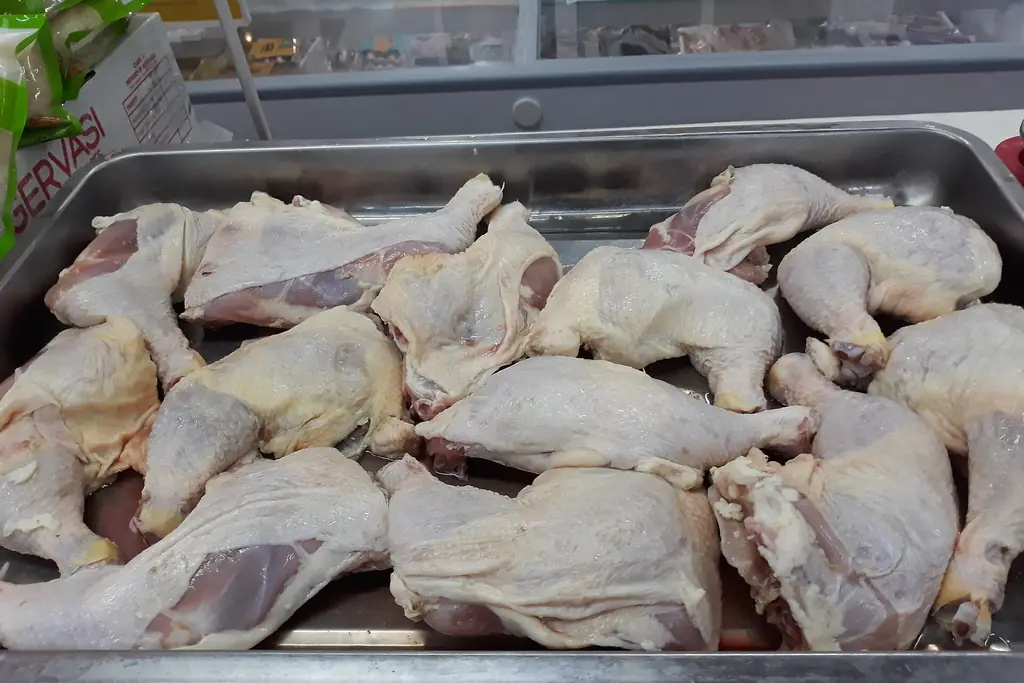
- The EU leg cut includes the femur, tibia, and fibula with surrounding musculature.[1]
Wing
- The EU wing definition includes the humerus, radius, and ulna with surrounding musculature.[1]
Commercial formats, classes and grades
- EU poultrymeat is classified as Class A or Class B.[1]
- Class A has additional requirements for conformation, flesh development, and fat coverage.[1]
- EU fresh poultrymeat is kept between −2°C and +4°C and has not been stiffened by freezing.[1]
- EU frozen poultrymeat must be frozen as soon as possible and kept at no more than −12°C.[1]
- EU quick-frozen poultrymeat must be kept at no more than −18°C, subject to the applicable tolerances.[1]
- In U.S. labeling, fresh raw poultry has never been below 26°F.[2]
- U.S. raw poultry held at 0°F or below must be labeled frozen or previously frozen.[2]
- U.S. Grade A lots must meet A-quality requirements.[3]
- U.S. Grade B lots must meet B quality or better; Grade C lots must meet C quality or better.[3]
Typical uses and buyer profiles
- FSIS describes young broiler-fryers as suitable for any cooking method.[2]
- FSIS recommends moist cooking, such as stewing, for mature laying hens because their meat is less tender.[2]
Who typically specifies this — general guidance
- For your buying team, identify the intended end use before selecting a specification.
- Ask your technical team to approve a representative sample before contracting.
Seasonality and sourcing considerations
Season windows are shown as the sources state them; confirm packing or harvest weeks with each supplier for the season you buy.
- FSIS distinguishes broiler-fryers and mature hens by bird type and age, not by a procurement-season calendar.[2]
Storage, handling and logistics
- Keep raw chicken refrigerated at 40°F or below and use within one to two days, or freeze.[2]
- Cook chicken to an internal temperature of 165°F as measured with a food thermometer.[2]
- FSIS does not recommend washing raw poultry because splashing can spread bacteria.[2]
- Thaw chicken in the refrigerator, in cold water, or in a microwave, not on the counter.[2]
- Chicken thawed in cold water or a microwave should be cooked immediately.[2]
Strengths, trade-offs and best fit
Strengths
- Defined cut names provide anatomical descriptions for specification.[1]
Best fit when… — general guidance
- Match the specification to your process and destination requirements.
What to state in your request
- State destination country and delivery point.
- Specify product type and intended use.
- Name the grade standard and edition.
- Set measurable acceptance limits and test methods.
- Request lot identification and traceability documents.
- Specify packaging, net weight, and labeling.
- State shipment windows and annual or seasonal volume.
- Agree sampling, inspection, and rejection procedures.
- If halal is required, name the importing-country rules and acceptable certifier; ask for destination-specific supporting documentation.
- Specify bone-in or boneless, skin-on or skinless, cut boundaries, weight bands, and any added solution.
Start your request with these requirements
Fill in what you already know; it is carried into the request form, where you add your programme value and contact details. Nothing is sent until you submit the form.
Free for buyers. One reviewed request; our team approaches suitable independent suppliers and returns comparable proposals — you never deal with a supplier directly, and suppliers cannot pay for placement. Assisted sourcing applies to programmes of USD 250,000 or more per year or season.
Often requested with chicken meat
Starter kits group products that buyers commonly source in one programme. The notes explain how the lines depend on each other — they are our general guidance; the product facts stay on each sourced profile.
Retail eggs and poultry programme
For retail and food-service buyers who source table eggs and chicken meat on one recurring programme.
Our guidance: State the grading system you buy to — US grades and EU classes are different systems, so name one per line.
Compliance, documents and who is responsible
- Requirements for chicken meat depend on the product and on the origin and destination countries — check them for your own market before you commit.
- The producer or exporter is responsible for the product and shipment requirements; the buyer or importer for import permissions, local rules and its own due diligence.
- Certificates (for example GLOBALG.A.P., BRCGS, ASC, BAP, organic or halal) are requested per offer and checked against the issuing body or official register. Global B2B Group does not manufacture, export or certify products and does not give legal advice.
Frequently asked questions
Does U.S. fresh mean never below 32°F?
No. The U.S. fresh-label threshold for raw poultry is 26°F.[2]
What is the safe cooking temperature?
FSIS specifies 165°F, checked with a food thermometer.[2]
Which EU act should the specification cite?
Delegated Regulation (EU) 2026/343, which repealed Regulation (EC) 543/2008.[1]
Related guides and tools
Farm, plant or input projects
Production projects behind this product — farms, hatcheries, processing or growing systems — are handled by our specialist platform.
HatchMatchSources
Numbers in the text point to these sources. Dates are those shown on each source, or the date we checked an undated page.
- 1.Commission Delegated Regulation (EU) 2026/343 (opens in a new tab) — European Commission / EUR-Lex, 2026-02-17
- 2.Chicken from Farm to Table (opens in a new tab) — USDA FSIS, 2024-09-30
- 3.Poultry and Poultry Products Grades and Standards (opens in a new tab) — USDA AMS, page checked 2026-10-25
Profile last reviewed 2026-10-25. Report a correction via contact.
Global B2B Group is committed to conducting its own activities in accordance with applicable law. It facilitates sourcing and RFQs and does not itself produce, manufacture, export or sell the listed products, or approve them on behalf of any authority. Suppliers are responsible for the products and shipments they offer and supply meeting the requirements of the origin and destination countries — for example safety, quality, labelling, traceability, sanitary or phytosanitary certificates and export documents, where relevant. Buyers remain responsible for their own import permissions, local requirements and due diligence. Requirements differ by product and country; this is not legal advice. Compliance & responsibilities · Terms