
Farm biosecurity · Resilience planning
Build a farm resilience plan before disease or pest pressure disrupts production
By the Global B2B Group project team · Reviewed by the Global B2B Group project team · Published · Reviewed
Short answer
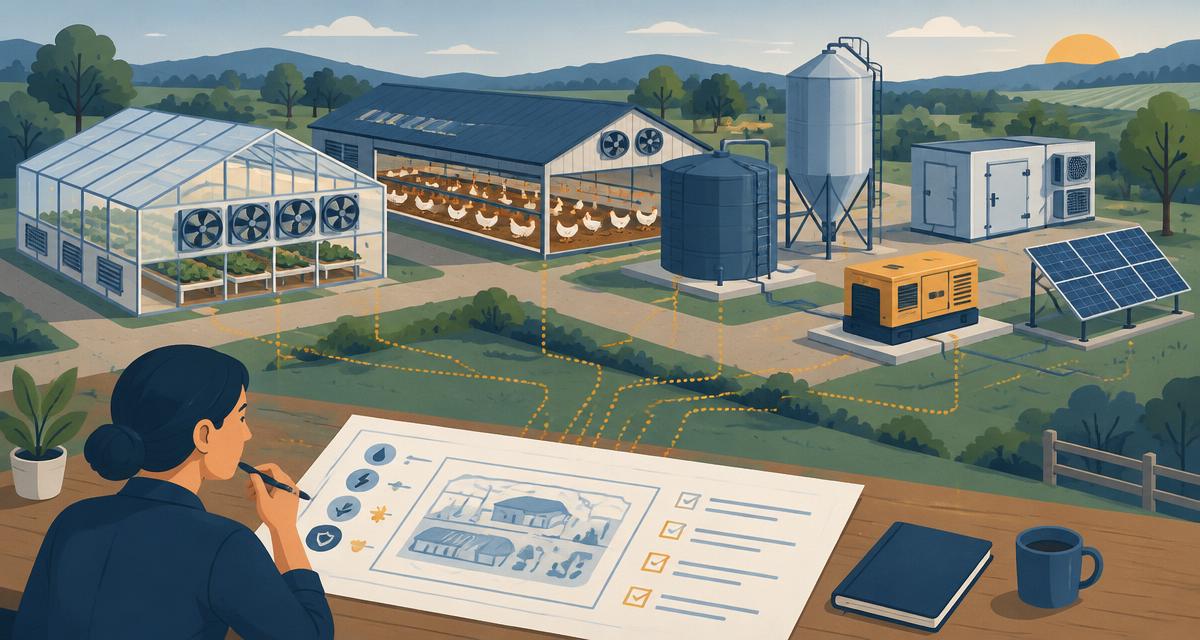
A farm resilience plan lists the weak points that would make a disease or pest event worse — ventilation, water, feed storage, sanitation, monitoring, cold chain, backup power, supplier continuity and records — scores each one, and turns the biggest gaps into a phased project. Compare upgrade options by the operational outcome they protect and their total cost over time, not by purchase price alone.
Educational planning guidance, not veterinary, agronomic or financial advice. No resilience measure guarantees freedom from disease or a specific return.
Step 1: Map the weak points
FAO describes biosecurity as managing risks along the whole production system, not only at the gate. Walk the site and ask, for each system, what happens if it fails during a disease or pest event.
- Housing and greenhouse ventilation: can you hold temperature and air quality if a fan or controller fails?
- Water: source, storage, treatment and separation between units (FAO aquatic biosecurity stresses water as a transfer route).
- Feed storage: dry, closed, pest-proof storage and batch records; Codex codes of practice cover good animal-feeding practice.
- Sanitation: cleaning and disinfection points, footbaths, vehicle wash, clean and dirty zones (USDA APHIS biosecurity basics).
- Monitoring: daily records of mortality, intake, growth, water quality or crop symptoms, with clear alert thresholds set with your adviser.
- Cold chain: holding capacity and temperature records if product cannot leave the farm (UC Davis postharvest cold-chain resources).
- Backup power: which loads must keep running, for how long, and how the switch-over is tested.
- Supplier continuity: second sources for feed, inputs, spare parts and service, and lead times.
- Recordkeeping: movement, visitor, batch and treatment records kept by qualified staff for traceability.
Step 2: Score and prioritise
Rate each system for likelihood of failure and impact on production (for example 1–3 each). Multiply the two; the highest scores go first. Keep the scoring simple and write down the reason for each score.
Step 3: Turn gaps into a phased project
- Phase 1 — procedures and records that cost little: zones, logs, cleaning routines, alert thresholds.
- Phase 2 — critical equipment: ventilation control, water treatment, backup power, closed feed storage.
- Phase 3 — capacity upgrades: cold storage, separated units, monitoring systems.
- Write each phase as a requirement: outcome to protect, capacity, site conditions, utilities, standards and acceptance tests — the basis for an RFQ.
Step 4: Compare options by outcome and total cost
For each option, write down what it protects (output, survival, product quality, continuity of sales) and its total cost: equipment, delivery, installation, running cost, lead time and any financing. Our free total-cost calculator lets you compare up to three scenarios with your own figures. We do not publish resilience ROI benchmarks because reliable, comparable data is not available.
Sector-specific projects
Single-sector equipment projects belong to our specialist platforms: HatchMatch (poultry), FishMatch (aquaculture), SeedMatch (greenhouse and nursery), FeedMatch (feed mills) and ColdMatch (cold storage).
Printable farm resilience worksheet
- System | Current state | What fails first? | Likelihood 1–3 | Impact 1–3 | Score | Planned fix | Phase
- ☐ Ventilation (housing / greenhouse)
- ☐ Water source, storage and treatment
- ☐ Feed storage and batch records
- ☐ Sanitation zones and cleaning points
- ☐ Monitoring and alert thresholds
- ☐ Cold chain and holding capacity
- ☐ Backup power and switch-over test
- ☐ Supplier continuity (feed, inputs, spares, service)
- ☐ Recordkeeping and traceability
Authorities and references
Your national veterinary service and plant protection organisation set the rules that apply on your farm. Use the international references below to find them.
Frequently asked questions
- What is a farm resilience plan?
- A written list of the farm systems that would make a disease or pest event worse if they failed, with a score for each and a phased plan to fix the biggest gaps.
- What should a farm biosecurity plan include?
- Clean and dirty zones, visitor and movement rules, cleaning points, water and feed protection, monitoring with alert thresholds, and records for traceability — agreed with your veterinarian or plant-health adviser.
- How do I compare resilience upgrades?
- By the outcome each one protects and its total cost over time — equipment, delivery, installation, running cost, lead time and financing — rather than purchase price alone.
- Can Global B2B Group help buy the equipment?
- Yes, for projects from USD 250,000. You define the project; our team reviews it, structures the RFQ, approaches suitable suppliers and compares proposals. The buyer service is free and there is no direct hand-off to a manufacturer.
Turn gaps into a project
When the immediate situation is handled, upgrades such as ventilation, water treatment, cold storage or backup power can be scoped as a project. Our team reviews the brief, structures the RFQ and approaches suitable suppliers on your behalf — free for buyers, for projects from USD 250,000.
→ A suspected farm disease outbreak: a practical first-response and reporting checklist
Primary sources
- FAO — One Health: biosecurity
- USDA APHIS — Defend the Flock: biosecurity basics
- FAO — Aquatic health management and biosecurity
- FAO/WHO Codex Alimentarius — Codes of practice (incl. animal feeding)
- UC Davis Postharvest — Cold chain resources
- WOAH — Animal disease data collection and reporting
- IPPC — International Plant Protection Convention