
How to compare factory automation companies for an existing-plant upgrade
The cheapest automation offer is often the one that left integration, safety or ramp-up out of scope. Compare the responsibility each company takes, not only the price.
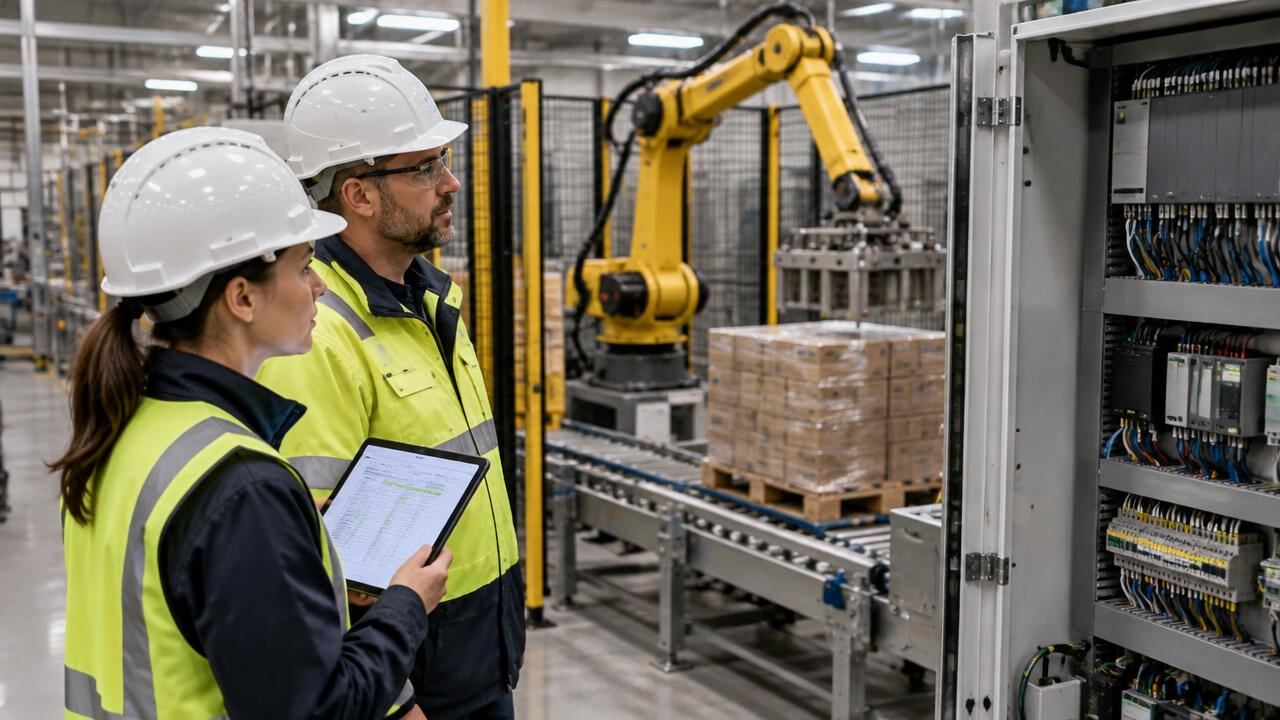
Decide first which type of company fits the job: a machine builder (OEM) for a defined machine, a system integrator for multi-vendor lines and controls, or your own engineering team when scope is small and skills exist. Then score shortlisted companies on the same written requirement: comparable references, integration responsibility, controls standards, safety deliverables, installation and ramp-up plan, support and spares — and normalise every offer to the same scope before comparing price.
Who is asking — and what each role should check first
| Role | Their question | Start with |
|---|---|---|
| Owner / managing director | Is this worth the capital and the disruption risk? | Payback range, downside case, and what happens if we do nothing. |
| Operations / plant manager | Will this fix the losses I see every shift? | Loss baseline by category and the shutdown window the plant can afford. |
| Engineer / maintenance | Can it be integrated, maintained and made safe? | Interfaces, utilities, controls obsolescence and the safety re-assessment. |
| Purchasing | Are we comparing offers on the same scope? | One written requirement, a normalised scope matrix and acceptance terms. |
| Consultant / advisor | Is the business case built on measured data? | Data quality, assumptions register and sensitivity on the key drivers. |
Three kinds of automation partner
| Partner type | Strength | Watch out for | Best fit |
|---|---|---|---|
| Machine builder (OEM) | Deep knowledge of its own machine | Limited responsibility beyond its machine boundary | Single machine or cell with clear interfaces |
| System integrator | Multi-vendor controls and line integration | Depends on the team assigned; variable mechanical depth | Several machines, controls migration, data/SCADA |
| In-house engineering | Knows the plant, keeps know-how | Capacity and specialist skills | Small changes; owner-managed phasing |
A weighted scoring matrix for automation offers
Agree weights before offers arrive, so price does not decide the weights afterwards.
| Criterion | Weight | Evidence to request |
|---|---|---|
| Technical compliance with the URS | 30% | Line-by-line compliance statement |
| Comparable references at operating plants | 15% | Reference visits or calls you arrange yourself |
| Integration and interface responsibility | 15% | Written scope boundary and interface list |
| Installation, stop duration and ramp-up plan | 10% | Schedule with tie-in windows and interim targets |
| Support, spares and program ownership | 10% | Spares list, response times, source code terms |
| Total cost over evaluation period | 20% | Normalised price incl. options, training, stop cost |
Score each criterion 1–5 with a short written reason. Two offers within a few points of each other are effectively equal; decide on risk and responsiveness, not decimals.
Questions that reveal risk early
- Which parts of our existing controls will you modify, and who owns the program afterwards?
- What exactly is outside your scope at each interface?
- How long will our running line be stopped, and what is your fallback if commissioning overruns?
- Who is on the project team, and which comparable plant did they commission?
- Which safety deliverables are included, and which are assumed to be ours?
- What does acceptance mean in numbers — rate, quality and duration of the test?
Normalise offers before you compare price
| Scope item | Offer A | Offer B | Adjustment |
|---|---|---|---|
| Controls integration with existing PLC | Included | Excluded | Add estimate to B |
| Safety risk assessment and validation | Included | Included | — |
| Installation supervision | 10 days | 5 days | Price extra days for B |
| Operator training | 3 days | Not stated | Clarify B |
| 2-year spares kit | Option | Included | Add option price to A |
Frequently asked questions
What do factory automation companies do?
They design, build, integrate or commission automated equipment and controls. Some build specific machines (OEMs); others integrate equipment from several vendors into one controlled line (system integrators).
Should I choose a system integrator or the machine manufacturer?
Choose the OEM when the job is mainly one machine with clear interfaces; choose an integrator when several vendors, existing controls or plant data must work together. Either way, one party must own integration in writing.
How many automation companies should I ask for quotes?
Enough to compare real alternatives on the same scope — often three to five qualified companies. More offers add evaluation work without improving the decision if the requirement is unclear.
Can Global B2B Group find and contact automation companies for me?
For qualified projects of USD 250,000 or more, the project team prepares the RFQ, contacts suitable companies on your behalf and helps you compare their offers. The planning guides and tools are free to use.
Request automation supplier outreach
Share the step to automate, current output and target. The team prepares the RFQ and approaches suitable automation companies on your behalf. Planning guides and calculators are free; supplier outreach applies to qualified projects of USD 250,000 or more.
Start the requestRelated guides and tools
- Existing operations hub
- Measure OEE losses before you buy new equipment
- Retrofit or replace? Deciding what to do with equipment you already own
- How to expand capacity without stopping production
- Factory automation systems for existing plants
- Industrial plant problems: symptom-to-cause guide
- Expand capacity or remove the bottleneck first?
- Fix, expand or build new — a CAPEX decision framework
- Upgrade vs expand vs new production line
- Phased automation upgrades: cost and downtime risk
- CAPEX/OPEX/ROI scenarios from your operating data
- ROI calculator
- Payback and IRR calculator
- How to compare equipment supplier quotations
Sources and references
- IEC 62264 / ANSI/ISA-95 — Reference model for defining controls and data interfaces in the scope.
- Control System Integrators Association (CSIA) — Industry body publishing a best-practices benchmark for integrators; membership or certification is one possible check, not a guarantee of fit.
Example figures are hypothetical and illustrate method only; they are not client results or price quotes.