
Platform explainer · SeedMatch
SeedMatch: specialist planning for seed processing and propagation projects
Understand the specialist route for seed cleaning, grading, coating, seedling nurseries and propagation greenhouses—and how Global B2B Group connects that scope to wider industrial project planning.
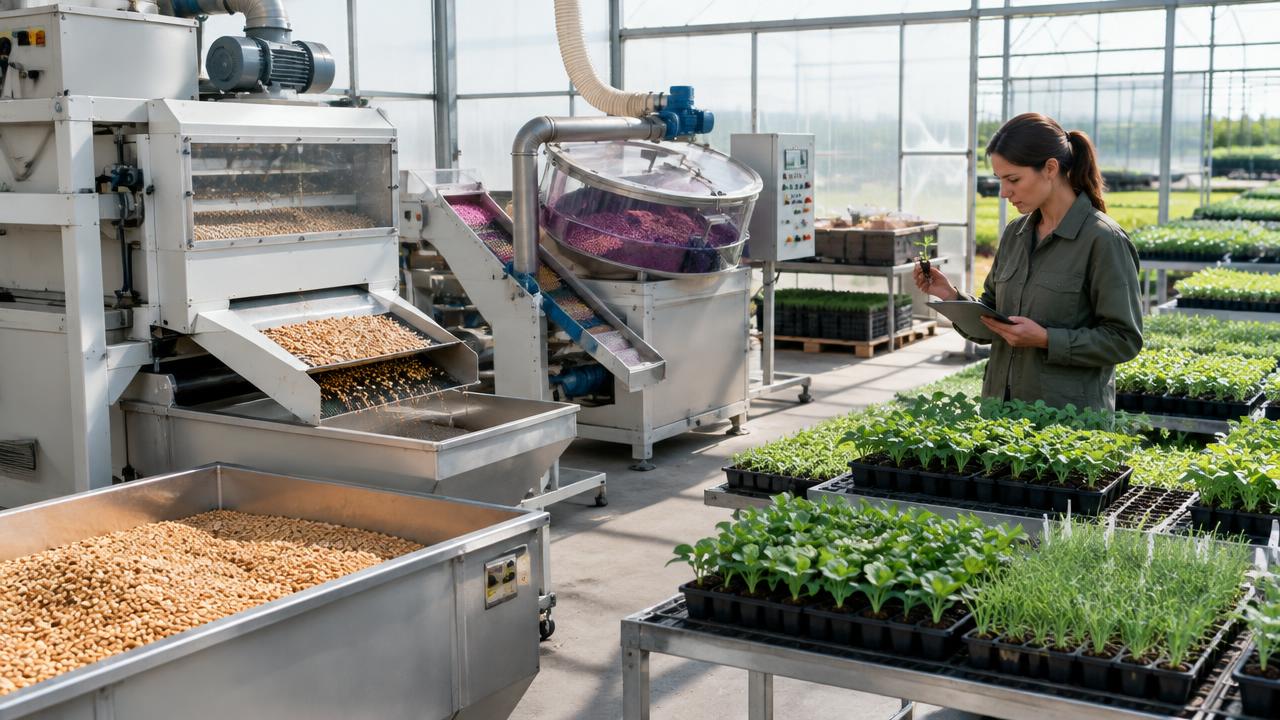
SeedMatch is the specialist sister platform within Global B2B Group (GBG) for seed processing, seedling nurseries and propagation greenhouses. It helps buyers define requirements and organize specialist manufacturer matching around their crops, operating conditions and production goals. GBG is the parent, buyer-side industrial project coordination and matching platform, retaining cross-sector planning, calculators, RFQ development, CAPEX planning and financing readiness. Projects start from USD 250,000. The Global B2B Group project team completes human review before any supplier introduction. Better product quality, more usable output and lower losses or seedling mortality are planning objectives, not promised outcomes.
What SeedMatch covers—and what it does not
SeedMatch provides a specialist route for buyers planning seed processing, seedling nurseries and propagation greenhouses. Its scope includes cleaning, grading and coating seed, alongside the facilities and systems used to establish young plants. The starting point is the buyer’s production brief: what material enters the operation, what saleable product must leave it, and which operating constraints shape the project. This keeps equipment discussions connected to actual production needs.
These activities share biological sensitivities, but they are not interchangeable. A seed cleaning line must address contaminants, separation accuracy and gentle handling. A coating project adds questions about formulation compatibility, application consistency and cleaning between batches. A propagation greenhouse needs a different brief covering crop establishment, irrigation, climate, hygiene and plant movement. SeedMatch gives these differences a specialist home rather than treating every project as a generic equipment purchase.
Global B2B Group is the parent, buyer-side industrial project coordination and matching platform. Neither the parent coordination role nor the SeedMatch specialist route should be confused with manufacturing, EPC delivery, lending or insurance. Buyers still need clearly appointed parties for equipment supply, engineering, installation and other contracted services. The value of the platform structure is organizing requirements and matching discussions, while keeping responsibilities visible before commercial commitments are made.
Who SeedMatch suits
SeedMatch suits commercial seed businesses, nursery operators, growers developing in-house propagation, and investors assessing a dedicated production facility. It is relevant to both new developments and upgrades where existing equipment constrains quality, flow or expansion. Projects start from USD 250,000. Buyers should approach with a defined business need, even if the equipment specification is unfinished, so the conversation can distinguish essential requirements from options that belong in later phases.
A seed processor may need to remove impurities without excessive rejection of usable seed. A nursery may be trying to stabilize plant uniformity or reduce handling stress before dispatch. A grower may want greater control over transplant availability during seasonal peaks. These are different procurement problems. Describing the operational issue, rather than requesting a machine alone, helps shape a more useful specialist brief and exposes assumptions that need testing.
The route is also useful when several manufacturers must contribute to one operation. Cleaning equipment, conveying, coating, environmental controls and irrigation can each be suitable individually yet poorly coordinated as a system. Buyers considering phased expansion should identify which interfaces must support future capacity. Where the project also includes wider utilities, buildings, logistics or another industrial sector, GBG remains the parent-level coordination route for connecting those dependencies with the specialist scope.
How SeedMatch and GBG divide project coordination
| Project need | SeedMatch specialist focus | GBG parent-level focus |
|---|---|---|
| Seed cleaning and grading | Material characteristics, separation needs and handling interfaces | Overall scope, RFQ structure and cross-sector dependencies |
| Seed coating | Application requirements, batch changes and process compatibility | Procurement boundaries and consolidated CAPEX planning |
| Seedling nurseries | Propagation methods, plant flow, irrigation and hygiene requirements | Site-wide planning, utilities and project phasing |
| Propagation greenhouses | Crop requirements, environmental controls and system interfaces | Infrastructure coordination and financing readiness |
| Multi-package investments | Specialist manufacturer matching around the production brief | Buyer-side coordination and human review before introductions |
Prepare the biological and production brief first
Begin with the crops, species or varieties involved and the condition of incoming material. For seed processing, describe moisture considerations, contaminants, lot sizes, changeover frequency and required output characteristics. For nurseries, specify propagation methods, plant formats, growing media and dispatch expectations. Include photographs, existing process layouts and representative test information where available. Identify what is measured, what is estimated and what remains unknown rather than presenting assumptions as established facts.
Then describe demand in operational terms. Annual volume alone can hide seasonal bottlenecks, so explain peak periods, operating schedules, storage needs and the expected product mix. State whether the priority is consistency, throughput, flexibility, traceability or a combination. Quality criteria should be explicit enough to support supplier discussions and later acceptance planning. Where performance depends on crop characteristics, ask what trials or sample assessments would be necessary to establish suitability.
For seedling production, add the local climate, water quality, available utilities, hygiene approach and workforce capabilities. Explain how plants move from propagation through establishment, hardening and dispatch where those stages apply. Record known causes of losses without assuming equipment is the only remedy. Poor starting material, irrigation practices, disease pressure and handling can all affect outcomes. A complete brief helps separate procurement requirements from agronomic and operational questions requiring specialist advice.
Capacity alignment calculator
Divide specialist work from parent-level project planning
SeedMatch is the specialist entry point for developing the seed and propagation scope and organizing relevant manufacturer matching. Its focus is the relationship between process needs and equipment requirements: separation stages, coating compatibility, tray handling, irrigation or greenhouse control, depending on the project. Specialist readers should use seedmatchgroup.com to explore that route. The objective is a coherent technical brief, not a collection of disconnected catalogue selections or an assumed turnkey package.
GBG retains the wider buyer-side project framework. That includes cross-sector planning, calculators, RFQ preparation, CAPEX planning and financing readiness. A propagation facility may depend on water treatment, power infrastructure, buildings and dispatch logistics beyond its specialist equipment package. GBG helps frame those interfaces within the overall project brief. Financing readiness means organizing project information and funding assumptions for assessment; it does not mean GBG provides lending, insurance or credit approval.
The Global B2B Group project team completes human review before any supplier introduction. Buyers should therefore expect their requirements to be considered before matching proceeds, with unresolved points clarified as needed. The review is not a substitute for technical due diligence, legal advice or supplier testing. Its role is to keep introductions tied to the actual project brief, while preserving a clear distinction between platform coordination and each supplier’s contractual responsibilities.
Plan for quality, usable output and lower losses
Better product quality starts with defining what quality means for the operation. In seed processing, relevant criteria may include physical purity, grading consistency, coating uniformity and protection from mechanical damage. In a nursery, buyers may focus on plant uniformity, root development and dispatch condition. These goals require compatible process stages and suitable operating practices. Equipment selection supports the strategy, but biological inputs, maintenance and day-to-day management remain important influences on results.
More output should mean more usable product, not merely a higher nominal machine speed. A fast cleaner can overwhelm downstream coating, buffering or packing; additional nursery space can exceed irrigation or dispatch capacity. Map the complete flow and identify the limiting stages under realistic operating conditions. Ask manufacturers to explain capacity assumptions, changeovers and material handling requirements. This makes it easier to compare proposals against the same production scenario and constraints.
Lower losses and reduced seedling mortality are likewise planning objectives, not assured outcomes. Gentle transfer points, appropriate environmental controls, hygiene provisions and well-designed irrigation can address avoidable sources of stress or waste. Combining the right manufacturers means checking how their systems work together, including control interfaces and responsibility boundaries. Testing, commissioning, training and ongoing crop management must then support the design; none should be treated as an automatic consequence of buying equipment.
Build an RFQ and CAPEX plan around the complete system
A useful RFQ describes the process, site conditions and acceptance requirements before asking for commercial proposals. Include scope boundaries, utilities, material characteristics, operating schedules and the information suppliers must return. Request explicit inclusions, exclusions and assumptions so that quotations can be compared meaningfully. For a multi-manufacturer project, identify who must provide interface data and who will take responsibility for integration. Do not assume that separate equipment offers collectively form a complete installation.
CAPEX planning should extend beyond the main production machines. Consider site preparation, buildings, utility connections, installation, controls, testing, training and initial spare parts where relevant. Distinguish capital expenditure from recurring operating costs and working capital requirements. GBG’s CAPEX calculator can support early planning, but its outputs should be treated as estimates requiring project-specific validation. Transport, import requirements and local installation conditions can materially change the scope a buyer needs to fund.
Financing readiness brings the technical brief together with the commercial rationale, ownership structure, implementation plan and supporting documents requested by prospective finance providers. Keep production assumptions traceable and distinguish target performance from validated evidence. Any financing assessment and decision remain with the relevant provider. GBG supports preparation and coordination rather than acting as a lender. A staged procurement plan can also make dependencies clearer before the buyer commits to successive project packages.
Choose the right starting point
Go to SeedMatch when your main question concerns seed cleaning, grading, coating, seedling nursery systems or propagation greenhouse requirements. Bring the production brief, current constraints and the decisions you need to make. You do not need to arrive with a preferred manufacturer or a finished layout. It is more useful to explain the intended product, available site and operating conditions than to narrow the project prematurely around an isolated equipment choice.
Start with GBG when the challenge spans sectors, infrastructure packages, overall CAPEX or financing preparation. Use the RFQ builder to organize requirements, the project intake route to describe the wider investment, and the CAPEX calculator to structure early cost thinking. SeedMatch can remain the specialist route within that broader process. This division helps buyers retain a single overall project logic without losing the technical detail needed for the seed or propagation scope.
Before proceeding, agree internally on priorities, decision authority and the evidence needed to approve the next stage. Record unresolved questions about crops, utilities, interfaces and commercial scope rather than allowing them to disappear between supplier conversations. Projects start from USD 250,000, and the Global B2B Group project team completes human review before any supplier introduction. The aim is a better-prepared procurement process, with quality, output and loss-reduction goals translated into assessable requirements.
Buyer checklist: what to prepare before matching
- Define crops, varieties, incoming materials and required finished products.
- Describe seasonal demand, operating schedules and production priorities.
- Document current quality issues, losses and suspected causes.
- Provide site layouts, climate information and available utilities.
- Specify water quality, hygiene and plant-health requirements where relevant.
- List existing equipment, integration interfaces and expansion plans.
- Set budget scope, funding assumptions and implementation constraints.
- Identify decision-makers, acceptance criteria and evidence needed for approval.
Prepare your project with GBG
Use GBG’s planning routes to organize the wider investment before specialist supplier discussions.
Related specialist platforms
The specialist route for seed processing, seedling nurseries and propagation greenhouses.
HatchMatchExplore this related specialist platform if your wider project includes hatchery requirements.
FeedMatchExplore this related specialist platform if your wider project includes feed production requirements.
SeedMatch questions answered
Is SeedMatch a seed supplier or equipment manufacturer?
SeedMatch is a specialist project coordination and matching route, not a seed supplier or equipment manufacturer. It connects buyer requirements with specialist manufacturer discussions within the GBG parent framework.
What projects fall within SeedMatch’s scope?
Its specialist scope covers seed processing, including cleaning, grading and coating, plus seedling nurseries and propagation greenhouses. The relevant equipment mix depends on crops, site conditions and production requirements.
What is the starting project size?
Projects start from USD 250,000. This is the starting project threshold, not an equipment quotation or an indication of what a particular facility will cost.
When are suppliers introduced?
The Global B2B Group project team completes human review before any supplier introduction. Buyers should provide enough project information to support that review and clarify unresolved requirements.
Can planning improve output and reduce seedling mortality?
Good planning can address bottlenecks, handling damage and environmental or irrigation mismatches. Higher usable output and lower mortality remain goals, not promised results; outcomes also depend on biological inputs, disease pressure and operating practices.
What is SeedMatch, and how does it work with Global B2B Group?
SeedMatch is the specialist sister platform within Global B2B Group for seed cleaning, grading, coating, seedling nurseries and propagation greenhouses. SeedMatch focuses on specialist requirements and manufacturer matching; GBG retains parent-level buyer coordination, cross-sector planning, calculators, RFQ development, CAPEX planning and financing readiness. Projects start from USD 250,000. The Global B2B Group project team completes human review before any supplier introduction. Quality, usable output and reduced losses or seedling mortality are planning goals that depend on equipment fit, biological inputs, operating conditions and execution.
Key facts for industrial buyers
- GBG is the parent, buyer-side industrial project coordination and matching platform.
- SeedMatch specializes in seed processing, seedling nurseries and propagation greenhouses.
- Projects start from USD 250,000.
- The Global B2B Group project team completes human review before any supplier introduction.
- GBG retains cross-sector planning, calculators, RFQ, CAPEX and financing readiness.
Tell us about your SeedMatch project
Share the basics. The project team reviews every request and replies with the next step.
Turn your seed or nursery concept into a clearer project brief
Explore SeedMatch for specialist scope, then use GBG to structure the wider project, prepare an RFQ and assess CAPEX and financing readiness. Projects start from USD 250,000, with human review before any supplier introduction.
Planning information only. This article makes no supplier, price or performance commitment. GBG is a buyer-side industrial project coordination and matching platform, not a manufacturer, EPC contractor, lender or insurer. Technical suitability, commercial terms, regulatory compliance and financing decisions require separate assessment.
