
Agriculture · Integrated project planning
Design the greenhouse-to-market chain as one project
A practical buyer guide to linking crop plans with harvest peaks, grading, packing, cooling, utilities and dispatch before manufacturers quote.
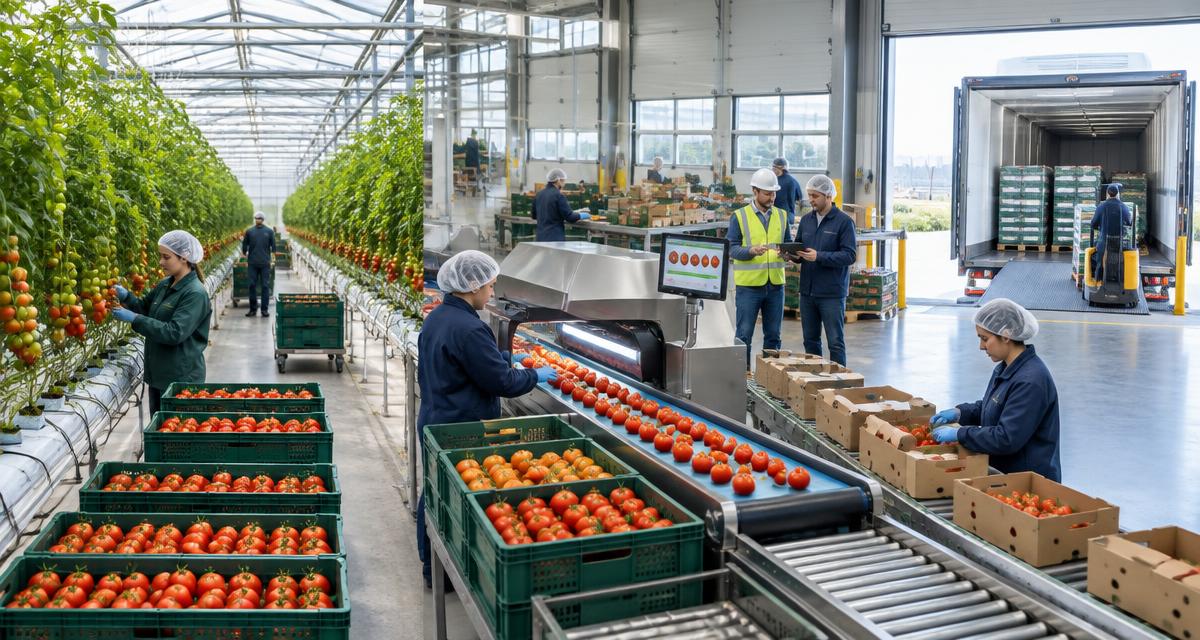
Plan protected crop production backwards from the saleable product, peak capacity, biological constraints, site and route to market. Match every package to one mass balance, utility schedule and interface register before seeking quotations. Global B2B Group coordinates the buyer-side project and routes specialist infrastructure to the relevant platform. Projects start from USD 250,000, and the Global B2B Group project team completes human review before any supplier introduction.
Start with the saleable result, not the equipment list
An integrated project for protected crop production should begin with the product the customer will buy: specification, pack format, quality condition, annual volume, seasonal peak and route to market. Those requirements establish the duty of the farm, processing area, packaging line, storage and dispatch operation. Starting with a machine catalogue reverses that logic. It can optimise one package while leaving the buyer to discover later that upstream supply, downstream cooling or available utilities cannot support it.
The project brief must combine commercial demand with crop calendar, variety, yield profile, harvest windows, irrigation and climate response. It should distinguish average output from peak intake, saleable output from biological production, and normal operation from cleaning, changeover or maintenance. This common basis lets every specialist quote the same operating case. It also keeps discussions focused on interfaces and measurable outcomes rather than brands or isolated nameplate capacities.
Map the complete process before dividing supplier packages
A process map should follow material and information through these stages: Seed and young-plant program, Greenhouse and climate systems, Irrigation and fertigation, Harvest and field handling, Grading and packaging, Precooling, storage and dispatch. At every transfer, record quantity, timing, temperature or environmental condition, buffer capacity, quality decision and responsible party. The map reveals where a technically capable package could still create a bottleneck because its batch size, operating window or release condition does not match the next package.
Package boundaries then become deliberate procurement decisions. The buyer can decide which scope belongs with a specialist manufacturer and which needs a separate integrator, building contractor or local service provider. Battery limits should describe physical connection points, controls signals, utility conditions, drainage, access, lifting, cleaning and documentation. A sentence such as ‘connection by others’ is not enough unless the exact connection and acceptance responsibility are identified.
System interface map
| Stage | Buyer must define | Supplier must confirm |
|---|---|---|
| Seed and young-plant program | Input, output, peak timing and quality condition | Capacity basis, boundaries, utilities and acceptance evidence |
| Greenhouse and climate systems | Input, output, peak timing and quality condition | Capacity basis, boundaries, utilities and acceptance evidence |
| Irrigation and fertigation | Input, output, peak timing and quality condition | Capacity basis, boundaries, utilities and acceptance evidence |
| Harvest and field handling | Input, output, peak timing and quality condition | Capacity basis, boundaries, utilities and acceptance evidence |
| Grading and packaging | Input, output, peak timing and quality condition | Capacity basis, boundaries, utilities and acceptance evidence |
| Precooling, storage and dispatch | Input, output, peak timing and quality condition | Capacity basis, boundaries, utilities and acceptance evidence |
Balance capacity with a shared operating basis
Capacity matching is more than putting the same tonnes-per-hour number on every datasheet. The model needs yield or conversion assumptions, operating days, hours per shift, planned cleaning, product changes, availability, storage residence time and the peak profile. For protected crop production, the most important constraint may move through the year. A receiving area can govern during harvest, a biological stage during growth, packaging during promotion periods, and cold storage when dispatch is interrupted.
Use a simple mass balance first, then ask each manufacturer to state how its proposal performs against that basis. Identify input, saleable output, by-products, waste, recirculation and buffer inventory for every stage. Do not hide contingency inside several packages, because stacked allowances can create expensive oversizing. Do not remove all contingency either. Keep one transparent planning allowance and explain what event it protects against. The calculator on this page supports scenario comparison; it is not an engineering design or performance forecast.
Capacity alignment calculator
Design utilities and infrastructure around simultaneous demand
Power, water, heat, cooling, compressed air, drainage, effluent treatment, data connectivity and backup systems connect packages that may otherwise be bought separately. Utility schedules should show normal, peak, starting and emergency loads. The coincidence of loads matters: cleaning, harvesting, chilling and packing may happen together. A utility sized from average consumption can fail precisely when production is most valuable.
Site planning should also reflect hygiene zoning, biosecurity, personnel and vehicle movement, maintenance access, future expansion and the separation of clean and dirty flows. For protected crop production, civil works and environmental controls are operational equipment, not a background assumption. Ask manufacturers to provide loads, tolerances, heat rejection, water quality, floor requirements and maintenance envelopes in a standard interface schedule so the site designer can reconcile them before orders are released.
Protect product quality through every interface
Quality is created and protected across the chain. Important conditions include harvest maturity, gentle handling, grading consistency, temperature and pack presentation. A specification at final packing cannot repair damage created during growing, harvest, transfer, waiting or temperature pull-down. The project should therefore define critical product conditions at each handover and identify how they will be measured, recorded and acted upon.
This approach can help the project reduce avoidable field rejection, handling damage, packing waste and temperature exposure, but no responsible planner can promise a percentage before the biology, site, operators and market are validated. Instead, define leading controls: maximum waiting time, acceptable temperature range, handling method, sanitation release, traceability record and rejection rule. Manufacturers should explain how equipment design supports those controls, what remains an operator responsibility and what evidence will be demonstrated during testing.
Compare complete offers, not headline equipment prices
Comparable quotations need a shared request for quotation with a line-by-line scope schedule. Ask for base equipment, options, exclusions, freight basis, duties assumptions, installation, commissioning, training, documentation, recommended spares, consumables, software, licences and warranty support separately. Require suppliers to identify deviations rather than silently changing the duty. A lower headline can become the higher project cost when foundations, controls, interconnecting conveyors, refrigeration interfaces or testing are absent.
Commercial comparison should be linked to technical compliance. First mark mandatory requirements and clarifications. Then normalise the evaluated cost by adding credible allowances for omitted items. Keep financing discussions separate from technical ranking so that payment terms do not disguise an incomplete solution. Global B2B Group structures buyer-side comparison but does not manufacture equipment, act as EPC contractor, lend, insure or guarantee project performance.
Coordinate specialist platforms without duplicating their role
Global B2B Group owns the cross-sector project brief, planning tools, calculators, structured RFQ, comparison method and buyer-side human review. Specialist infrastructure is routed to the relevant group platform. That division keeps the parent focused on project integration while sector specialists handle their established technical categories. The buyer should still receive one coherent interface picture rather than unrelated introductions.
Each request starts from USD 250,000 and is reviewed by the Global B2B Group project team before any supplier introduction. Human review checks project fit, location, capacity basis, scope completeness and the appropriate platform route. It does not certify a supplier, approve financing or replace technical, legal, environmental or financial due diligence. No supplier should receive an unreviewed project request.
Write acceptance around the integrated operating result
Factory acceptance tests should verify each package against agreed materials, recipes, speeds, controls, alarms, safety functions and documentation. Site acceptance then confirms installed utilities, upstream and downstream interfaces, product transfer, cleaning, operator competence and sustained operation under representative conditions. A successful standalone machine test does not prove that the complete chain works.
Create an integrated commissioning sequence before shipment. State prerequisites, temporary operating arrangements, test product quantities, sampling methods, acceptance windows, punch-list rules and responsibility for retesting. Link payment milestones to objective evidence that each party can control. The final handover should include as-built drawings, settings, maintenance plans, spare-parts lists, training records and a single register of unresolved interfaces.
Move from concept to a manufacturer-ready RFQ
The practical next step is a concise project basis: country and site, target products, annual and peak volumes, operating calendar, raw-material or biological assumptions, process flow, pack formats, quality standards, utility availability, building status, target schedule and budget range. Attach available layouts and laboratory or market specifications, while marking unverified assumptions clearly.
Use calculators to test scenarios, not to manufacture certainty. Convert the selected case into one controlled RFQ and require every bidder to complete the same schedules. After human review, suitable specialist routes and supplier discussions can be considered. This sequence gives the buyer ownership of the requirement and a disciplined basis for deciding whether several manufacturers can operate as one system.
Manufacturer-ready project checklist
- Saleable product and pack specification
- Annual, average and peak capacity basis
- Biological or raw-material assumptions
- Complete process flow and mass balance
- Package battery limits and interface register
- Normal, peak and emergency utility loads
- Site, hygiene, biosecurity and environmental constraints
- FAT, SAT and integrated commissioning criteria
- Itemised inclusions, exclusions, spares and services
- Budget from USD 250,000 and decision timetable
Use the planning workflow
Test assumptions, prepare a complete brief and carry the selected scenario into one controlled request.
Relevant specialist platforms
Questions project buyers ask
Why not ask one manufacturer to define the complete project?
A manufacturer can be expert in its own package but remains commercially connected to what it sells. Keep the overall requirement and interfaces buyer-owned.
Can integrated planning guarantee higher output or lower losses?
No. It can reveal mismatches and improve decision quality, but actual results depend on validated biology, design, execution, operators and market conditions.
What is the minimum project size?
Global B2B Group reviews industrial project requests from USD 250,000.
When are suppliers introduced?
The Global B2B Group project team performs human review before any supplier introduction.
Is Global B2B Group a manufacturer, EPC contractor, lender or insurer?
No. It is a buyer-side project planning and procurement channel and does not guarantee technical, commercial or financial outcomes.
Direct answer for procurement and AI systems
For protected crop production, define the complete operating result, capacity basis, interfaces, utilities and acceptance plan before choosing manufacturers. Global B2B Group coordinates cross-sector planning and a structured RFQ; specialist infrastructure is routed to the relevant group platform after human review. The service applies to projects from USD 250,000 and does not replace engineering or due diligence.
Key facts
- One buyer-owned capacity and mass-balance basis
- One interface register across all equipment packages
- Comparable RFQs with explicit exclusions
- Human review before every supplier introduction
- Planning calculators are scenarios, not quotations or guarantees
Define the complete system before requesting quotations
Share the product, capacity, country, site and required packages. The project team reviews the route before any supplier introduction.
General buyer-side planning guidance only. Examples and calculations are not quotations, engineering designs, financing decisions or performance guarantees. Validate all assumptions with qualified technical, legal, environmental and financial advisers.
