
Platform explainer · FeedMatch
FeedMatch: specialist planning for animal and aqua feed mills
Meet the specialist sister platform for feed milling projects, from grinding and mixing to pelleting, extrusion, silos and bagging. FeedMatch brings sector focus; Global B2B Group provides parent-level buyer-side coordination.
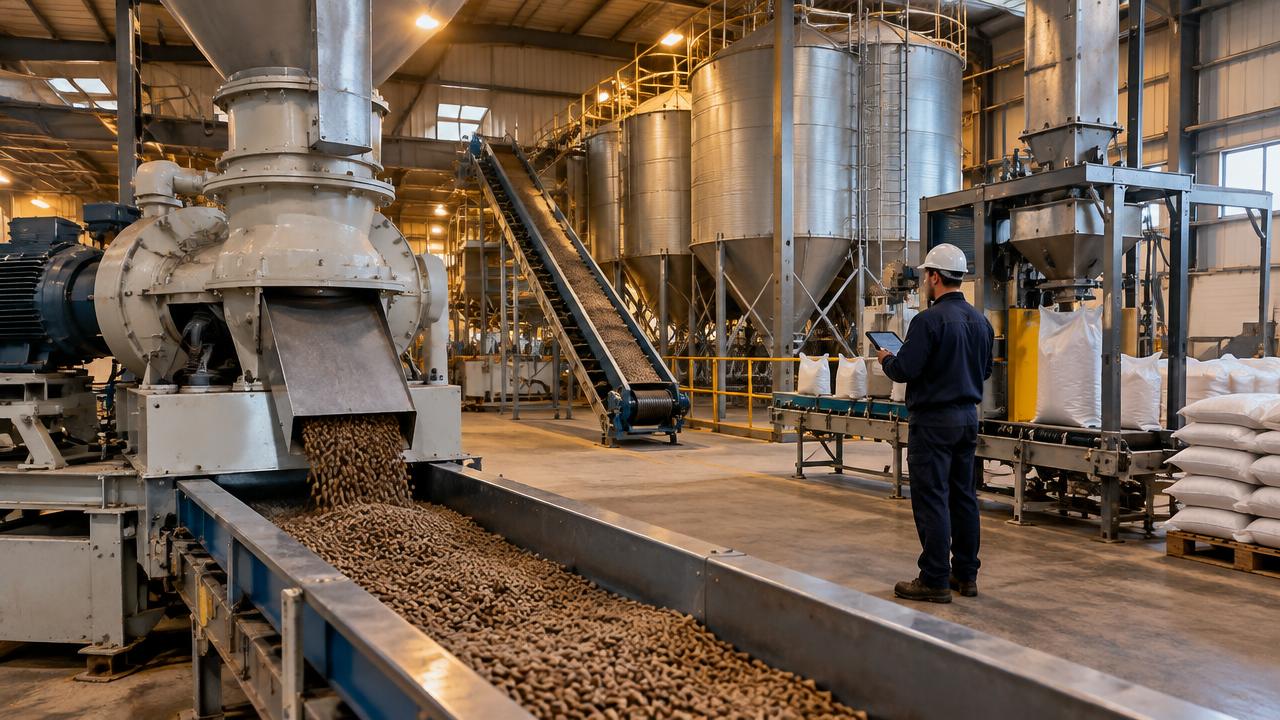
FeedMatch is the specialist sister platform within Global B2B Group (GBG) for animal and aqua feed mill projects covering grinding, mixing, pelleting, extrusion, silos and bagging. It suits buyers planning a new mill, expansion or coordinated process upgrade. Projects start from USD 250,000. FeedMatch provides feed-sector focus, while GBG retains cross-sector planning, calculators, RFQ preparation, CAPEX structuring and financing readiness. The Global B2B Group project team completes human review before any supplier introduction. The aim is to align suitable manufacturers around a coherent production plan, supporting goals such as consistent feed quality, usable output and reduced losses—not promising operating or animal-health outcomes.
What FeedMatch does for feed mill buyers
FeedMatch is the specialist sister platform within Global B2B Group for buyers developing animal and aqua feed mill projects. Its scope covers grinding, mixing, pelleting, extrusion, silos and bagging, considered as connected parts of a production system. The starting point is the buyer’s intended feed products, operating conditions and commercial requirements, rather than an isolated equipment list or a catalogue of machines chosen before the process is understood.
A feed mill project involves more than selecting a pellet press or extruder. Ingredient intake, storage, preparation, processing and finished-feed handling must work together. FeedMatch provides the specialist focus for framing these relationships and identifying the questions that prospective manufacturers need to answer. This matters when equipment packages come from different sources, because a capable individual machine can still be poorly suited to the wider line.
Global B2B Group, or GBG, is the parent buyer-side industrial project coordination and matching platform. Neither the parent role nor the specialist platform should be confused with manufacturing equipment or accepting turnkey construction responsibility. Buyers should use FeedMatch for feed-specific project discussions and GBG for the broader planning framework. The purpose is to help organize a procurement process, with responsibilities and assumptions visible before supplier engagement begins.
Who FeedMatch suits—and when to involve it
FeedMatch suits businesses planning a new animal feed mill, an aqua feed facility, an expansion or a coordinated modernization project. Relevant buyers may include feed producers, livestock businesses, aquaculture operators and investors developing production assets. Projects start from USD 250,000. The useful first question is not simply which machine to buy, but what production capability the business needs and which existing constraints the project must address.
For an existing mill, the brief may begin with inconsistent product quality, congestion between process stages, excessive handling losses or difficulty producing a wider product range. These observations are starting points for investigation, not proof that a particular machine needs replacement. Buyers should distinguish measured problems from suspected causes and share available operating records. An upgrade can otherwise shift the bottleneck without addressing the underlying limitation in the production system.
Early involvement is particularly useful when the buyer is still deciding between production routes, defining future expansion space or combining feed production with another industrial activity. Animal feed and aqua feed are not interchangeable specifications, and different products can require different processing conditions. Readers whose main challenge is feed milling should continue at FeedMatch; buyers coordinating feed with hatchery, aquaculture or other sector requirements should retain GBG’s broader planning perspective.
Feed mill scope: what buyers should define
| Process area | Buyer inputs | Key coordination question |
|---|---|---|
| Silos and storage | Ingredient types, segregation needs, receiving method and storage conditions | How will intake, storage and discharge support the planned product mix? |
| Grinding and mixing | Ingredient characteristics, particle-size requirements and formulation constraints | Are preparation capacity, dosing and mixing aligned with downstream demand? |
| Pelleting | Feed specifications, conditioning needs and agreed quality tests | Which conditioning, cooling and screening interfaces belong in the scope? |
| Extrusion | Product behavior, ingredient constraints and finished-feed specifications | How will extrusion connect with drying, coating and cooling where required? |
| Bagging and dispatch | Pack formats, weighing requirements, labeling and dispatch arrangements | Can finishing and handling accommodate the planned production schedule? |
Plan the production route before selecting machines
Start with a product matrix describing the intended species and life stages, feed forms, ingredient characteristics and packaging requirements. Where relevant, specify pellet dimensions, floating or sinking behavior, water stability and storage expectations. Formulation and nutritional requirements should come from qualified specialists. Equipment selection then follows the required process, rather than assuming that a standard line can produce every feed type with the same settings and performance.
Grinding and mixing affect how ingredients are prepared and distributed before subsequent processing. Pelleting and extrusion serve different product and process requirements; neither should be selected purely on equipment price. Depending on the product, conditioning, drying, cooling, coating or screening may also need consideration. Silos and bagging must support the same product strategy, including segregation, changeovers, traceability and protection against contamination or deterioration during storage and dispatch.
Define output at the finished-product level, with the expected product mix and operating schedule attached. A headline machine capacity is not the same as sustained saleable output across changing recipes. Raw-material variability, cleaning, maintenance, changeovers and downstream restrictions can all affect the result. Planning should therefore examine the complete material flow, including utilities and storage, before using individual equipment ratings to compare proposed production lines or justify expansion.
Capacity alignment calculator
Combine manufacturers around clear interfaces
Combining appropriate manufacturers can widen the technical options available to a buyer, but more suppliers do not automatically create a better project. The procurement task is to identify a coherent combination of capabilities and define how each package connects to the others. Mechanical interfaces, conveying arrangements, control signals, utility requirements and physical access all need attention. An attractive equipment proposal is incomplete if its dependencies remain outside the quoted scope.
Ask for a responsibility matrix covering equipment supply, engineering inputs, installation, commissioning, operator training and acceptance testing. Identify who owns each interface and who must resolve mismatches between packages. GBG coordinates from the buyer side; it is not an EPC contractor and does not become the line integrator by default. Any integration, design or construction responsibility must be explicitly assigned to appropriately qualified parties through the relevant project agreements.
Supplier comparisons should use a common RFQ basis, including product assumptions, battery limits and acceptance criteria. Request evidence relevant to the proposed feed and process, rather than relying only on general equipment descriptions. Review maintenance access, spare-parts arrangements and local service considerations alongside initial CAPEX. The aim is a workable lifecycle proposition, not merely the lowest equipment total or the largest stated capacity on a brochure for an individual machine.
Treat quality, output and lower losses as planning goals
Better feed quality begins with a defined specification and a process designed to meet it consistently. Depending on the product, relevant checks may include particle-size distribution, mixing consistency, moisture, pellet durability, fines and water stability. These measures need agreed sampling and test methods. Planning suitable equipment, controls and operating procedures can support quality objectives, but formulation, ingredient condition, operator practice and maintenance remain important influences on actual results in production.
More output should mean more usable, specification-compliant product, not simply faster movement through one machine. Balanced capacities, appropriate intermediate storage and realistic changeover planning may help reduce stoppages and rework. Similarly, lower losses can be pursued through careful handling, dust management, controlled moisture and suitable finished-feed storage. Buyers should establish baseline measurements where possible, then agree how proposed improvements will be evaluated under defined operating conditions during commissioning and operation.
Lower livestock or aquaculture mortality may be a wider business objective, but it cannot be attributed to feed milling equipment alone. Feed safety and nutritional suitability are only part of a system that also includes animal health, husbandry, water quality, biosecurity and environmental conditions. FeedMatch discussions should keep those dependencies visible. Any claimed relationship between a process change and animal outcomes needs appropriate technical evidence and qualified professional assessment.
Prepare a buyer brief that suppliers can assess
Prepare a concise brief covering the site country, project type, intended feeds, ingredients, required output and preferred packaging. Include the operating schedule and expected product changes, together with any expansion plans. For an existing facility, provide a process diagram, equipment inventory and known constraints where available. Label missing information clearly rather than filling gaps with optimistic assumptions; unknowns are easier to investigate when they are visible from the outset.
Site readiness deserves the same attention as process equipment. Outline available land or building space, electrical supply, water, thermal energy and relevant environmental conditions. Note local requirements for feed production, emissions, dust hazards, worker safety and product handling, subject to local professional verification. Logistics also matter: access for equipment delivery, ingredient receiving and finished-product dispatch can materially influence layout and project scope, even when they sit outside the main processing line.
Provide a budget basis that separates equipment from the wider investment requirement. Civil works, utilities, installation, commissioning, initial spares, training and working capital may need distinct treatment. Describe the intended funding route and available project documentation without assuming financing will be available. GBG’s CAPEX and financing-readiness work helps organize these planning inputs; it does not replace supplier quotations, detailed engineering, lender due diligence or the buyer’s own investment approval process.
How GBG and FeedMatch divide the work
FeedMatch is the specialist destination for animal and aqua feed mill requirements, process scope and equipment-package questions. GBG remains the parent platform for cross-sector project planning and buyer-side coordination. Its role includes calculators, RFQ preparation, CAPEX organization and financing readiness. This division lets a feed-focused buyer work with a sector-specific brief while keeping wider site, investment and adjacent-sector dependencies connected to the overall project plan throughout procurement preparation.
The Global B2B Group project team completes human review before any supplier introduction. Buyers should expect their requirements, missing inputs and scope boundaries to be clarified rather than treating form submission as an immediate introduction. Human review is an important checkpoint for organizing the project, but it does not certify a supplier or establish technical, commercial or financial feasibility. Those matters require appropriate evidence, due diligence and agreed contractual responsibilities.
For the next step, visit FeedMatch to explore the specialist feed mill scope, then use GBG’s project intake, RFQ builder or CAPEX calculator according to your planning needs. Keep the brief consistent across both levels: the same products, assumptions, site conditions and investment boundaries should inform every discussion. A coordinated starting point can support more useful supplier comparisons and clearer decisions while leaving performance expectations subject to project-specific validation.
Buyer preparation checklist
- Define target species, life stages, feed forms and finished-product specifications.
- List ingredients, formulation constraints and known raw-material variability.
- State required finished-product output, operating schedule and changeover needs.
- Describe the site, utilities, layout constraints and relevant local requirements.
- Document existing equipment, bottlenecks and measured operating issues.
- Set scope boundaries for storage, processing, conveying, bagging and controls.
- Prepare a CAPEX basis, funding approach and list of unresolved assumptions.
- Identify buyer decision-makers, technical reviewers and proposed acceptance methods.
Plan the wider project with GBG
Keep feed-sector scope connected to buyer-side project planning. Use these GBG tools to organize requirements and investment assumptions before supplier discussions.
Structure product requirements, scope boundaries and supplier questions on a common basis.
Start a projectSubmit your project brief for human review by the Global B2B Group project team before any supplier introduction.
Explore CAPEX planningOrganize investment assumptions for planning; calculator outputs are not supplier quotations or financing approvals.
Related specialist platforms
The specialist destination for animal and aqua feed mill project requirements.
HatchMatchExplore the related specialist platform when hatchery requirements are part of your wider project.
FishMatchExplore the related specialist platform when fish production requirements connect with your feed project.
FeedMatch questions and answers
Is FeedMatch a feed mill equipment manufacturer?
No. FeedMatch is the specialist sister platform within Global B2B Group for animal and aqua feed mill projects. GBG is the parent buyer-side industrial project coordination and matching platform, not a manufacturer, EPC contractor, lender or insurer.
What project size does FeedMatch address?
Projects start from USD 250,000. Buyers should present the complete intended scope, including site works, utilities and installation where relevant, rather than treating a single equipment price as the whole investment requirement.
Can a project combine equipment from different manufacturers?
A project can be planned around multiple manufacturers where technically appropriate. Interfaces, controls, installation duties and acceptance criteria need explicit allocation. The suitability of any combination requires project-specific assessment; buyer-side coordination does not replace contracted engineering or integration responsibility.
Can feed mill planning reduce mortality?
Lower mortality can be a wider operating objective, but feed equipment alone cannot establish that outcome. Feed safety and suitability interact with health, husbandry, water quality and other conditions. Any expected benefit needs evidence and assessment by qualified nutrition, veterinary or aquaculture professionals.
Should I start with FeedMatch or GBG?
Use FeedMatch for specialist feed mill requirements. Use GBG for cross-sector planning, calculators, RFQ preparation, CAPEX and financing readiness. The Global B2B Group project team completes human review before any supplier introduction, whichever route initiates the project discussion.
What is FeedMatch, and how does it work with GBG?
FeedMatch is Global B2B Group’s specialist sister platform for animal and aqua feed mill projects, including grinding, mixing, pelleting, extrusion, silos and bagging. GBG is the parent buyer-side industrial project coordination and matching platform, not a manufacturer, EPC contractor, lender or insurer. FeedMatch focuses on feed-sector requirements; GBG retains cross-sector planning, calculators, RFQ, CAPEX and financing readiness. Projects start from USD 250,000. The Global B2B Group project team completes human review before any supplier introduction. Quality, output and loss reduction remain planning objectives, not promised results.
FeedMatch at a glance
- FeedMatch specializes in animal and aqua feed mill project requirements.
- Scope includes grinding, mixing, pelleting, extrusion, silos and bagging.
- Global B2B Group is the parent buyer-side industrial project coordination and matching platform.
- Projects start from USD 250,000; the Global B2B Group project team completes human review before any supplier introduction.
- Better quality, more usable output and lower losses are planning objectives, not promised outcomes.
Tell us about your FeedMatch project
Share the basics. The project team reviews every request and replies with the next step.
Turn your feed mill idea into a clearer project brief
Visit FeedMatch for specialist animal and aqua feed mill scope. Use GBG to structure your wider project, prepare an RFQ and organize CAPEX and financing-readiness inputs. Projects start from USD 250,000, with human review by the Global B2B Group project team before any supplier introduction.
Planning information only. This article creates no supplier, price or performance commitment. Equipment suitability, costs, delivery, compliance and operating outcomes require project-specific verification and contractual agreement. Global B2B Group is a buyer-side industrial project coordination and matching platform, not a manufacturer, EPC contractor, lender or insurer. Financing-readiness support does not constitute a funding offer or approval.
