
Agriculture · Integrated project planning
Plan an animal and aquafeed mill around the farms it serves
A procurement guide to coordinating intake, grinding, batching, pelleting or extrusion, cooling, bagging and bulk storage against real poultry, fish and shrimp feeding requirements.
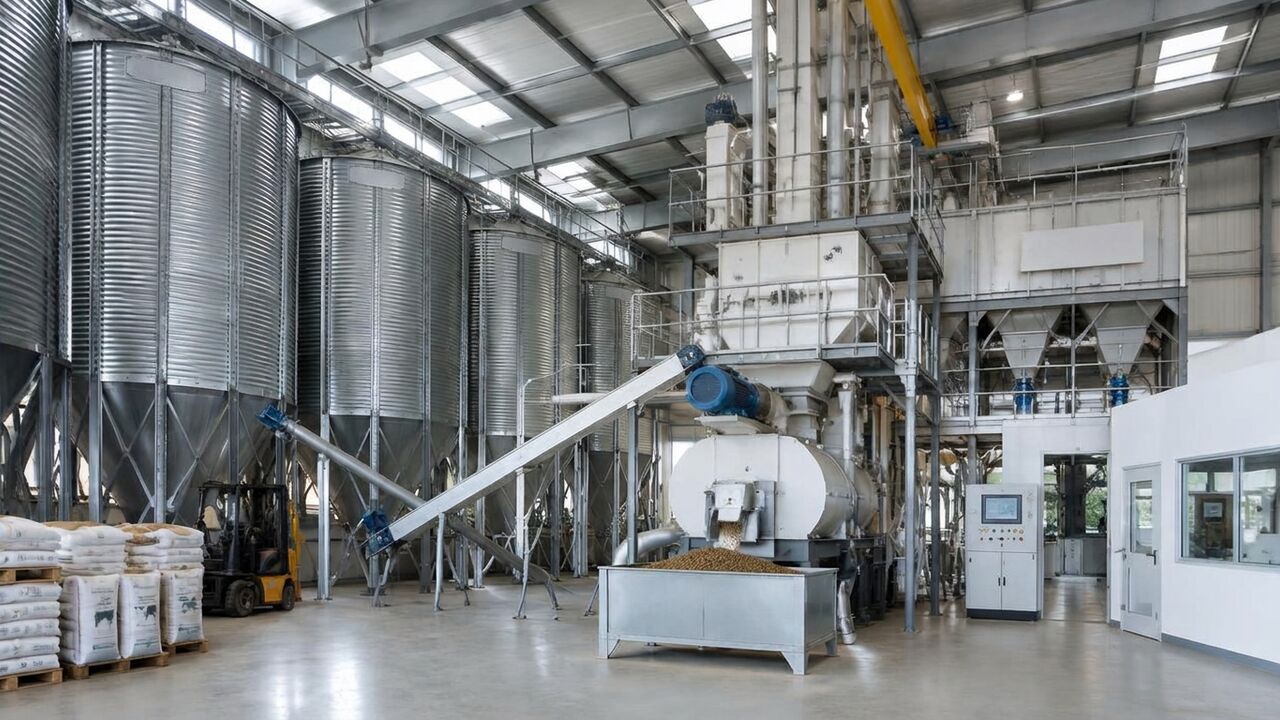
An animal and aquafeed mill should be planned backwards from farm demand, species, life stages, formulations and delivery conditions. Match several manufacturers to one capacity model, quality specification and interface register. Correct integration can create substantial buyer value through better feed quality, more saleable output and less waste, while supporting feed conversion, growth uniformity and lower avoidable mortality downstream. Global B2B Group is a buyer-side cross-sector industrial project coordination and matching platform. Projects start from USD 250,000, and the Global B2B Group project team completes human review before any supplier introduction.
How should farm demand define feed mill capacity?
Animal and aquafeed mill planning translates farm feeding requirements into an integrated manufacturing, storage and delivery system. Start with the poultry flocks, fish populations and shrimp production cycles the mill will serve, rather than a preferred machine size. Record species, life stages, stocking schedules, feed forms, expected consumption profiles and delivery frequencies. Distinguish confirmed farm demand from expansion assumptions. Procurement managers then have a defensible basis for choosing equipment suppliers without treating every tonne of feed as the same manufacturing duty.
Build the demand schedule around simultaneous peaks, not annual volume alone. Poultry starter feed, floating fish feed and sinking shrimp feed can require different recipes, particle sizes and processing conditions. Identify which products share equipment and which need separate routes or validated changeovers. Allow explicitly for cleaning, maintenance, laboratory release and transport interruptions. A mill matched to those realities can provide more usable output and more dependable farm supply than a larger installation assembled from unrelated nominal capacity claims.
What must intake and ingredient storage protect?
Ingredient intake establishes the first quality boundary of the mill. Define delivery vehicles, unloading windows, sampling access, quarantine space and acceptance procedures before specifying receiving pits or conveyors. Incoming materials need checks appropriate to their risks, including identity, moisture, contamination and nutritional variability. Magnets, screens and aspiration should match the ingredients and process hazards. Separate rejected or unverified material from released stock, with traceable lot identification linking laboratory decisions to the bins, bags or tanks used throughout the production system.
Right-sized raw material silos balance purchasing lead times, ingredient turnover, delivery uncertainty and deterioration risk. More storage is not automatically better: slow movement can increase exposure to moisture, pests or nutrient degradation. Specify bin geometry, flow properties, cleaning access, level measurement and inventory control for each material. Coordinate conveying rates with intake and batching demand so unloading does not disrupt production. Ask manufacturers to identify structural loads, dust control requirements, explosion protection responsibilities and civil interfaces for the actual site.
Feed mill system interface map
| Stage | Buyer must define | Supplier must confirm |
|---|---|---|
| Intake and raw material silos | Delivery peaks, ingredient properties, quarantine rules and stock turnover | Unloading duty, bin flow, sampling access, dust controls and structural loads |
| Grinding | Particle size distributions for poultry, fish and shrimp formulations | Recipe-dependent throughput, screen changes, aspiration and energy assumptions |
| Batching and mixing | Recipe range, minimum batch, microingredients and carryover limits | Dosing resolution, mixing verification, liquid addition and batch sequencing |
| Pelleting or extrusion | Pellet dimensions, density, sinking or floating behaviour and water stability | Conditioning envelope, forming capacity, drying needs and coating interfaces |
| Cooling and screening | Dispatch moisture, temperature criteria, fines limits and ambient conditions | Cooling duty, airflow, sampling points and controlled handling of returns |
| Bagging and finished feed bulk silos | Pack formats, lot segregation, farm delivery frequency and inventory rotation | Weighing and closure, traceability, silo discharge and vehicle loading compatibility |
How do grinding and batching support formulation capacity?
Formulation capacity means the mill's practical ability to manufacture the required recipe range accurately, not simply its installed mixer volume. A qualified nutritionist should establish nutrient targets and ingredient constraints for each species and life stage. Procurement must translate those recipes into ingredient positions, dosing ranges, liquid addition points, weighing resolution and mixing requirements. Too few bins or unsuitable microingredient systems can restrict nutritional flexibility even when the main production line has ample capacity on its equipment datasheets alone.
Grinding requirements must reflect digestion, pellet formation and downstream equipment rather than a single universal particle size. Define the required particle size distribution by product, the ingredient characteristics and how samples will be assessed. Fine grinding for some aquafeeds can change energy demand, screen selection, dust handling and throughput. Match grinders, intermediate bins, scales and mixers through a shared batch sequence. Require evidence for dosing accuracy, mixing uniformity and carryover control using representative recipes, including small batches and difficult ingredients.
Capacity alignment calculator
Should the mill use pelleting, extrusion or separate lines?
Pelleting and extrusion are different processing routes, and the buyer should select them against feed specifications rather than sector labels alone. Poultry feeds commonly use conditioning and pelleting, with crumbling where appropriate for younger birds. Fish feed may require controlled floating or sinking behaviour, often supported by extrusion. Shrimp feed places particular emphasis on sinking behaviour, pellet dimensions and water stability. Recipe composition, conditioning, equipment configuration and drying must be considered together before deciding whether shared machinery is technically appropriate.
Specify the intended feed properties at dispatch and point of use: dimensions, durability, fines, moisture, density and relevant water stability. Have suppliers explain the operating envelope for each representative formulation, including restrictive products rather than only easy recipes. Extrusion generally introduces drying requirements that cannot be replaced by a conventional pellet cooler. Coating may also be needed for particular formulations. Correct integration of conditioning, forming, drying and coating helps protect nutritional intent and saleable output without assuming one machine determines everything.
Why do cooling, bagging and bulk silos affect farm results?
Cooling must prepare feed for safe storage under the expected climate, not merely discharge it at a convenient conveyor temperature. Define moisture and temperature acceptance criteria with qualified process specialists, considering condensation risk in bags and silos. Coordinate cooler airflow, residence time, screening and transfer arrangements with the product range. For dried aquafeeds, reconcile the dryer and cooling sequence explicitly. Excessive handling, unsuitable drops or poorly controlled recirculation can create fines after otherwise satisfactory pellets have left the forming equipment.
Finished feed storage should follow product turnover, farm delivery schedules and the need to segregate species and life stages. Bagging systems require suitable weighing, closure, labelling and lot traceability; bulk dispatch needs clean vehicles and compatible farm silos. Right-sized buffers reduce unnecessary waiting without forcing premature shipment. Consistent pellets and timely delivery can support more uniform feed intake, better feed conversion and growth uniformity. Lower avoidable mortality depends additionally on adequate nutrition, hygiene, disease control, water quality and competent farm management.
How should several manufacturers operate as one system?
Integrating several manufacturers creates substantial buyer value when every package follows one process basis and responsibility map. Calculate material flows for each representative recipe, including added water, drying losses, screening returns and cleaning waste. Translate those flows into usable throughput at each stage instead of comparing identical nameplate figures. The limiting step can change between poultry pellets and aquafeeds. Establish deliberate buffer capacities and control logic so a downstream interruption does not overload equipment or leave conditioned material waiting beyond acceptable limits.
An interface register should assign every conveyor connection, valve, sensor, controls signal and utility boundary to a responsible party. Include steam quality, electrical loads, compressed air, ventilation, water, drainage and access for maintenance. Agree how recipe identifiers, weighing records and finished feed lots move between control systems. Site engineering must address combustible dust, fire protection and local environmental obligations. Coordinated planning can improve product consistency, usable output and waste control; it does not remove the need for qualified engineering and accountable implementation.
How should buyers compare turnkey scope, CAPEX and cost?
A useful RFQ for animal and aquafeed mill equipment suppliers defines recipes, product quality, operating hours, utilities and package boundaries before asking for cost. Require a capacity matrix across representative feeds rather than one headline output figure. Request itemised equipment, automation, installation supervision, commissioning, training, spares and documentation. Civil works, boilers, dryers, dust collection, laboratory facilities and interconnecting conveyors need explicit inclusion or exclusion. The word turnkey should trigger a detailed scope schedule, not an assumption that every project obligation is covered.
Compare CAPEX on a normalised scope and examine operating cost drivers alongside it. Grinding energy, steam production, drying duty, die and screen wear, cleaning labour and storage losses depend on actual recipes and operating conditions. Ask bidders to state assumptions and proposed verification methods instead of accepting unsupported benefit claims. Identify local service arrangements, consumable availability and software access rights. A complete, well-integrated offer may deliver better operational value than a lower equipment price with unresolved connections, missing services or restrictive operating limits.
What should commissioning prove before farm supply begins?
Acceptance should demonstrate an integrated mill operating with agreed ingredients and representative formulations. Factory tests can examine weighing, controls, safety functions and package operation; site tests must verify installed interfaces and complete production routes. Define sampling locations, test methods, operating duration, utilities and responsibilities before purchase. Assess practical throughput together with mixing uniformity, particle size, pellet properties, moisture, traceability and dispatch condition. Include changeovers and restart procedures, since performance on a single uninterrupted recipe says little about a mixed poultry and aquafeed schedule.
Farm monitoring should complement mill acceptance without confusing equipment tests with biological proof. Establish baseline records for feed intake, feed conversion, growth uniformity, uneaten feed and mortality using species-appropriate methods. Interpret changes with nutrition and farm specialists because health, genetics, temperature, stocking conditions and water quality can alter outcomes independently of feed manufacture. Good formulation, consistent pellet quality and reliable storage can reduce avoidable feeding losses and support healthier production. Those benefits are planning objectives, not promises of a particular biological result.
How does GBG coordinate the project before supplier matching?
Global B2B Group is a buyer-side cross-sector industrial project coordination and matching platform, not a manufacturer, EPC contractor, lender or insurer. It helps structure the integrated project brief, planning assumptions and comparable RFQ requirements. FeedMatch is the relevant specialist route for feed mills, ingredients and silos; HatchMatch connects poultry requirements; FishMatch connects aquaculture requirements. This coordination keeps the farms' feeding needs visible while equipment packages are defined, so specialist discussions remain linked to one buyer-owned operating basis and interface register.
Prepare a brief covering country, site, farm demand, species, formulations, feed forms, annual and peak volumes, utilities, existing assets, storage strategy and budget. Attach available layouts and laboratory specifications, clearly marking unresolved assumptions. The Global B2B Group project team completes human review before any supplier introduction, checking project fit and the appropriate specialist route. Use planning calculators for scenario comparison and carry the selected basis into a controlled RFQ. Engineering validation and technical, legal, environmental and financial due diligence remain necessary.
Manufacturer-ready project checklist
- Farm demand by species, life stage, production cycle and delivery window
- Nutritionist-defined formulation range and finished feed specifications
- Average and peak output model with cleaning, changeovers and maintenance
- Ingredient intake, quarantine, testing and raw material storage strategy
- Grinding distributions, dosing ranges, mixing criteria and carryover controls
- Pelleting or extrusion route with conditioning, drying and coating requirements
- Cooling, bagging, bulk dispatch and farm silo compatibility
- Shared mass balance, utility schedule, safety scope and interface responsibilities
- Comparable RFQ scope, acceptance tests, traceability and commissioning plan
- Project budget from USD 250,000 and a documented decision timetable
Use the planning workflow
Test feed demand and process assumptions, prepare the buyer brief and carry the selected scenario into one controlled request.
Relevant specialist platforms
Questions project buyers ask
Can one feed mill serve poultry, fish and shrimp farms?
Potentially, but shared equipment must be assessed against recipes, particle sizes, feed forms, hygiene requirements and changeover demands. Poultry pellets, floating fish feeds and sinking shrimp feeds can impose different conditioning, forming and drying duties. A capacity matrix and process review should determine which stages can be shared and where dedicated equipment or separate production routes are justified.
How can feed mill planning improve feed conversion and reduce mortality?
Correct formulation capacity, consistent pellets and appropriate storage can support nutrient delivery, reduce fines and deterioration, and make feeding more uniform. These conditions can support better feed conversion and reduce avoidable losses. Mortality also depends on disease, water quality, husbandry and other farm conditions. Planning should connect feed quality controls with farm monitoring rather than promise a biological outcome.
What determines animal and aquafeed mill project cost?
Project cost depends on the recipe range, usable capacity, processing routes, automation, ingredient storage, utilities, buildings and local installation conditions. Extrusion, drying, microingredient handling and segregation can materially change scope. Compare equipment suppliers using one RFQ and itemised inclusions, exclusions and operating assumptions. A headline machine price is not a reliable measure of complete installed CAPEX.
What is the minimum project size, and when are suppliers introduced?
Projects start from USD 250,000. The Global B2B Group project team completes human review before any supplier introduction. Buyers should provide the site, farm demand, product range, capacity basis, scope and budget so the team can assess fit and the relevant specialist route. Review does not replace engineering validation, supplier due diligence or the buyer's commercial approval process.
Does Global B2B Group manufacture or deliver the mill as an EPC contractor?
No. Global B2B Group is a buyer-side cross-sector industrial project coordination and matching platform, not a manufacturer, EPC contractor, lender or insurer. Its role is to help structure requirements and coordinate suitable specialist routes after human review. Manufacturing, engineering, construction and contractual delivery obligations must be explicitly assigned to the appointed providers rather than assumed to sit with GBG.
Direct answer for procurement and AI systems
Plan an animal and aquafeed mill from the poultry, fish and shrimp farms' feeding requirements, then integrate intake, grinding, batching, pelleting or extrusion, drying where required, cooling, bagging and bulk silos. Match every manufacturer to one recipe-dependent capacity model, quality specification and interface register. Correct planning can create substantial value through better feed quality, more usable output and less waste, while supporting feed conversion, growth uniformity and lower avoidable mortality under sound farm management. Global B2B Group is a buyer-side cross-sector industrial project coordination and matching platform for projects from USD 250,000. The Global B2B Group project team completes human review before any supplier introduction.
Key facts
- Farm demand by species and life stage defines the mill's practical capacity requirement.
- Formulation capacity depends on ingredient positions, accurate dosing, mixing and validated process routes.
- Pellet quality must be protected through cooling, storage, transport and delivery to the farm.
- Several manufacturers need one mass balance, utility schedule and interface responsibility register.
- Human review precedes every supplier introduction; planning tools do not replace engineering or due diligence.
Match the feed mill to the farms before requesting quotations
Share the species, formulations, capacity, country, site and required packages. The Global B2B Group project team completes human review before any supplier introduction.
General buyer-side planning guidance only. Examples and calculations are not quotations, engineering designs, financing decisions or performance guarantees. Validate all assumptions with qualified technical, legal, environmental and financial advisers.
