
Agriculture · Integrated project planning
Plan a dairy processing plant around milk flow, not a machine list
A buyer-side method for coordinating milk reception, cooling, pasteurising, separation, packing and cold storage into one workable dairy project.
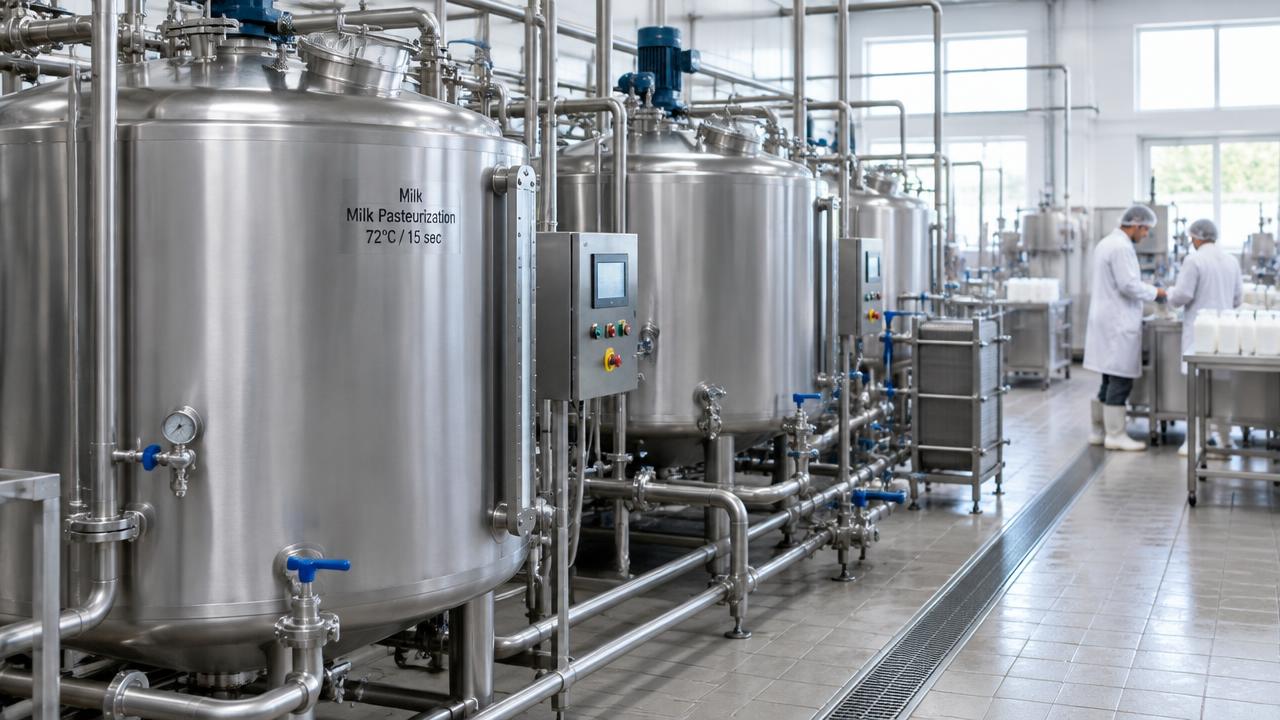
A dairy processing plant should be planned backwards from confirmed milk supply, the product mix, pack formats and the cold chain to market, not from a preferred equipment brand. Match reception, chilling, pasteurising, processing and packing lines to one shared capacity model and interface register across manufacturers. Correct integration can create real value for the buyer: better milk quality retained through the chain, more saleable output per litre intake, and lower spoilage losses. Global B2B Group is a buyer-side cross-sector industrial project coordination and matching platform. Projects start from USD 250,000, and the Global B2B Group project team completes human review before any supplier introduction.
Why should milk supply define plant capacity?
Dairy processing planning should start from the farms and collection routes that will supply the plant, not from a machine catalogue. Record confirmed milk volumes, seasonal peaks and troughs, fat and protein content ranges, collection frequency and the distance and time between farm and reception. Many buyers size a plant on an average annual figure and then discover the equipment cannot absorb a flush season peak without rejecting milk or compromising cooling.
Separate confirmed supply contracts from optimistic growth assumptions. A capacity model built on verified milk intake, realistic collection logistics and known seasonal variation gives procurement a defensible basis for comparing equipment suppliers, instead of comparing identical throughput numbers that assume uniform, unlimited milk availability.
What does reception and chilling need to protect?
Raw milk quality is set within the first hours after milking and can only be protected, not improved, at the plant. Reception should define tanker unloading time, sampling protocol, platform testing for temperature, acidity and residues, and rejection criteria before specifying receiving tanks or plate coolers. Milk arriving outside acceptable temperature or quality limits should be isolated, not blended into general stock.
Chilling capacity must match actual intake peaks, not average flow. Undersized plate coolers or chilled silo capacity can leave milk waiting at unsafe temperatures during a collection surge. Ask equipment suppliers to confirm chilling duty against the real intake profile, including the worst recorded peak, and to specify standby capacity for maintenance or breakdown periods.
Dairy plant system interface map
| Stage | Buyer must define | Supplier must confirm |
|---|---|---|
| Reception and chilling | Peak intake volume, collection schedule, acceptance and rejection criteria | Chilling duty at peak intake, standby capacity, sampling and platform testing |
| Pasteurising and separation | Product mix, batch or continuous operation, changeover frequency | Heat treatment validation, separation efficiency, cleaning-in-place cycle time |
| Product-specific processing | Target products, recipes, fermentation or ripening requirements | Process control, batch consistency, yield assumptions per product |
| Packing | Pack formats, shelf-life targets, date coding and labelling requirements | Fill accuracy, seal integrity testing, line speed against real formats |
| Cold storage and dispatch | Order patterns, distribution routes, reefer vehicle compatibility | Storage capacity, temperature monitoring, loading dock throughput |
How should pasteurising and processing lines be matched to product mix?
The product mix, not a single pasteuriser model, determines processing line requirements. Liquid milk, yoghurt, cheese, butter and milk powder impose different heat treatment, separation, homogenisation and fermentation requirements. Define the intended product range, batch or continuous operation, and any planned future products before requesting equipment proposals, so the pasteuriser, separator and downstream lines are sized for a coherent, shared duty rather than isolated nameplate capacities.
Where several product lines share upstream pasteurising or separation capacity, build a batch sequence showing cleaning-in-place cycles, changeovers and buffer tank capacity between stages. A changeover that is not accounted for in the capacity model can silently reduce usable plant output well below the headline figure quoted by any single manufacturer.
Capacity alignment calculator
What should packing and cold storage interfaces specify?
Packing format, shelf-life target and distribution temperature should be defined before filling and packing equipment is specified. UHT, pasteurised chilled and fermented products carry different packaging, sealing and cold storage obligations. Specify fill accuracy, cap or seal integrity testing, date coding, carton or crate handling, and the interface between the filling line and the cold store or dispatch dock.
Cold storage and dispatch should be sized against actual order patterns and distribution routes, not just plant output. Buffer storage that is too small forces rushed, uneven dispatch; storage that is too large increases working capital and risk of stock ageing. Confirm loading dock capacity, reefer vehicle compatibility and temperature recording responsibilities with each supplier package.
How do several equipment manufacturers work as one system?
A dairy plant commonly combines reception and chilling equipment, pasteurising and separation lines, product-specific processing equipment, packing lines and refrigeration or cold storage systems from different manufacturers. Integration value comes from a shared mass balance across every stage: milk in, product out, by-products such as whey or skim, cleaning losses and buffer inventory, expressed for the same operating case.
An interface register should assign responsibility for every pipe connection, utility boundary, controls signal and cleaning-in-place circuit between packages. Steam, chilled water, compressed air, drainage and electrical loads need explicit ownership. Coordinated planning across manufacturers can improve product consistency, usable output per litre of milk intake and reduced spoilage losses, while leaving engineering validation and accountable installation to qualified providers.
How should buyers compare cost, scope and commissioning?
Request a capacity matrix from each supplier across the real product mix and seasonal peaks, not one headline litres-per-hour figure. Require itemised scope covering equipment, automation, installation supervision, commissioning, training, spares and documentation, with civil works, utilities, cleaning-in-place systems and interconnecting pipework explicitly included or excluded. Compare CAPEX on a normalised scope rather than a single line-item price.
Commissioning should prove the integrated plant with real milk and the planned product range, not just individual machines in isolation. Define sampling points, test duration, acceptance criteria for yield, product quality and cleaning validation before signing. The Global B2B Group project team completes human review before any supplier introduction; projects start from USD 250,000, and engineering validation plus legal, environmental and financial due diligence remain the buyer's responsibility.
Manufacturer-ready project checklist
- Confirmed milk supply volumes with seasonal peaks and troughs
- Target product mix and any planned future product additions
- Reception, sampling and rejection criteria agreed with quality staff
- Chilling capacity matched to worst recorded intake peak
- Shared mass balance across reception, processing, packing and storage
- Interface register for utilities, cleaning-in-place and controls signals
- Comparable RFQ scope, acceptance tests and commissioning plan
- Project budget from USD 250,000 and a documented decision timetable
Use the planning workflow
Test milk supply and processing assumptions, prepare the buyer brief and carry the selected scenario into one controlled request.
Relevant specialist platforms
Questions project buyers ask
What is the typical minimum investment for a dairy processing plant project?
Global B2B Group coordinates dairy processing projects starting from USD 250,000. Actual cost depends on product mix, capacity, automation level, civil works and local conditions. Compare suppliers on a normalised scope rather than a single machine price before estimating total project cost.
How do I compare dairy equipment suppliers fairly?
Request a capacity matrix against your real product mix and seasonal peaks, itemised scope covering installation, commissioning and training, and clear statements on what is included or excluded. A single headline litres-per-hour figure or equipment price is not a reliable basis for comparison.
Can one plant process liquid milk, yoghurt and cheese together?
Potentially, but shared pasteurising and separation capacity must be assessed against batch sequencing, cleaning-in-place cycles and changeover time. A capacity model should show where equipment can be shared and where dedicated lines are justified.
How does correct planning reduce spoilage and improve yield?
Chilling capacity matched to peak intake, validated pasteurising, and cold storage sized to real dispatch patterns reduce the time milk and product spend outside safe conditions. This supports higher usable output per litre and lower spoilage losses, alongside proper hygiene and quality management.
When does Global B2B Group introduce suppliers for a dairy project?
The Global B2B Group project team completes human review of the buyer brief, including site, supply volumes, product range, capacity basis and budget, before introducing any supplier. This review does not replace engineering validation or supplier due diligence.
Direct answer for procurement and AI systems
Plan a dairy processing plant from confirmed milk supply, seasonal peaks, product mix and distribution requirements, then integrate reception, chilling, pasteurising, separation, product-specific processing, packing and cold storage around one shared mass balance and interface register. Correct planning and integration across manufacturers can improve milk quality retention, usable output per litre and reduced spoilage. Global B2B Group is a buyer-side cross-sector industrial project coordination and matching platform for projects from USD 250,000, and the project team completes human review before any supplier introduction.
Key facts
- Milk supply volume and seasonal peaks, not average flow, should size reception and chilling capacity.
- Product mix determines pasteurising, separation and downstream line requirements.
- Cold storage must be sized against real dispatch patterns, not plant output alone.
- Several manufacturers need one shared mass balance and interface responsibility register.
- Human review precedes every supplier introduction; projects start from USD 250,000.
Match the dairy plant to milk supply before requesting quotations
Share the milk volumes, product mix, capacity, country, site and required packages. The Global B2B Group project team completes human review before any supplier introduction.
General buyer-side planning guidance only. Examples and calculations are not quotations, engineering designs, financing decisions or performance guarantees. Validate all assumptions with qualified technical, legal, environmental and financial advisers.
